Which Amazon predictions for 2025 came true?
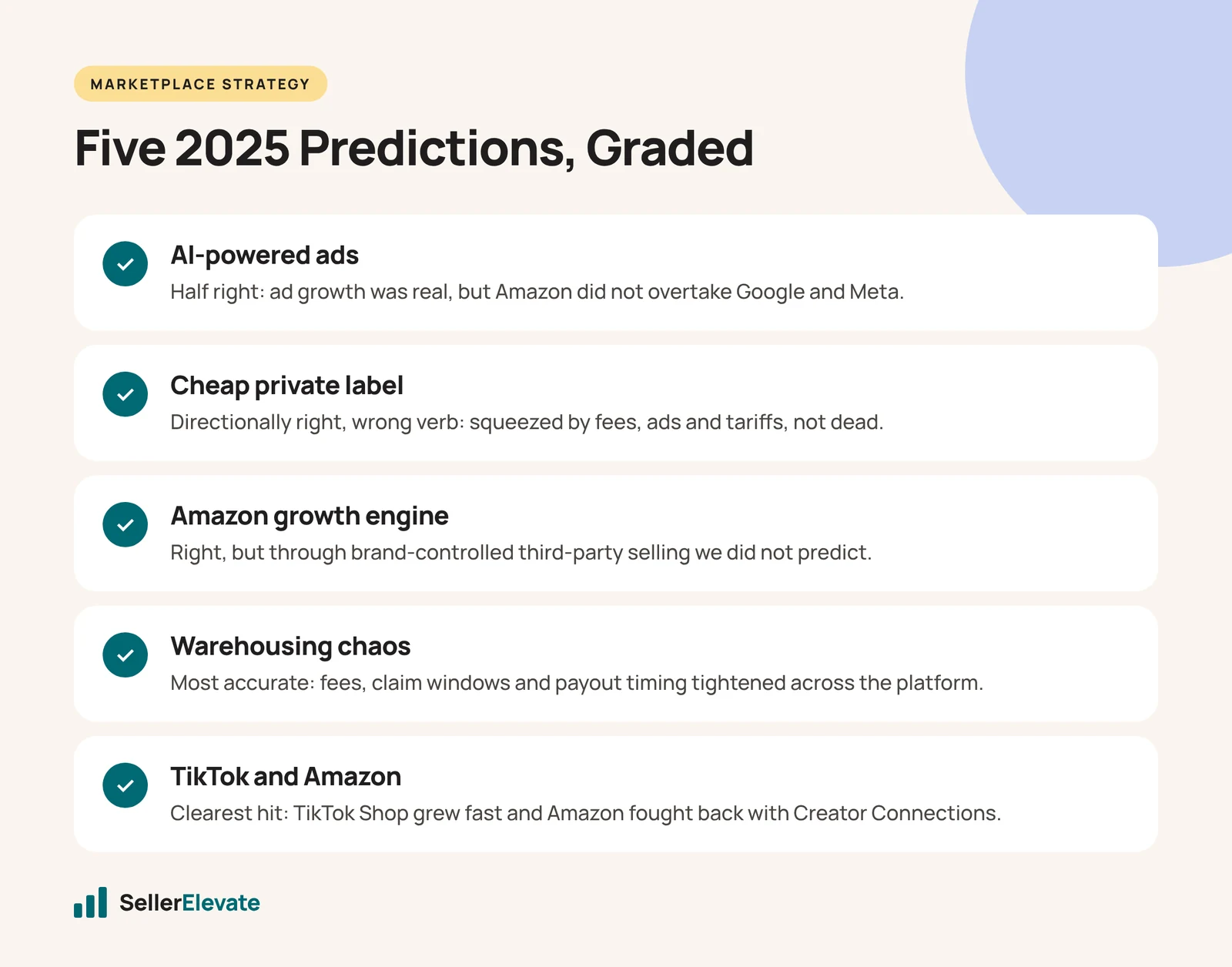
Two of our five were clear hits: tighter warehousing and cash-flow rules created winners and losers, and TikTok Shop grew while Amazon fought back with Creator Connections. AI ads and the death of private label were directionally right but overstated, and brands leaning into Amazon was right for a reason we did not predict.
Key takeaways
- Amazon's advertising revenue reached $69.7 billion in 2025, up from $56.2 billion, but Amazon ads did not outperform Google and Meta.
- CPCs rose 18 to 32% in early 2026, so more capable ad tools arrived in a more crowded and more expensive auction.
- Cheap private label did not die but got squeezed by fees, ad costs and tariffs, and experienced sellers now set a hard 20% net margin floor at research stage.
- Reimbursement claim windows shrank from an 18-month lookback to roughly 60 days, one of many changes shifting risk and working capital onto sellers.
- TikTok Shop's US sales reached roughly $15.8 billion in 2025, more than doubling year on year.
Everybody publishes predictions. Almost nobody goes back and marks their own homework.
So here are the five calls we made at the start of 2025, graded against what has actually happened since — including the two we got wrong and the one that was right for a reason we did not anticipate.
Did Amazon's AI-powered ads outperform Facebook and Google?
Grade: half right, and overstated.
The direction was correct and the growth was real. Amazon’s advertising revenue reached $69.7 billion in 2025, up from $56.2 billion the year before — roughly 24% growth in a mature ad market. More than 70% of sellers now advertise, up from around 40% five years ago.
The AI part landed too, more so than we expected. Amazon Marketing Cloud gained a generative SQL generator, so building a custom audience no longer requires writing the query yourself. And in June 2026 Amazon dropped the requirement that you hold a DSP account to access AMC at all, opening first-party audience building to ordinary sponsored-ads sellers through partners. That single change did more to democratise sophisticated targeting than anything in the prediction.
Shopping behaviour shifted too. Alexa for Shopping, which absorbed Rufus in May 2026, reported over 300 million users with interaction volume up 210% year on year, and was present in 38% of Amazon sessions by Black Friday 2025.
Where we were wrong: Amazon ads did not outperform Google and Meta. Amazon remains the third-largest digital ad platform by most measures. Saying it would overtake them was a headline, not a forecast.
What we underplayed: advertising got more expensive, not just smarter. CPCs rose 18 to 32% in early 2026 with another 10 to 15% forecast. More capable tools in a more crowded auction is a harder environment, not an easier one.
Did cheap private label brands die on Amazon?
Grade: directionally right, wrong verb.
Cheap private label did not die. Roughly half of active Amazon sellers still run private label as their primary model, and it remains the most popular route onto the platform.
What actually happened is that it got squeezed from every side at once. Fees rose, including a 3.5% fulfilment surcharge. Advertising costs climbed. Tariffs pushed input costs up 10 to 25% on imported goods. Competition intensified in most popular categories.
The practical consequence shows up in how experienced sellers now advise newcomers: set a hard 20% net margin floor at the research stage, before sourcing, and walk away from anything that fails it. That is a meaningfully higher bar than existed in 2022.
So the model did not die. It became far less forgiving of mistakes. A brand with genuine differentiation still does well; a me-too product with a logo on it now loses money faster than it used to.
Where we were wrong: we predicted a funeral and got a tightening. Those require different responses.
3. "Retailers will treat Amazon as their primary growth engine"
Grade: right, but for a reason we did not predict.
Brands did double down. We have seen it directly in our own client work — one brand now takes around 55% of its total revenue from Amazon, with its retail business growing roughly tenfold over the same period rather than being cannibalised by it.
But the interesting development was not brands arriving on Amazon. It was brands changing how they sell there.
Through 2026, major consumer brands including Adidas and Colgate have reportedly pruned low-margin SKUs from Amazon’s 1P wholesale channel rather than accept the prices Amazon was willing to pay. With tariffs raising input costs and Amazon refusing to lift wholesale rates, some brands walked.
That creates a gap. Every SKU a brand pulls from 1P is a hole in the catalogue that a third-party seller can fill. The prediction that retailers would lean into Amazon was right. The mechanism — a shift away from vendor relationships toward brand-controlled third-party selling — was not something we called.
4. "3PL and warehousing chaos will create winners and losers"
Grade: the most accurate of the five, and we still understated it.
We framed this as a logistics problem. It turned out to be a systematic tightening of the operational and cash-flow bar across the whole platform. A partial list of what has landed since:
- Storage limits cut from six months of forecasted sales to five, which cost some sellers a large share of their capacity
- FBA fees up around $0.08 per unit from January 2026
- Inbound defect fees jumped from $0.02–0.07 to $0.32–$1.74 on standard items
- A 3.5% fulfilment fuel surcharge
- Reimbursements moved from sale price to manufacturing cost, cutting recoveries by 50 to 75%
- Reimbursement claim windows shortened from an 18-month lookback to roughly 60 days
- SAFE-T claim windows for seller-fulfilled orders cut from 60 days to 30 in February 2026
- Inventory commingling ended entirely by 31 March 2026
- Since March 2026, Amazon holds sale proceeds until seven days after delivery
Any one of those is manageable. Together they represent a real transfer of operational risk and working capital onto sellers, and they arrived faster than most brands adjusted their processes.
The winners-and-losers framing held up exactly as predicted. The losers are not the brands with bad products. They are the brands whose reconciliation happens quarterly, whose cost fields are out of date, and whose cash flow assumed disbursement timing that no longer exists.
5. "TikTok and Amazon are merging faster than you think"
Grade: correct, and the clearest hit of the five.
TikTok Shop’s US sales reached roughly $15.8 billion in 2025, more than doubling year on year, with 2026 projections between $20 and $23 billion. US shops grew from around 4,450 in mid-2023 to roughly 475,000 by 2026.
And Amazon did fight back, as predicted. Creator Connections gained direct messaging with accepted creators, campaigns spanning up to 1,200 ASINs, and a 24-hour window to edit or cancel a campaign. We have run it ourselves at an effective 11.75% ACoS and $3.64 cost per order — genuinely competitive with search advertising once you account for the intent gap.
The “leverage both” advice held up too. In our own accounts, TikTok content consistently drives measurable lift on Amazon, even though the attribution to prove it cleanly still does not exist.
Scoring ourselves honestly
Two clear hits. Two that were directionally right but overstated in the telling. One that was right on the outcome and wrong on the mechanism.
The pattern in our misses is worth naming: both wrong calls were too dramatic. “Outperform Google and Meta” and “the death of private label” are the kind of phrases that perform well on social media and fail as forecasts. What actually happened in both cases was slower, less binary and more consequential — costs rose, bars moved, and the gap between well-run and badly-run accounts widened.
That is usually how this platform changes. Not with a death, but with a squeeze that only shows up in your margin three quarters later.
If you take one thing from this scorecard, take that. The threats to your Amazon business in 2027 will probably not be announcements. They will be a fee schedule, a shortened claim window, and a cash-flow term you did not read closely.
If you want to know which of those squeezes is currently affecting your account, that is what our free audit produces — in writing, ranked, and yours to keep.
Frequently asked questions
Did Amazon ads overtake Google and Meta in 2025?
No. Amazon's advertising revenue grew to $69.7 billion in 2025 from $56.2 billion the year before, roughly 24% growth, and more than 70% of sellers now advertise. But Amazon remains the third-largest digital ad platform by most measures. The growth and the AI tools were real; overtaking Google and Meta was a headline, not a forecast.
Is private label still viable on Amazon?
Yes, but it is far less forgiving. Roughly half of active Amazon sellers still run private label as their primary model. Fees, rising ad costs and tariffs that pushed input costs up 10 to 25% on imported goods have squeezed margins, so experienced sellers set a hard 20% net margin floor at the research stage and walk away from products that fail it.
Which Amazon fee and policy changes hit sellers hardest since 2025?
The combination, more than any single change. Storage limits fell from six months of forecasted sales to five, FBA fees rose around $0.08 per unit from January 2026, inbound defect fees jumped, reimbursements moved to manufacturing cost, claim windows shortened to roughly 60 days, and since March 2026 Amazon holds sale proceeds until seven days after delivery. Check Seller Central for current rules.
How fast is TikTok Shop growing compared with Amazon?
TikTok Shop's US sales reached roughly $15.8 billion in 2025, more than doubling year on year, with 2026 projections between $20 and $23 billion. Amazon responded by expanding Creator Connections with direct messaging and campaigns spanning up to 1,200 ASINs. The practical answer is to use both, since TikTok content consistently drives measurable lift on Amazon even without clean attribution.
Get the honest version of your numbers
A free account audit from the person who would actually run your account.