
How should brands run a TikTok Shop affiliate program?
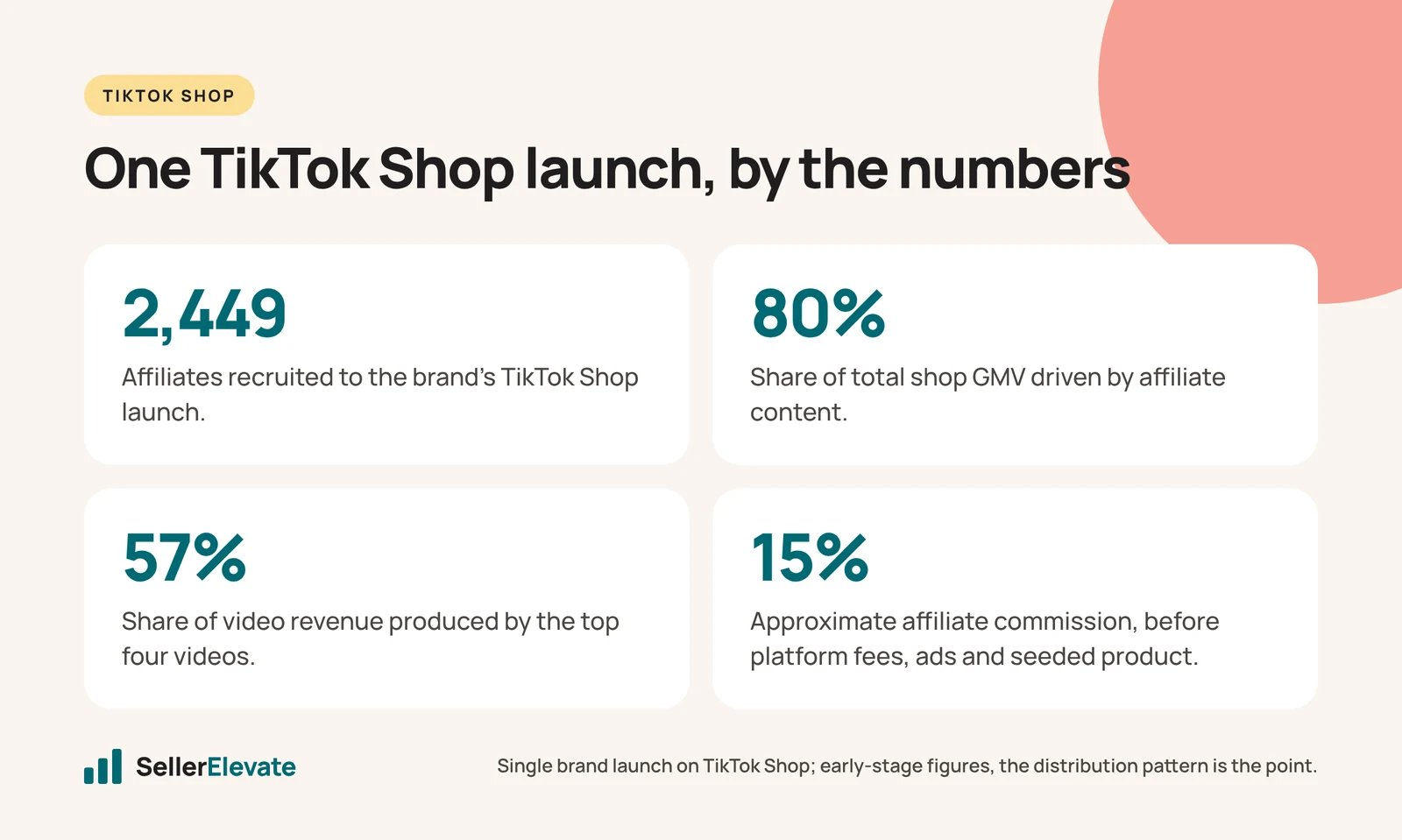
Treat affiliate recruitment as a filter, not a goal. In our launch, 2,449 affiliates were recruited, yet the top four videos produced about 57% of video revenue. The job is to spot converting videos fast, put Spark Ads behind them, and make sure your margin can absorb roughly 15% commission plus fees.
Key takeaways
- In one TikTok Shop launch, affiliate content drove 80% of total shop GMV, and shoppable video was effectively the entire channel.
- The top four videos produced about 57% of all video revenue, while LIVE contributed under $34 and product cards under $90.
- Recruiting 2,449 affiliates was the cost of finding a few winners, so affiliate count is the wrong success metric.
- Affiliate commission came to roughly 15% before platform fees, ad spend and seeded product, against an average order value just under $20.
- Sales on Amazon, Walmart and retail rose as TikTok exposure ramped, but there is no attribution to prove a causal link.
We launched a new brand on TikTok Shop and recruited 2,449 affiliates to it.
Four of their videos produced more than half of the affiliate revenue.
That single fact is the most useful thing we learned, and it is almost the opposite of how TikTok Shop gets sold to brand owners. The pitch is usually volume: sign up hundreds of creators, seed product widely, let the algorithm sort it out. The reality is a power law so steep that the strategy has to change completely.
What the numbers actually looked like
Affiliate content drove 80% of total shop GMV. Not our ads. Not our own brand account. Creators.
Within that, shoppable video was effectively the entire channel. LIVE contributed under $34. Product cards contributed under $90. Everything else came from videos with a product tagged in them. If you are planning a TikTok Shop launch around live selling because that is what the case studies talk about, look at your own split before you commit the hours.
And inside the video number, the concentration was extreme. The top four videos pulled in roughly 114,000 views between them and produced about 57% of all video revenue. The other 2,445 affiliates, collectively, produced the rest.
Average order value sat just under $20. That tells you what kind of channel this is: impulse pricing, low consideration, decided in the seconds a video is on screen.
What does affiliate concentration mean for your TikTok Shop strategy?
If four videos out of thousands carry the result, then the job is not recruiting creators. It is finding the few whose content converts and then doing everything possible to extend their run.
Three things follow from that.
Recruitment is a filter, not a strategy. You need volume at the top because you cannot predict which creator will hit. But signing up 2,449 affiliates is the cost of finding four, not an achievement in itself. Anyone reporting affiliate counts as a success metric is reporting the wrong number.
The winners need to be amplified, fast. A video that converts organically is the single best ad creative you will ever have, because it has already proven itself against a cold audience. Putting paid spend behind it through Spark Ads is not optional — it is the entire point of having found it. The gap between a video going viral and that video going quiet is short.
Most of the tail is not worth managing. There is a real temptation to nurture every creator in the programme. The maths does not support it. Identify the ones producing, invest there, and let the rest run on the standard commission without consuming your team’s week.
What do TikTok Shop affiliates really cost?
Commission on that affiliate revenue came to roughly 15%. That is before TikTok’s own platform commission, before ad spend, before the cost of the product you seeded to 2,449 people, and before the time spent running the programme.
Stack that up honestly. A 15% affiliate commission plus a platform fee plus paid amplification plus seeded inventory, against a sub-$20 average order value. This channel can absolutely work, but the margin has to be built for it before you start. A product with a thin gross margin on Amazon does not survive contact with TikTok Shop economics.
This is the part that gets left out of most TikTok Shop content, and it is the part that decides whether the channel makes you money or just makes you busy.
Is TikTok Shop still early?
Yes and no, and the honest answer matters if you are deciding whether to invest.
The demand side is genuinely enormous and still accelerating. US TikTok Shop sales reached about $15.8 billion in 2025, roughly doubling year on year, with 2026 projections in the $20–23 billion range. Globally the platform is on track for over $100 billion in GMV in its fourth full year — a threshold that took Amazon around eighteen years to reach. Short-form video drives the majority of it.
The supply side is where the “undersaturated” story falls apart. US shops went from roughly 4,450 in mid-2023 to around 475,000 by 2026. Globally there are more than 15 million sellers, which is more than Amazon has, on a platform most people had not heard of three years ago. Unusually for a marketplace, sellers are arriving faster than buyers.
So the accurate version is this: the market is still growing far faster than Amazon, and there is real opportunity in it. But competition for attention is already intense, and the window for establishing a category position narrows every quarter. “Get in before the crowd” was true in 2023. In 2026 it is “get in while the growth still outpaces the crowding” — a weaker claim, but a true one.
The cross-channel effect
We did observe sales climbing on Amazon, Walmart and in retail over the same period that TikTok exposure ramped up.
We will not claim a clean causal link, because the attribution does not exist to prove one. A shopper who sees a product on TikTok and buys it on Amazon two days later leaves no trace connecting the two. What we can say is that the pattern is consistent, it matches what other operators report, and Amazon’s algorithm does reward the external traffic and velocity that TikTok exposure produces.
If you are modelling TikTok Shop purely on its own GMV, you are probably undercounting it. If you are promising your CFO a specific halo number, you are overcounting it. Somewhere between those is the truth, and the honest move is to say so.
What we would actually run
A TikTok Shop programme that works has four moving parts, and it fails if any one of them is missing:
Creator recruitment at volume, understood as a filter rather than a goal, with product seeded widely and cheaply enough that a low hit rate is survivable.
Fast identification of winners, watching video-level revenue daily rather than weekly, because the window to amplify closes quickly.
Paid amplification through Spark Ads on proven organic content, plus search and retargeting layers — not ads built from scratch in a studio.
Cross-channel measurement that expects a halo on Amazon and Walmart and tracks it as an observation rather than a promise.
Run three of those four and the channel underperforms. Run none of them and you have 2,449 affiliates and a rounding error.
Figures in this article come from a single brand launch on TikTok Shop. Absolute numbers are early-stage and deliberately not the point — the distribution pattern is what carries across accounts. If you want to know whether your margins can survive this channel, that is a conversation worth having before you seed a single unit.
Frequently asked questions
How many TikTok Shop affiliates do you need?
Enough to find the few who convert. You cannot predict which creator will hit, so volume at the top matters, but it is a filter rather than an achievement. In our launch, 2,449 affiliates were recruited and the top four videos produced about 57% of video revenue. Seed product widely and cheaply enough that a low hit rate is survivable.
Is TikTok Shop LIVE selling worth it?
Check your own data before committing the hours. In our launch, LIVE contributed under $34 and product cards under $90, while videos with a tagged product were effectively the entire channel. Case studies often highlight live selling, but your own channel split should decide where your team's time goes.
What does a TikTok Shop affiliate program really cost?
More than the commission line. In our launch, affiliate commission came to roughly 15%, and that is before TikTok's platform commission, ad spend, the product seeded to creators and the time spent running the program. Against an average order value just under $20, the margin has to be built for this channel before you start.
Is TikTok Shop still early for new sellers?
Partly. Demand is large and still growing, with US TikTok Shop sales reaching about $15.8 billion in 2025, roughly doubling year on year. But US shops grew from roughly 4,450 in mid-2023 to around 475,000 by 2026. The opportunity is real while growth outpaces crowding, but competition for attention is already intense.
Get the honest version of your numbers
A free account audit from the person who would actually run your account.