Why did TikTok Shop affiliate commissions drop, and how much should I pay creators?
Reports say TikTok cut default affiliate commission caps around June 22, 2026, with no transition, taking typical payouts in beauty, supplements and home from about 20% to 10 to 15%. Sellers still set their own rates. Pay a premium on two or three hero SKUs for proven creators, and stay near the default elsewhere.
Key takeaways
- Novadata and beBOLD report that TikTok cut affiliate commission caps around June 22, 2026, with payouts falling from about 20% to 10 to 15% in affected categories.
- Sources disagree on the size of the cut: Ecommerce Times reported smaller reductions of 2 to 4 percentage points.
- Sellers still control individual collaboration rates, so the cut changes the market rate rather than what you are allowed to pay.
- Tier creator rates, because on one launch with 2,449 affiliates the top four videos drove about 57% of video revenue.
- Since September 15, 2025, affiliate eligibility depends on your seller-fault return and refund rate.
TikTok Shop affiliate payouts dropped because TikTok reportedly cut default commission caps around June 22, 2026, with no transition period, pushing typical creator payouts in beauty, supplements and home from about 20% to 10 to 15%. You can still set your own rates, so the right answer is not one number: pay above the market on a few hero products and proven creators, and stay at or near the new default everywhere else.
One caveat up front. Everything we know about the cuts comes from secondary reporting. We could not find a TikTok announcement, and the exact mechanics are not fully clear. So check your own collaboration settings in Seller Center as of October 2026 before you change anything.
What actually changed in June 2026?
Here is what the reporting says, and where it disagrees.
Novadata (June 22, 2026) dates the change to June 22, 2026, with no transition window. It says beauty, supplements and home goods saw the deepest reductions, and that creator payouts fell from roughly 20% to a 10 to 15% range.
beBOLD (June 26, 2026) adds apparel to the list and describes the mechanics: the platform sets default commission caps, but sellers retain control over individual collaboration rates. In its words, the change compresses margin room “rather than mandate specific payouts.” beBOLD also cites Ecommerce Times reporting smaller cuts of 2 to 4 percentage points.
So the size of the cut depends on who you read. “From 20% to 10 to 15%” and “2 to 4 points” are not the same story. Our working assumption is that the defaults moved, that many creators saw lower payouts on open offers, and that brands who set their own rates were less affected.
Why does it matter if sellers can still set their own rates?
Because creators compare. A creator who was earning around 20% across most beauty offers now sees a lower default on many of them. Some will post less. Some will move effort elsewhere. Novadata expects creators to reroute volume to Amazon Associates and Pinterest Amazon storefronts, where commissions were not cut, and suggests watching Amazon session data and BSR on hero ASINs for early signs.
The stakes are highest in beauty. beBOLD notes that TikTok Shop is now the fourth-largest health and beauty ecommerce retailer in the US, with beauty sales of $4.4 billion and 107.7% year-over-year growth. A category that size runs on creator content, so a change in what creators earn there shows up in brand sales quickly. beBOLD also expects some creators to post less often, push for retainers instead of pure commission, or favor the brands that still pay well.
That creates an opening and a trap.
The opening: if most brands drift down to the new default, a brand that pays a clear premium on a few products stands out to the creators who still post daily.
The trap: paying a premium across the whole catalog. Commission is one of the largest lines in the TikTok cost stack. One July 2026 CFO model, which we break down in TikTok Shop’s real take rate, uses a 13% average creator commission inside an all-in channel take of 46.7%. Raise commission across the board and you can erase the margin the channel was meant to produce.
How much should you pay creators now?
Here is the framework we use. The rates are starting points to test, not market data.
| Creator tier | Who they are | What we’d offer |
|---|---|---|
| Proven | Posted for you before and drove orders | Premium rate on hero SKUs, plus a flat bonus for a posting date |
| Promising | One video with good engagement, few orders yet | Your standard rate, plus a free sample of a second SKU |
| Open pool | Everyone else browsing your offers | At or near TikTok’s default for the category |
For reference, AfterShip’s 2026 BFCM guidance suggests at least 15% on hero products and 20% on new products. Eightx notes that targeted collaboration rates commonly run 18 to 30%. Both were published around the time of the cuts, so treat them as ceilings for proven creators rather than the floor for everyone.
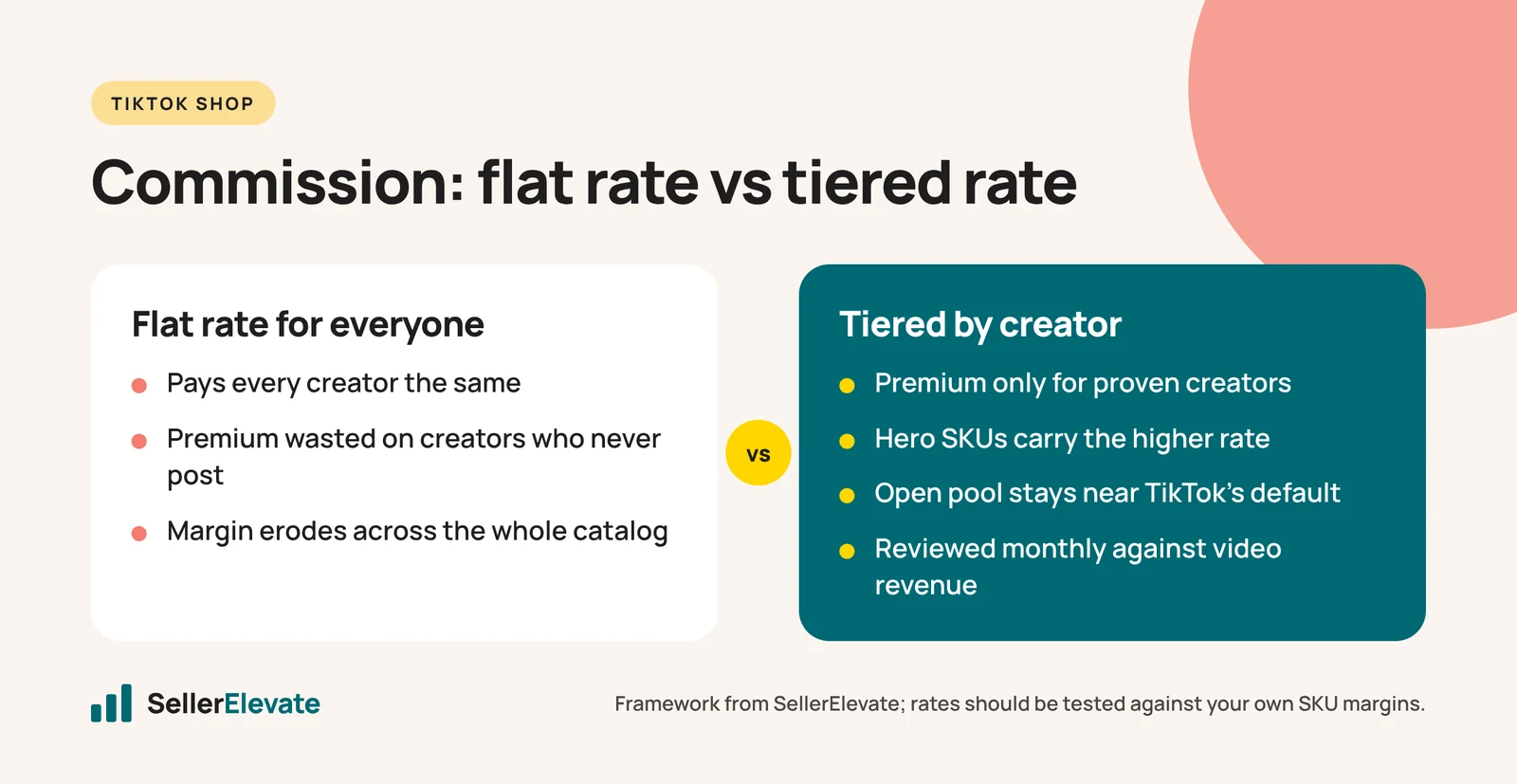
The reason to tier is our own data. On one launch we recruited 2,449 TikTok affiliates, and the top four videos drove about 57% of video revenue. A flat rate pays the 2,445 creators who did not move the needle the same as the four who did. A tiered rate puts the money where the sales are.
Tiers are not permanent. We review them monthly against video-level revenue: a promising creator whose second video converts moves up, and a proven creator who stops posting moves back to the standard rate. That review is what keeps the premium pointed at current performance instead of past reputation.
How do you keep top creators loyal without overpaying?
Commission is not the only lever, and it is the most expensive one.
- Pay for the posting date, not just the sale. A small flat fee for a video live by a specific date gives you schedule control that commission alone cannot, which matters most in Q4.
- Give them first access. New products, bundles and limited stock go to proven creators before the open pool.
- Authorize and amplify their best videos. When GMV Max or Spark Ads puts spend behind a creator’s video, their commission grows without you raising the rate. See how to keep control of GMV Max.
- Keep your shop eligible. Since September 15, 2025, affiliate eligibility has been tied to your seller-fault return and refund rate, and since October 20, 2025 serious complaints can bring 14 to 30 day affiliate suspensions, according to AuditSocials. A suspension costs your creators money, and they remember.
- Talk to them. Ask your top ten what they earn elsewhere. It is the only market data that applies to you.
What should you do before Black Friday?
The timing is tight. Black Friday is November 27, and creator samples need to be moving by mid-October for videos to go live before the campaign. Our BFCM creator sample timeline has the dates.
What we would do this week:
- Rerun margins by SKU at 10%, 12% and 15% commission, as beBOLD suggests, and add your premium rate as a fourth column. Any SKU that fails at the premium rate stays on the default.
- Pick two or three hero SKUs for the premium rate, based on margin and past creator performance.
- List your proven creators from the last 90 days of video-level revenue, and message them directly with the offer and a posting date.
- Check for creator drift to Amazon. If your brand sells there, compare sessions on hero ASINs before and after June 22. If creators are moving, make sure your Amazon listing and Creator Connections setup are ready for them.
- Hold your open-pool rate near the default. Raising it now mostly pays creators who were not going to post anyway.
The commission cut does not make TikTok Shop a worse channel by itself. It makes the difference between brands that manage creators and brands that only list an offer more obvious. If you want help sorting your creator list into tiers, our TikTok Shop management team does that work, and it is a good first conversation before peak.
Frequently asked questions
Did TikTok officially announce the June 2026 commission cuts?
We could not find an official TikTok announcement. The reporting comes from secondary sources, mainly Novadata on June 22, 2026 and beBOLD on June 26, 2026. They agree that default caps fell in beauty, supplements and home, but the exact mechanics are unclear. Check your collaboration settings in Seller Center before changing rates.
Can I still pay creators more than TikTok's default commission?
Yes. According to beBOLD, the platform sets default commission caps but sellers retain control over individual collaboration rates. That means you can pay a premium to proven creators through targeted collaborations. Model it first, because creator commission is one of the largest lines in the TikTok Shop cost stack.
Will creators move from TikTok Shop to Amazon?
Some may. Novadata expects creators to reroute volume to Amazon Associates and Pinterest Amazon storefronts, where commissions were not cut. If your brand sells on Amazon, compare sessions and BSR on hero ASINs before and after June 22, 2026 to see whether creator traffic is shifting.
Can a high return rate stop creators promoting my products?
Yes. Since September 15, 2025, TikTok Shop affiliate eligibility has been tied to your seller-fault return and refund rate. Since October 20, 2025, serious complaints such as empty parcels or counterfeits can lead to 14 to 30 day affiliate suspensions, according to AuditSocials.
Sources
- Novadata: TikTok Shop affiliate commission cuts, June 2026 (Jun 22, 2026)
- beBOLD: TikTok Shop affiliate commission cuts in beauty (Jun 26, 2026)
- AuditSocials: TikTok Shop ad compliance in 2026 (Jun 5, 2026)
- AfterShip: TikTok Shop BFCM 2026 creator outreach timeline (Sep 9, 2026)
- Eightx: TikTok Shop real take rate (Jul 7, 2026)
Get the honest version of your numbers
A free account audit from the person who would actually run your account.