Why did my strikethrough price disappear on Amazon?
Since April 23, 2026, Amazon only displays a List Price that customers bought at as the Featured Offer on Amazon, or that another retailer recently charged. If yours fails that check, the strikethrough and savings disappear. Since May 18, products discounted for more than half of 90 days also get a lower Typical Price.
Key takeaways
- Since April 23, 2026, a List Price must be backed by Featured Offer sales at that price or a recent price at another retailer, or no strikethrough shows.
- Since May 18, 2026, if a product sat below its non-promotional median price for more than 45 of 90 days, Typical Price is calculated from all sales.
- Reference prices help set the minimum discount for deals, so a lower reference can suppress Black Friday deals or force deeper discounts.
- Recovery needs a 90-day rolling window, and there are only 55 days from October 3 to Black Friday on November 27.
- Coupons, Buy X Get Y, Subscribe and Save and peak event sales are excluded from the Typical Price recalculation.
Your strikethrough most likely disappeared because, since April 23, 2026, Amazon only shows a List Price that customers actually paid on Amazon as the Featured Offer, or that another retailer recently charged. If your “was” price fails that check, Amazon simply stops displaying it, along with the savings amount next to it.
A second change on May 18 hit the other reference price, Typical Price, for products that were on “sale” most of the time. Together they ended the permanent discount as a conversion tactic, and they matter more now than at any point this year, because Black Friday deals are priced off these same reference prices.
What changed on April 23 and May 18?
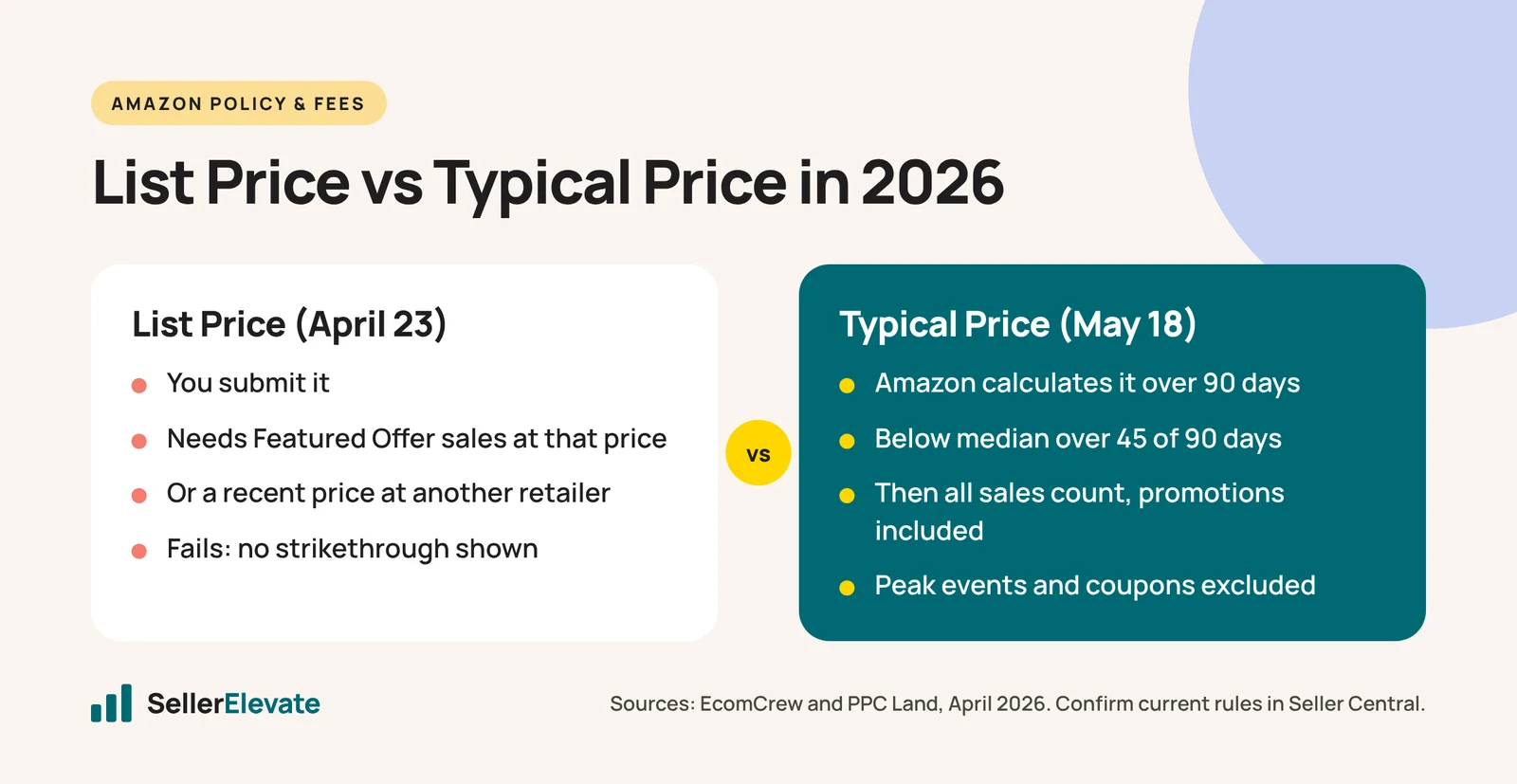
There were two separate rules. Sellers often blur them, so here they are side by side, as reported by EcomCrew and PPC Land:
| List Price validation | Typical Price recalculation | |
|---|---|---|
| Effective | April 23, 2026 | May 18, 2026 |
| Applies to | The List Price you submit | The price Amazon calculates from sales history |
| The rule | Must have been bought by customers as the Featured Offer on Amazon at that price, or offered at that price recently by another retailer | Normally the median non-promotional price over 90 days; if the Featured Offer was below that median for more than half of the 90 days (over 45 days), Amazon uses all sales, promotional ones included |
| If it fails | No strikethrough, no savings shown | A lower Typical Price, so your discount looks smaller |
| Excluded | Buy X Get Y, Subscribe and Save, tailored coupons, peak event sales such as Prime Day |
Neither source gives a definition of “recently” for the other-retailer test, or a minimum number of sales at the List Price. We have not found Amazon publishing either, so anyone quoting you a precise number is guessing.
Behind both rules sits the Fair Pricing Policy. My Amazon Guy lists the consequences for misleading reference prices as Featured Offer removal, and for repeated or serious cases, suspension. Losing a strikethrough is the mild outcome.
Why did my strikethrough disappear even though I never changed my price?
Because the rule looks at evidence, not at what you typed into the List Price field. The common patterns we see:
- The List Price was never actually charged. A manufacturer’s suggested price that no one has ever paid on Amazon now fails validation.
- You only sell on Amazon. With no other retailer showing that price, the only route left is Featured Offer sales at the List Price.
- You were always on “sale”. If your product sat below its normal price for most of the last 90 days, the May 18 change pulled your Typical Price down toward your sale price.
- Someone else holds the Featured Offer at a lower price. Sales at the List Price must happen as the Featured Offer. If a reseller undercuts you, your full-price sales may never count. (This is also where the 2026 Featured Offer change comes in.)
- Your other-retailer price is not visible or not matching. A price on a site Amazon cannot see, or a different pack size, does not help.
How does this affect Black Friday and Prime deals?
Directly. beBOLD Digital quotes Amazon guidance that “reference prices help determine the minimum discount required for deals, coupons, and price discounts.” When your reference price drops, the deal price you must hit drops with it, or the deal can be suppressed.
A hypothetical to make it concrete. Take a product with a normal price of $34.99 that has run a “sale” at $24.99 for 70 of the last 90 days:
- Before May 18, the Typical Price would be built from non-promotional sales, so roughly $34.99.
- Now, because it was below its non-promotional median for more than 45 of 90 days, Amazon counts all sales, so the Typical Price moves toward $24.99.
- A Black Friday price of $22.49 used to look like a big saving. Against $24.99 it is about 10% off, which may not meet a deal’s minimum discount and certainly will not look like much to a shopper.
The fix takes time. PPC Land reports that products with persistent discounting need a full 90-day rolling window before normal exclusion logic resumes. From October 3 to Black Friday on November 27 is 55 days. If your product is caught in the “always on sale” pattern today, you probably cannot fully reset Typical Price before Black Friday. You can still make better decisions about which ASINs to put on deal and at what price.
How do I rebuild a legitimate reference price?
Here is the order we would work in, as of October 2026. Confirm the details in Seller Central first, since Amazon has not published every threshold.
- Diagnose per ASIN. For each top seller, note whether the detail page shows a List Price strikethrough, a Typical Price, or nothing. Then start a test deal setup for each and note the eligibility and maximum deal price Amazon shows, since that is built on the reference price Amazon is using.
- Set a List Price you can defend. Make it a price customers have actually paid on Amazon, or one you genuinely charge elsewhere today. A smaller honest strikethrough beats none.
- Sell at that price as the Featured Offer. Hold full price long enough to record real purchases.
- Use your other channels honestly. If you sell on your own site or on Walmart, keep the same product, same pack size and same regular price visible there. Do not raise prices elsewhere just to create a reference; that is exactly what the Fair Pricing Policy targets.
- End permanent discounts. If an ASIN has been on “sale” for months, go back to the regular price and use short, real promotions. Peak events such as Prime Day are excluded from the Typical Price recalculation, so event pricing will not count against you the same way.
- Pick your Black Friday ASINs from the ones with a clean reference. Put deal budget where the discount will actually display.
- Win back the Featured Offer where you lost it. If a reseller holds it, your full-price sales do not count. Unauthorized sellers are a separate problem with separate tools; see our listing hijacker removal service and the new Reseller role rules for ASIN creation.
What if I only sell on Amazon?
Then the other-retailer route is closed to you, and the only way to validate a List Price is for customers to buy at that price as the Featured Offer. That has two practical consequences.
First, your List Price should be close to the price you actually sell at most of the time. If you sell at $29.99 for ten months of the year, a $49.99 List Price will not validate, and there is no honest way to make it validate.
Second, you need to hold the Featured Offer at that price. If you share the listing with resellers who undercut you, your full-price sales may never be recorded as Featured Offer sales. That makes seller control part of your pricing strategy, not a separate project.
Launching on your own website or another marketplace is not a workaround to be set up for its own sake. But if you were already planning it, keeping a consistent regular price across channels gives Amazon a second, legitimate reference point.
Is fake-discount pricing worth the risk any more?
No. It was always a fragile tactic, and the 2026 rules make it a visible one. A discount that is real converts better than one shoppers do not believe, and Amazon is now the one deciding whether it is real. We made the broader case for treating price as strategy rather than a lever in your price is doing more work than your ads.
The brands that will have the best Black Friday displays are the ones that held a real regular price through the summer. If that is not you this year, set it up now for 2027, and plan this year’s deals around the reference prices you actually have.
What we'd do this week
- List your top 20 ASINs with their current List Price, Typical Price and whether a strikethrough shows.
- Remove or correct any List Price you cannot back with sales or a visible price elsewhere.
- Move ASINs off permanent “sale” pricing today, knowing the 90-day clock starts now.
- Choose Black Friday deal ASINs based on clean reference prices, and read our Black Friday 2026 discount strategy before setting depth.
- While you are on the detail pages, check the other 2026 changes: the 75-character title limit and labels for AI-generated models.
If you want someone to run this per ASIN with you, it is part of our account management work.
Frequently asked questions
How long does it take to get a strikethrough price back on Amazon?
Amazon has not published a minimum number of sales for List Price validation. For Typical Price, PPC Land reports that products with persistent discounting need a full 90-day rolling window before the normal calculation resumes. Start holding a genuine regular price now, and expect the full reset to take around three months.
Do Prime Day prices count against my Typical Price?
No. Peak event sales such as Prime Day are excluded from the May 18, 2026 Typical Price recalculation, along with Buy X Get Y, Subscribe and Save and tailored coupons. Short event discounts are much safer for your reference price than a permanent sale price that runs for months.
Can I use my own website's price as the Amazon List Price reference?
Possibly. One validation route is that another retailer recently offered the product at that price. It must be a genuine, visible price for the same product and pack size. Raising prices elsewhere just to create a reference is what Amazon's Fair Pricing Policy targets and can lead to Featured Offer removal.
What is the difference between List Price and Typical Price on Amazon?
List Price is the reference price you submit, which since April 23, 2026 must be validated by sales or another retailer's price. Typical Price is calculated by Amazon, normally as the median non-promotional price over 90 days. Either can sit behind a strikethrough, and both changed in spring 2026.
Sources
- EcomCrew: Amazon cracks down on inflated discounts with new pricing rules starting April 23 (April 6, 2026)
- PPC Land: Amazon’s fake discount crackdown, List Price rules tighten April 23 (April 1, 2026)
- My Amazon Guy: Amazon listing price policy crackdown (April 6, 2026)
- beBOLD Digital: Amazon reference pricing and Prime Day deal suppression (June 26, 2026)
Get the honest version of your numbers
A free account audit from the person who would actually run your account.