Can ChatGPT do Amazon product research?
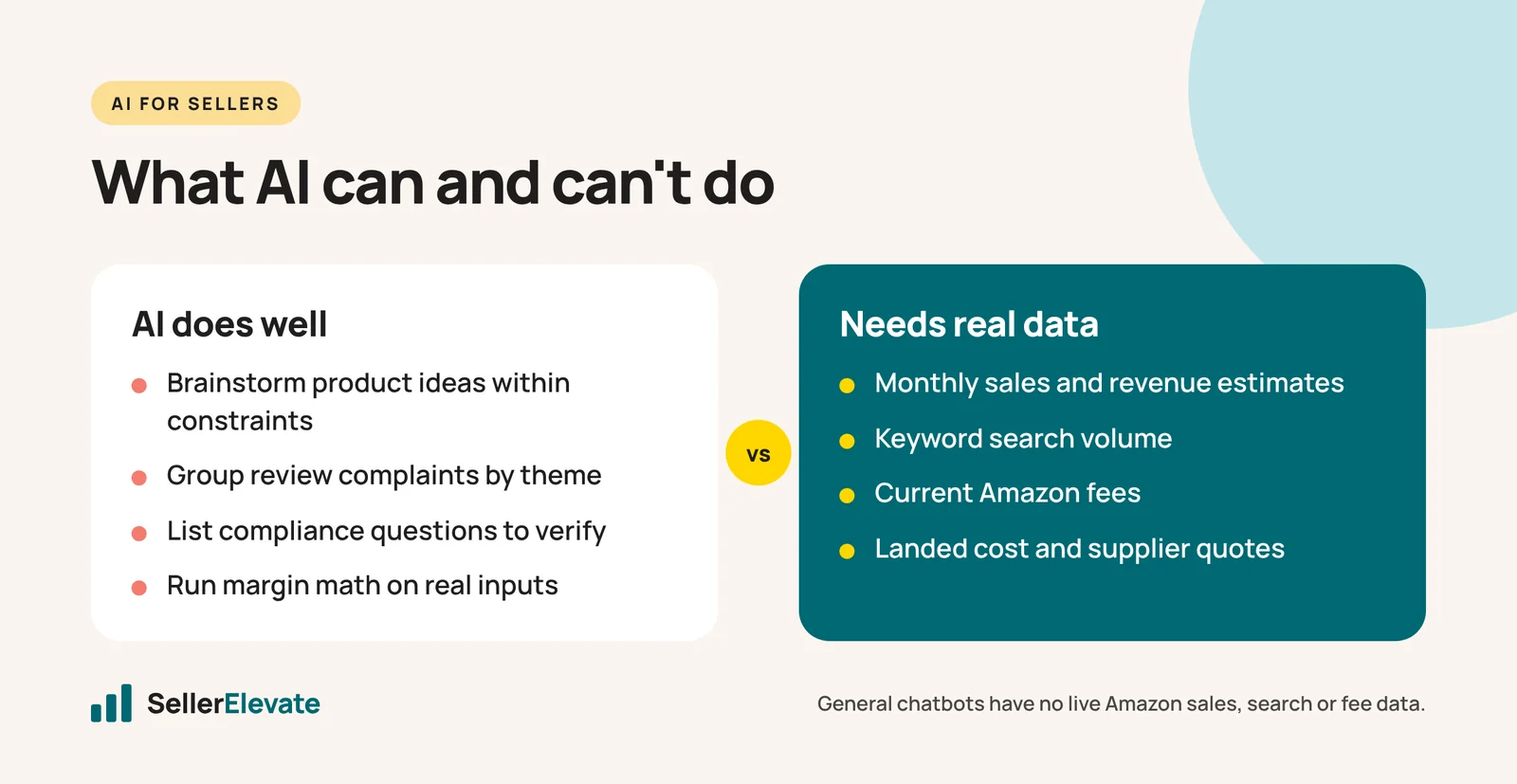
Not on its own. ChatGPT has no live Amazon sales, search volume or fee data, so it cannot tell you which product will sell or make money. It is useful for brainstorming ideas, analyzing reviews you supply, listing compliance questions and running margin math on real inputs from research tools and supplier quotes.
Key takeaways
- General chatbots cannot estimate Amazon sales or search volume; any numbers they give are made up.
- In popular ChatGPT product research methods, the sales data actually comes from a paid tool like Helium 10.
- AI is genuinely useful for idea expansion, review gap analysis, compliance pre-checks and spreadsheet work.
- Tell the model not to estimate sales so it does not invent figures you later rely on.
- In our hypothetical $30 example, profit falls from $6.90 to $4.50 per unit when ad cost rises to 20% of sales.
No, ChatGPT can’t find you a winning Amazon product on its own, because it has no live data on what sells, how many units competitors move, or what it costs to land and fulfill an item. It can make a good research assistant: generating ideas, reading reviews for gaps, and checking compliance risks. But the decision still rests on real sales data and your own margin math.
That answer hasn’t changed much since sellers first asked. A December 29, 2022 post in r/FulfillmentByAmazon, “This Is How Amazon Sellers Can Leverage AI (ChatGPT)”, put it plainly: “ChatGPT cannot do the product research for us (yet!).” Helium 10’s own ChatGPT guide says the tool can’t yet independently find products to sell. The models are far better now. The missing data is still missing.
Where does the "$8K a month with ChatGPT" claim come from?
Look closely at the content that promises AI-found winners and the AI is rarely doing the finding. A typical example is a Shulex article on ChatGPT FBA research with “$8K/month products” in the title. Its six steps:
- Ask ChatGPT for product categories on Amazon.
- Rank categories by return rates.
- List subcategories.
- Generate product lists inside them.
- Analyze those products in Helium 10.
- Pick products with high sales and low competition.
Steps 1 to 4 are brainstorming. Step 5 is where every sales number comes from, and it’s a paid data tool, not ChatGPT. Step 6 is the judgment call the whole article is promising to automate, and nothing in the method explains how ChatGPT would know a product’s sales or competition. The $8K figure has no supporting data in the article.
Step 2 is also a trap. A language model doesn’t have category return rates for Amazon. Ask it and it will produce a plausible-sounding ranking anyway. That’s the core problem: a model that lacks the data doesn’t reliably say so.
What happens when you test each research task against what an AI actually knows?
Here is how we’d grade a general-purpose chatbot on each step of a normal product research process, based on what these models can and can’t access. This is not a claim about any specific run; it’s what you should expect.
| Research task | Can a chatbot do it? | Why | Use instead or alongside |
|---|---|---|---|
| Brainstorm product ideas in a niche | Yes, well | Wide general knowledge, fast | Nothing needed; just filter hard |
| Estimate monthly sales or revenue | No | No access to Amazon sales data; numbers will be made up | Research tools with sales estimates, Brand Analytics if you have it |
| Judge competition (reviews, sellers, brand strength) | Only if you give it the data | Can analyze a pasted export, can’t look it up reliably | Export from your research tool, then ask the AI |
| Find review gaps in existing products | Yes, if you supply reviews | Strong at grouping complaints | See our review mining workflow |
| Flag compliance and gating risks | Partly | Knows common categories that need approvals or testing; can be out of date | Confirm in Seller Central and with your test lab |
| Landed cost, fees and margin | Math yes, inputs no | Can calculate if you give real quotes and fees | Supplier quotes, Amazon’s fee schedule and revenue calculator |
| Keyword demand | No | No live search volume | Brand Analytics search terms, keyword tools |
| Trend direction | Weakly | Training data has a cutoff; browsing helps a little | Search term history, Google Trends |
Read down the “No” rows. They are the rows that decide whether a product makes money.
What is AI actually good for in product research?
Used inside a proper process, it saves real time on four jobs.
1. Idea expansion. Give it a niche and constraints (“lightweight, under 2 lb, not electrical, not food contact, sells for $25 to $50, solves a problem for dog owners”) and ask for 40 ideas. Most will be bad. That’s fine. You’re widening the funnel before the data tools narrow it.
2. Review gap analysis. Paste or upload competitor reviews, split by star rating, and ask for ranked complaint themes with counts and quotes. This is where AI genuinely beats doing it by hand.
3. Compliance pre-checks. Ask: “What certifications, testing, labeling or Amazon category approvals might apply to selling [product] in the US?” Treat the answer as a checklist of questions to verify, not as an answer.
4. Spreadsheet work. Once you have exported data, a model can clean it, rank candidates by your criteria, and run the margin math consistently across 50 products.
A useful starting prompt:
I’m researching Amazon US products. Constraints: [price range, size, weight, no batteries, etc.]. Generate 40 product ideas in [niche]. For each, give the target buyer, the problem it solves, and one reason it might be hard to sell (gating, fragility, seasonality, liability). Do not estimate sales or revenue; I will check those with real data.
The last line stops it from inventing numbers you might later believe.
How should you check margin before trusting any idea?
This is the step chatbot-first content skips. A hypothetical example, with every input labeled as an assumption:
- Selling price: $30
- Referral fee: 15% of price, so $4.50 (the rate varies by category; check Amazon’s current fee schedule)
- FBA fulfillment fee: assume $6.00 for this example (depends on size and weight tier)
- Landed product cost (unit, freight, duty): assume $7.50
- PPC budget: assume 12% of sales, so $3.60
- Returns, storage and other costs: assume $1.50
Total costs: $23.10. Profit: $6.90 per unit, a 23% margin before overhead.
Change one assumption, say ad cost rises to 20% of sales during launch, and profit falls to $4.50. If duty changes or the product lands in a bigger size tier, it shrinks again. An AI can run these scenarios for you instantly, but every input has to come from a real source: supplier quotes, the fee schedule, your own ad history. Garbage inputs give you a confident-looking spreadsheet that’s wrong.
What we'd do this week
If you’re looking for your next product and want AI in the process:
- Write your constraints first (price band, size, weight, categories you’ll avoid, capital available).
- Use a chatbot to generate 40 to 60 ideas within those constraints. Tell it not to estimate sales.
- Cut to 15 using real data: sales estimates and search volume from a research tool or Brand Analytics.
- Export reviews for the top 5 competitors in each remaining niche and run a complaint analysis. Keep niches where there’s a fixable, frequent complaint.
- Run margin math with real quotes and current fees. Drop anything under your margin floor after realistic ad costs.
- Ask the AI for compliance questions, then verify each one in Seller Central and with a supplier or lab.
- Pick one or two to sample. No model can tell you how the product feels in hand.
AI shortens steps 2, 4, 5 and 6. It doesn’t replace step 3, and step 3 is where most ideas die. If you’d like help with the data side, our product research service starts from sales and search data and uses AI where it actually helps. For a broader view of where these tools fit, see will AI replace Amazon agencies.
Frequently asked questions
Can ChatGPT tell me how many units a product sells on Amazon?
No. It has no access to Amazon sales data, and it may still produce a confident estimate if asked. Use a research tool with sales estimates or Brand Analytics for demand, and only use the chatbot to analyze data you export from those sources.
Is ChatGPT with web browsing good enough for product research?
Browsing helps with recent news and public pages but does not give it Amazon sales, conversion or search volume data. It can read listings and articles, which helps with idea generation, but the core demand and competition numbers still need a dedicated data tool.
What is the best prompt for Amazon product ideas?
State your constraints first: price band, size, weight, categories to avoid. Ask for 40 ideas with the target buyer, the problem solved and one reason each might be hard to sell. End with an instruction not to estimate sales or revenue.
Can AI check whether a product needs Amazon approval?
Partly. It knows common gated and regulated categories and can list certifications to ask about, but its information can be out of date. Treat its answer as a checklist of questions and confirm each one in Seller Central and with your supplier or test lab.
Sources
Get the honest version of your numbers
A free account audit from the person who would actually run your account.