Does Meta's buy-now button in ads replace the landing page?
For most brands, no. Common Thread Collective's March 2026 view is that in-ad checkout suits simple impulse products under $50, while high-AOV products that need research still need strong landing pages. Sort your catalog by price and complexity, test a few products, and judge the result on profit per order.
Key takeaways
- Meta's buy-now feature lets people purchase directly from an ad, and it was still described as a test in March 2026.
- Common Thread Collective says products under $50 with simple purchase decisions are the best candidates.
- Median ecommerce AOV in Triple Whale's 2026 data was $73.36, above that impulse range for many brands.
- Landing pages still do the work of answering objections, building trust and raising order value.
- Test in-ad checkout on a few products and judge it on profit per order, not conversion rate alone.
For most brands, yes. A buy-now option inside a Meta ad can help simple, low-priced impulse purchases, and Common Thread Collective’s March 2026 read is that products under $50 with simple purchase decisions are the best candidates. Anything that is higher priced, needs explaining, or has variants and objections to handle still needs a landing page built around the ad’s promise.
The useful question is not “landing page or no landing page.” It is which products in your catalog belong in which path.
What is Meta's buy-now feature in ads?
In its March 2026 roundup of Meta updates, Common Thread Collective (CTC) described a buy-now feature being tested that lets people purchase directly from an ad. The point is to remove steps between seeing the ad and completing the order.
What we could not confirm from the sources we reviewed: which accounts and countries have it, how payment and fulfillment data flow back to your store, and whether any fees apply. Meta has changed its on-platform shopping features several times over the years, so check what your own Ads Manager and Commerce Manager actually offer before planning around it, and treat details as subject to change.
What CTC did say clearly:
- Impulse buys at lower price points benefit most.
- “High-AOV products that require research will still need strong landing pages.”
- Brands should monitor conversion rate and average order value when the feature becomes available to them.
Does in-ad checkout replace the landing page?
It replaces the landing page only for the purchase where the landing page was not doing much work in the first place.
Think about what a landing page does. It answers questions (size, ingredients, compatibility, shipping time), builds trust (reviews, guarantees, brand story), and raises order value (bundles, upsells, free-shipping thresholds). If a product needs none of that, the page is mostly friction, and removing it should help.
If the product needs any of it, removing the page removes the selling. You may get fewer clicks wasted, but you also lose the shoppers who needed one more reason to buy.
There is a data trade too. Your landing page is where you capture email and SMS sign-ups, run post-purchase offers and see how shoppers browse before they buy. A checkout inside the ad may get the first order faster, but check how much of that customer relationship reaches your store before you move a product over.
There is also an order value angle. Triple Whale’s 2026 ecommerce data, summarized by Coupler, puts the median AOV at $73.36 and the median conversion rate at 1.53%. If your typical order is already above $50, most of your revenue is in the territory CTC says still needs a page. And a page is where most AOV levers live.
Which products should go to in-ad checkout?
Use this as a starting filter:
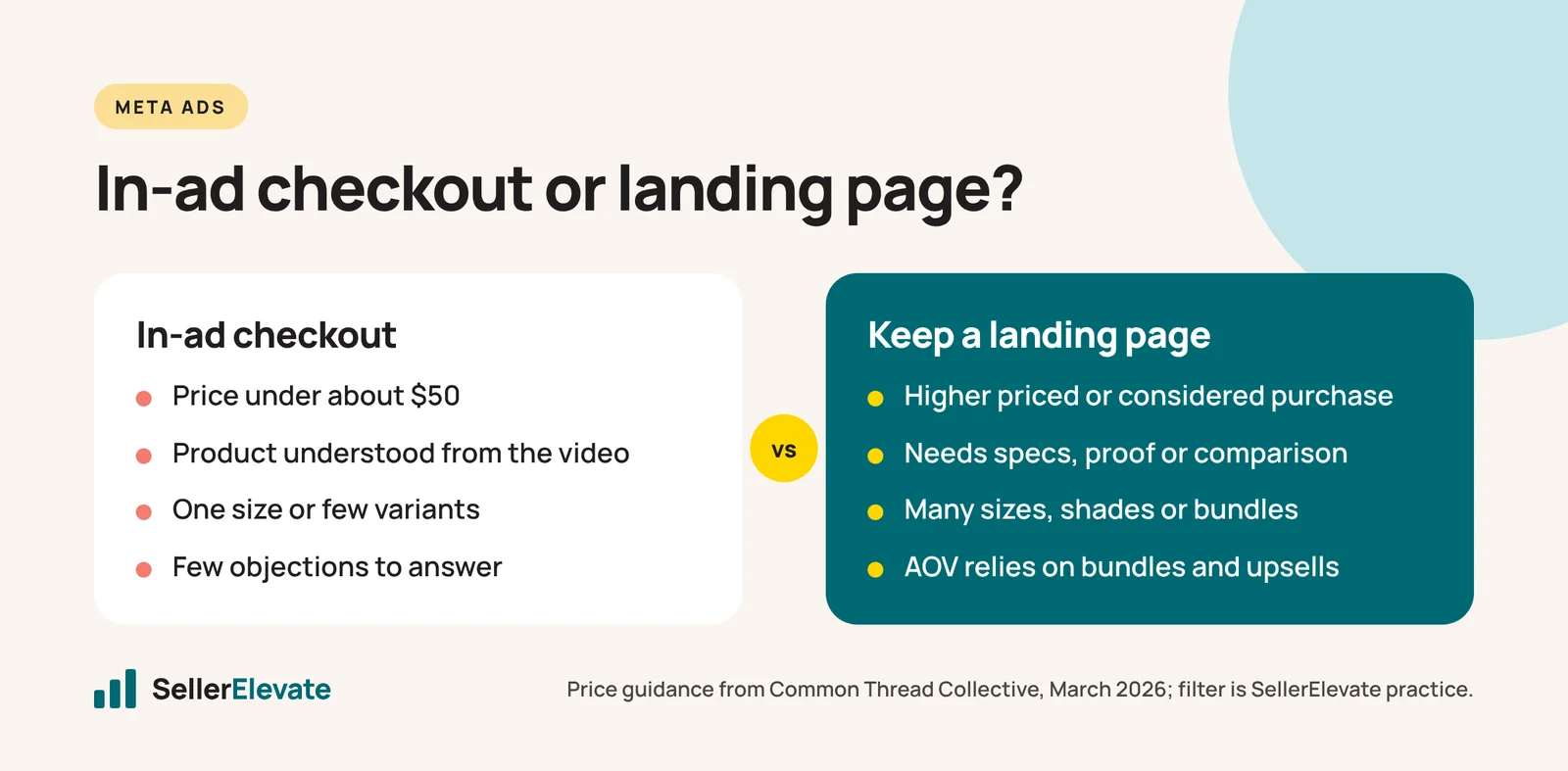
| Product trait | In-ad checkout candidate | Keep a landing page |
|---|---|---|
| Price | Under about $50 | Higher priced, or a considered purchase |
| Decision | Obvious from the video in seconds | Needs comparison, specs or proof |
| Variants | One size or very few options | Many sizes, shades, bundles |
| Objections | Few (shoppers know the category) | Fit, safety, results, compatibility |
| AOV strategy | Single-unit purchase is fine | You rely on bundles or upsells |
| Repeat buying | Low priority | You want email or SMS capture and a subscription |
A product does not have to tick every box. If three or more traits fall in the right-hand column, we would keep the landing page.
Some hypothetical examples:
- A $19 phone grip shown working in a 10-second video. Strong in-ad candidate. The video is the product page.
- A $45 skincare serum. Borderline. The price fits, but shoppers want ingredients and before-and-after proof. Test both.
- A $180 ergonomic chair. Landing page. Nobody buys a chair from a feed without checking dimensions, reviews and returns.
How do I test it without hurting results?
Do not switch your whole account over. Run a controlled test on a small set of products.
- Pick two or three products that pass the filter above. Avoid your top seller for the first test.
- Record a baseline for each: cost per purchase, conversion rate from click, AOV, and refund rate over the last 30 days.
- Run the same creative to both paths if your account lets you split it, either as separate ad sets or separate campaigns with similar budgets. Same audience settings, same optimization event.
- Give it enough orders to read. A handful of purchases means nothing. Wait until each side has a meaningful number of conversions before deciding.
- Compare on contribution per order, not ROAS alone. A lower AOV can make conversion rate look better while profit per order falls.
- Watch what happens after the sale. Refunds, customer service tickets, and whether you can still email the customer. A checkout that loses the relationship can cost more than it saves.
Decision rules after the test
- Conversion rate up, AOV roughly the same, profit per order up: expand to similar products.
- Conversion rate up, AOV down enough that profit per order falls: keep the landing page, or add a bundle to the in-ad offer if that is possible.
- No real difference: keep the landing page. It gives you more control and better data.
- Refunds or support tickets up: the product needed more explanation than the ad gave. Move it back.
What makes in-ad checkout perform worse?
- Sending complex products straight to checkout because the feature is new and exciting.
- Ignoring tracking. If purchases from the new path are not reported cleanly to your store and to Meta, optimization suffers. Check that orders show up correctly before scaling.
- Judging on one week. New features often get early volume swings. Read two to three weeks of data.
- Forgetting the landing page still matters for everything else. Most of your catalog will still send people to your site, and if that page does not match the ad’s promise, you lose the click there instead.
What we'd do this week
- Check whether the buy-now option is available in your Ads Manager. If it is not, there is nothing to change yet.
- Sort your catalog by price and complexity using the table above. Mark the products under about $50 that a shopper can understand in a few seconds.
- For everything else, check that each ad sends people to a page that continues the ad’s exact promise. A generic homepage is the most common leak we see. Our landing page and listing images work starts there.
- If the feature is live for you, set up one controlled test using the steps above, and pick a date to review it.
- Decide in advance which metric wins: profit per order, not conversion rate.
If your Meta traffic converts poorly no matter where it lands, the issue is usually creative and offer rather than checkout. Our posts on rising Meta CPMs and break-even ROAS cover the math, and our Meta ads management team can review the full funnel.
Frequently asked questions
Is Meta's in-ad checkout available to every advertiser?
We could not confirm that. Common Thread Collective described it as a feature being tested in March 2026. Check your own Ads Manager and Commerce Manager for the option, and treat availability, countries and any fees as things to verify in your account before planning around them.
Will in-ad checkout lower my average order value?
It can. Landing pages hold most AOV levers, such as bundles, quantity breaks and free-shipping thresholds. If shoppers buy one unit inside the ad, conversion rate may rise while AOV falls. Common Thread advises monitoring both, so compare profit per order before expanding.
What kind of landing page works best for Meta ads?
A page that continues the exact promise of the ad. If the ad shows a specific product solving a specific problem, the page should open on that product and that benefit, with reviews and key objections answered quickly. Sending ad traffic to a generic homepage is one of the most common leaks.
Should I use in-ad checkout for my best-selling product?
Not as a first test. Your top seller carries the most revenue risk if the new path underperforms. Start with two or three smaller products that pass the price and complexity filter, set a baseline, and expand only if profit per order improves.
Sources
- Common Thread Collective: Meta Advantage+ shopping campaigns in 2026 (March 30, 2026)
- Coupler: Facebook ads statistics 2026 (September 25, 2026)
Get the honest version of your numbers
A free account audit from the person who would actually run your account.