Do Amazon Marketing Cloud audiences actually improve ad performance?
Yes, when the account is ready for them. In our testing, high-intent buyer audiences returned around 9x ROAS and ad engagers around 8x, without more spend. But many audiences fail to build because they fall under the 2,000 user ID floor, and AMC amplifies a working account rather than fixing a messy one.
Key takeaways
- AMC lets you build audiences from behavior you actually observed in your own advertising data, rather than relying on Amazon's category-level segments.
- In our testing, high-intent buyers returned around 9x ROAS, Sponsored Ads engagers around 8x, and cart abandoners and product page audiences around 6x each.
- A rule-based AMC audience needs at least 2,000 user IDs to activate and a lookalike needs 500, and you cannot check size before running the query.
- When an audience fails on size, widening the lookback window from 30 days to 60 or 90 often fixes it without diluting intent much.
- If your campaign structure is messy or your listing converts poorly, fix those first, because first-party targeting amplifies what already works.
Amazon Marketing Cloud changes how Amazon ads should be run. Not because it is new, and not because it is complicated, but because it moves you from targeting the audiences Amazon hands you to building the audiences your own data describes.
We have built and tested more than a hundred SQL-driven AMC audiences across client accounts. Some produced the strongest returns we have seen on the platform. Some failed outright. Both are worth talking about.
The ceiling on native targeting
Run Sponsored Products long enough and you notice the same pattern. Keyword targeting works until it doesn’t. You harvest search terms, negate the waste, tighten the bids, and eventually you are optimising inside a box. Everyone bidding on “collagen powder” is reaching roughly the same shoppers, so the only lever left is paying more than the next seller.
Native audience targeting has the same problem from a different angle. Amazon’s in-market and lifestyle segments are built for breadth. They are useful, but they describe a category, not your customer.
AMC is a privacy-safe clean room sitting on top of your advertising data. You write SQL against pseudonymised signals — impressions, clicks, add-to-carts, purchases, across Sponsored Products, Sponsored Brands, Display and DSP — and you get back either an analysis or an audience. Nobody is identifiable. The output is aggregate. But the segment you build is yours, defined by behaviour you actually observed rather than a label Amazon applied.
That is the difference. Not better targeting. Different targeting, built from first-party behaviour.
Which AMC audiences perform best?
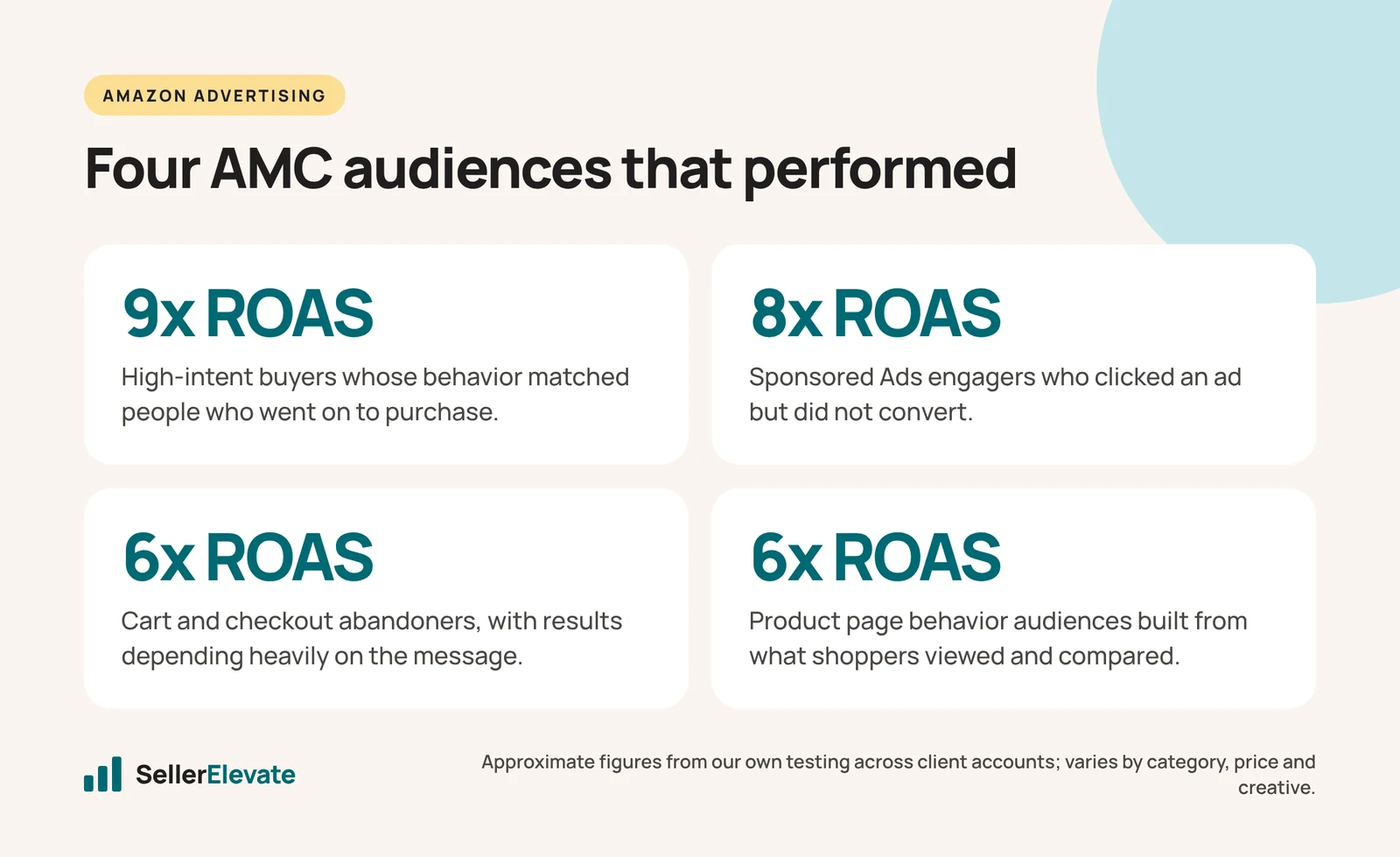
Across our testing, four audience types returned the strongest results without any increase in spend:
High-intent buyers — around 9x ROAS. Shoppers whose behaviour pattern in the lookback window matched people who went on to purchase. The tightest segment we build, and reliably the best performing.
Sponsored Ads engagers — around 8x ROAS. People who had already clicked an ad but not converted. They know the product exists. They have shown intent once. Reaching them again costs less than manufacturing that intent from scratch.
Cart and checkout abandoners — around 6x ROAS. The obvious one, and it still works. What surprised us was how much the result depended on what we said to them rather than simply reaching them again.
Product page behaviour audiences — around 6x ROAS. Built from how people moved through the detail page: what they viewed, what they compared, what they did next.
One important caveat, and we would rather say it than let you find out yourself. These figures come from our own testing across client accounts. They vary by category, by price point, and by the creative pointed at the segment. A 9x on a $60 supplement with a strong review profile is not a 9x on a $19 commodity in a crowded category. Treat them as evidence that this works, not as a number you should expect.
Why do some AMC audiences fail to build?
Look at any real AMC audience list and you will see failures sitting next to completions. Ours is no different. That is not a sign of bad SQL. It is how the system works, and understanding why saves a lot of wasted effort.
The size floor. A rule-based audience has to contain at least 2,000 user IDs before Amazon will activate it. Lookalike audiences need 500. Below that, the audience simply does not build, because a segment small enough to be activated would also be small enough to start identifying individuals.
You cannot check first. There is no way to know an audience will clear the threshold before you run the query. You write it, you run it, and you find out. This is the single most common reason a well-reasoned segment fails, and it catches everyone.
Over-specification. The tighter the conditions, the better the audience performs and the more likely it is to be too small to use. “People who viewed the product page, added to cart, abandoned, and previously bought from the brand” is a beautiful segment and will almost certainly fail on volume. The craft is finding the point where a segment is still specific enough to outperform but broad enough to exist.
When one fails, the fix is usually the lookback window rather than the logic. Widening from 30 days to 60 or 90 often clears the floor without diluting intent much. Sometimes it doesn’t, and the honest answer is that the segment is not available to you at your current scale.
Who can use Amazon Marketing Cloud now?
For most of AMC’s life, an Amazon DSP account was a hard prerequisite. That put it out of reach for the majority of Seller Central brands, and it is why a lot of sellers still assume AMC is an enterprise-only tool.
That changed. Amazon has adjusted the eligibility criteria, and DSP registration is no longer required — advertisers running sponsored ads can access AMC through a registered partner. Audiences built there can be used in Sponsored Products and Sponsored Brands as bid modifiers, in Sponsored Display for targeting, and in DSP for the full range.
Two practical limits worth knowing before you plan around it. An audience can take up to 48 hours to appear in Sponsored Ads after it builds, so this is not a same-day tactic. And audience exclusion is not currently supported in Sponsored Ads — if you need to exclude a segment rather than target it, that remains a DSP capability.
Is it worth it for your account?
Honestly, not always.
If your ad spend is modest and your campaign structure is still messy, AMC is the wrong problem to solve. Separating branded from generic traffic, negating the long tail, and fixing a listing that converts at eight percent will all return more than a clever audience will. First-party targeting amplifies what is already working. It does not rescue what isn’t.
If your structure is clean, your listings convert, and you have hit the ceiling on keyword targeting, this is the next thing. That is the point where the difference between targeting a category and targeting your own observed customers starts to show up in the numbers.
We have built more than a hundred of these across client accounts and we are still learning what works in which category. If you want to know whether your account is at the stage where AMC would pay for itself, ask us — it is a straightforward answer and we will tell you if it isn’t.
Amazon is also selling its ad technology to other retailers, which may bring AMC-style audiences off Amazon. Read what Amazon Retail Ad Service means for brands.
Frequently asked questions
Do you need an Amazon DSP account to use Amazon Marketing Cloud?
No, not anymore. For most of AMC's life DSP was a hard prerequisite, but Amazon has adjusted eligibility so advertisers running sponsored ads can access AMC through a registered partner. Audiences can then be used in Sponsored Products and Sponsored Brands as bid modifiers, in Sponsored Display for targeting, and in DSP. Eligibility rules change, so check the current requirements before planning around them.
What is the minimum audience size in Amazon Marketing Cloud?
A rule-based AMC audience needs at least 2,000 user IDs before Amazon will activate it, and a lookalike audience needs 500. Below that the audience does not build, because a segment that small could start identifying individuals. There is no way to check the size before you run the query, which is the most common reason a well-reasoned segment fails.
Why did my AMC audience fail to build?
Usually because it was too small. The tighter your conditions, the better a segment tends to perform and the more likely it is to fall under the size floor. The fix is normally the lookback window rather than the logic: widening from 30 days to 60 or 90 often clears the threshold. Sometimes the segment is simply not available at your current scale.
How long does an AMC audience take to show up in Sponsored Ads?
An audience can take up to 48 hours to appear in Sponsored Ads after it builds, so AMC is not a same-day tactic. Also note that audience exclusion is not currently supported in Sponsored Ads. If you need to exclude a segment rather than target it, that remains a DSP capability.
Get the honest version of your numbers
A free account audit from the person who would actually run your account.