Why doesn't raising bids fix a high ACoS on Amazon?
Because ads buy attention, not conversion. If the listing, offer or price is failing, more bids just multiply the cost of a broken funnel. In one client account we fixed the listing and targeting first, then raised ad spend 25%, and net profit rose 81.5% quarter on quarter.
Key takeaways
- PPC amplifies whatever the listing already does, so doubling budget on a poorly converting page doubles the cost of the leak.
- We audited and rebuilt the listing, cut broad and auto campaigns, tightened targeting and set aggressive negations before scaling ads.
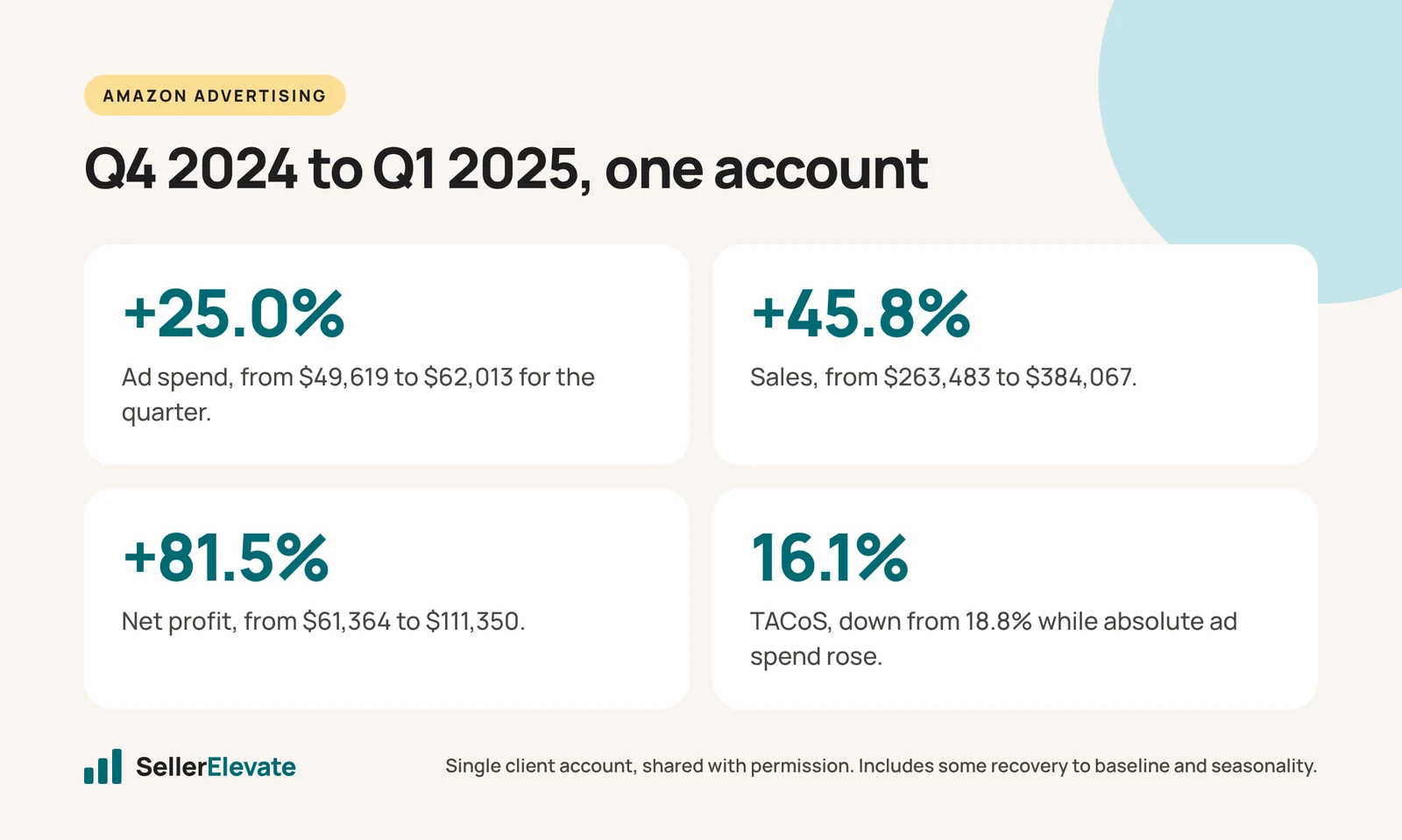
- From Q4 2024 to Q1 2025, ad spend rose 25.0% while sales rose 45.8% and net profit rose 81.5%.
- TACoS fell from 18.8% to 16.1% even as absolute ad spend increased, because spend was now pointed at a page that converted.
- Part of the gain was recovery to baseline, quarter comparisons carry seasonality, and refunds rose from 1.30% to 1.51% of orders.
A brand called us when their net profit had fallen by more than half.
That is usually the moment. Not when sales dip, because a dip can be explained away. Not when ACoS creeps up, because ACoS always creeps up. It is when the profit line halves and the explanations stop working.
Here is what we walked into, what we changed, and what the numbers actually did — including the parts that did not move as much as the headline suggests.
What was happening
Sales and profit had been falling for months. Q3 2024 closed at $270,388 in sales with net profit down 54% year on year. Q4, which should be the strongest quarter of the year for most consumer products, came in lower than Q3 at $263,483. A brand going backwards through the holiday quarter is not experiencing a soft market. It has a problem.
The advertising account was the clearest symptom. Broad and auto campaigns had been left running on autopilot, harvesting clicks and producing very little. Targeting was loose enough that irrelevant traffic was being paid for daily. And the previous agency had one response to every slowdown: raise bids, increase budget.
That approach has a certain logic to it. Sales fell, so buy more traffic. It is also the single most reliable way to turn a conversion problem into a much more expensive conversion problem.
Why does raising bids fail to fix falling sales?
Advertising does not create demand for a product people do not want at the price you are asking. It buys attention. What happens after the click is decided entirely by the listing, the offer and the price.
So if your listing converts at 8% and you double the budget, you have not fixed anything. You have doubled the cost of a broken funnel. The ad account looks busier, the spend line climbs, and the profit line keeps falling — which triggers another round of bid increases, because the assumption was never questioned.
This is what we mean when we say PPC is an amplifier. Point it at a listing that converts and it multiplies a working machine. Point it at one that does not and it multiplies the leak.
Every persistently high ACoS we have audited traces back to one of three things: campaign structure that mixes branded, generic and competitor traffic so nothing can be measured separately; a listing that does not convert the traffic it already receives; or product economics that never worked at that price in that category. None of the three is solved by spending more. Two of them are not advertising problems at all.
What should you fix before scaling Amazon PPC?
Audited the listing and the offer before touching a bid. Title, images, bullets, A+ content, price, and the value proposition a shopper meets in the first three seconds.
Scraped competitor data to find what the alternatives were doing better — not to copy them, but to find the objections our listing was failing to answer that theirs already did.
Rebuilt the listing around conversion. Title, image sequence, bullets and value proposition, written for the shopper first.
Cut the wasteful broad and auto campaigns. Not paused pending review. Cut.
Tightened targeting to the keywords with proven conversion rates and defensible margin.
Set aggressive negations so irrelevant traffic stopped being purchased at all.
Only then did we scale the advertising. The sequence matters more than any individual step in it.
What happened to profit after the listing rebuild?
Q1 2025, the first full quarter after the rebuild:
| Q4 2024 | Q1 2025 | Change | |
|---|---|---|---|
| Sales | $263,483 | $384,067 | +45.8% |
| Units | 15,324 | 21,760 | +42.0% |
| Ad spend | $49,619 | $62,013 | +25.0% |
| Net profit | $61,364 | $111,350 | +81.5% |
| TACoS | 18.8% | 16.1% | −2.7 pts |
| Net margin | 23.3% | 29.0% | +5.7 pts |
The line that matters most is the one people skip. Ad spend went up 25%, and profit went up 81.5%.
We did not cut advertising. We increased it by roughly $12,400 for the quarter. That extra spend produced about $120,600 in additional sales and roughly $50,000 in additional profit — around $9.70 of sales and $4.00 of profit for every additional advertising dollar.
That ratio is only available once the conversion engine works. Spend the same $12,400 against the old listing and you get a fraction of it, because the money is buying clicks on a page that was already failing to convert the traffic it had.
TACoS falling from 18.8% to 16.1% while absolute spend rose is the same fact from the other direction. The account was not spending less. It was spending against a page that finally converted.
The parts we would not overstate
Sales did not double. Across the two quarters from Q3 2024 to Q1 2025, sales rose 42% and net profit rose about 85%. Profit nearly doubled. Sales grew strongly. Those are different claims and it is worth being precise about which is which, because anyone reading a dashboard screenshot will do the arithmetic.
Some of this was recovery, not creation. A brand whose profit had halved was performing below its own baseline. Part of the gain is getting back to where it should have been, and it is honest to separate that from growth beyond it.
Quarter-on-quarter comparisons carry seasonality. This product has a low average order value, around $18, and a fairly flat seasonal profile, which is why the comparison holds up reasonably well. For a gift-heavy or highly seasonal category, a Q4-to-Q1 comparison would be close to meaningless. Always check what your own seasonal shape is before reading a quarterly jump as performance.
Refunds ticked up. Refunds rose from 192 to 320 as volume grew. As a rate that is 1.30% to 1.51% of orders — still low, but moving in the wrong direction, and the kind of thing worth watching rather than burying.
The takeaway
Real growth does not come from spending more. It comes from spending against something that works, and finding that out before the budget goes up rather than after.
If your ACoS has been climbing for six months and every response has been to adjust bids, the bids are probably not the problem. Look at what happens after the click. Pull your unit session percentage, compare it to your category, and ask honestly whether you would buy your own listing.
The fix usually costs less than another quarter of amplified waste.
Figures come from a single client account and are shared with permission. Every account is different, and we would not present this as a projection for anyone else. If your profit line is falling while your ad spend rises, that pattern is worth an hour of someone’s attention — ask us for a free audit and we will tell you which of the three causes you are dealing with.
Frequently asked questions
Should I raise my bids when Amazon sales drop?
Usually not first. Advertising buys attention; what happens after the click depends on the listing, the offer and the price. If those are failing, raising bids only makes a conversion problem more expensive. Check your unit session percentage against your category and ask honestly whether you would buy your own listing before adjusting bids.
What causes a persistently high ACoS on Amazon?
Every persistently high ACoS we have audited traces back to one of three things: campaign structure that mixes branded, generic and competitor traffic; a listing that does not convert the traffic it already gets; or product economics that never worked at that price in that category. None is solved by spending more, and two are not advertising problems.
Can you increase ad spend and still improve profit?
Yes, once the listing converts. In this account, ad spend rose about $12,400 for the quarter and produced about $120,600 in additional sales and roughly $50,000 in additional profit, around $9.70 of sales and $4.00 of profit per extra ad dollar. The same spend against the old listing would have returned a fraction of that.
Why can TACoS fall while ad spend goes up?
Because TACoS is ad spend divided by total sales, so it falls when sales grow faster than spend. In this account, ad spend rose 25.0% but sales rose 45.8%, so TACoS dropped from 18.8% to 16.1%. The account was not spending less; it was spending against a page that finally converted.
Get the honest version of your numbers
A free account audit from the person who would actually run your account.