What should a brand do if someone else is selling its products on Amazon?
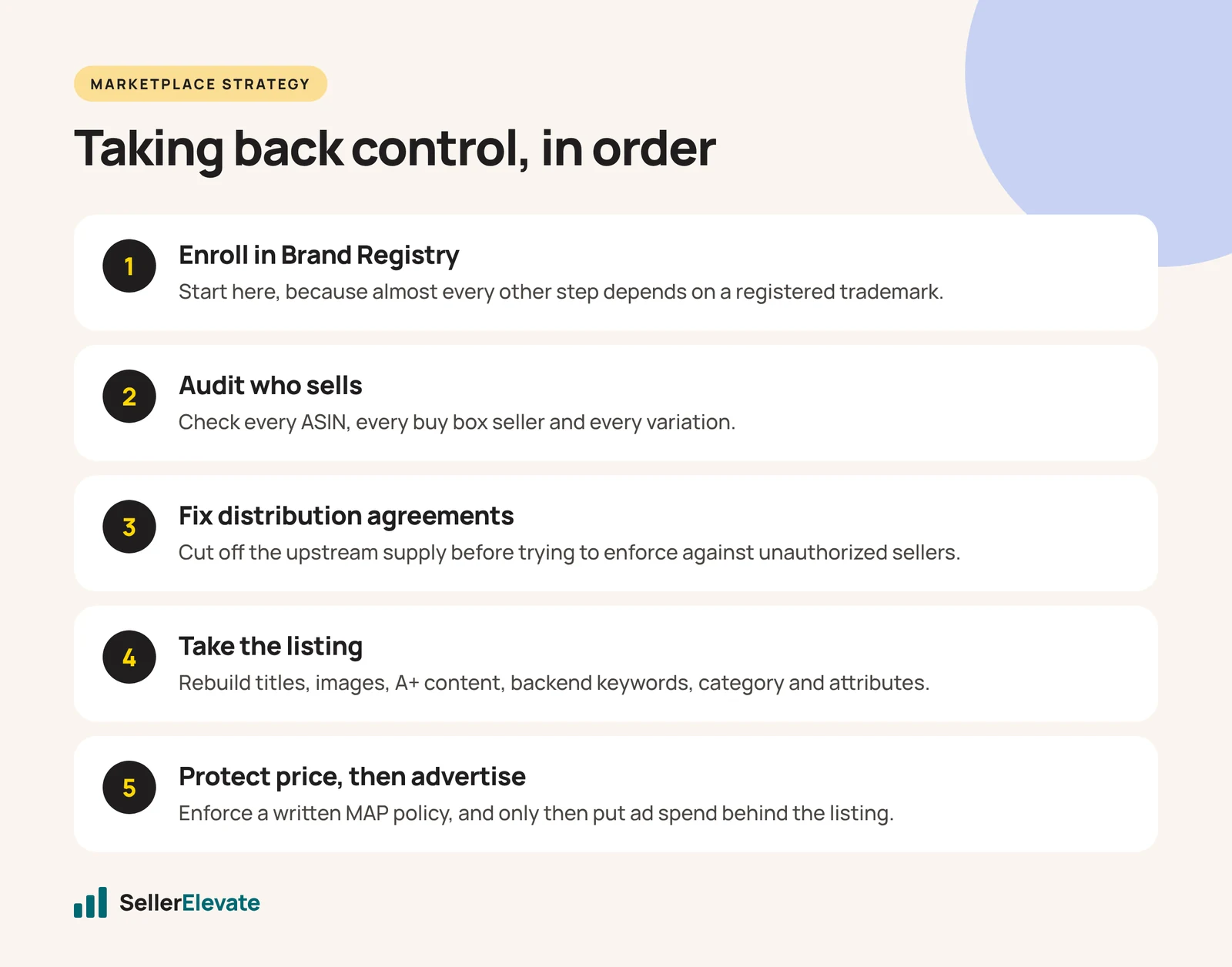
Take control in sequence. Enroll in Brand Registry, audit every seller and ASIN, fix the distribution agreements supplying unauthorized sellers, then rebuild the listing, protect the price with an enforced MAP policy, and only then advertise. Skipping steps, especially advertising into a broken listing, is what makes most takeovers fail.
Key takeaways
- Not selling on Amazon does not keep your brand off Amazon; it only decides who controls the listing your customers find.
- A wholesaler's goal is to move units at a margin, so it has little reason to invest in photography, A+ content or a price floor.
- Most unauthorized Amazon sellers are supplied by an authorized wholesaler upstream, so fixing distribution agreements comes before enforcement.
- A persistently high ACoS usually traces to campaign structure, a listing that does not convert, or product economics, and spending more fixes none of them.
- Taking control adds inventory, fulfillment, returns and ad costs, so a well-managed wholesale relationship with MAP can be the better answer for thin margins.
Most CPG founders don’t take marketplaces seriously until the damage is already done.
The reasons are always the same three. They don’t want to burn budget on ads. Investors don’t credit the channel. And they’re tired of looking at ACoS numbers that make the whole thing seem like a bad trade.
So it gets deferred. Next quarter. After the retail push. Once the DTC site is profitable.
Then the emails start.
“This product is fake.”
“It arrived damaged.”
“Is this even from your brand?”
That is usually the moment a founder discovers their brand has been on Amazon for two years, sold by people they have never spoken to, on a listing they have never seen, with photographs they did not approve.
Can your brand be on Amazon if you don't sell there?
This is the part that surprises people, so it is worth stating plainly: not selling on Amazon does not keep you off Amazon. It only decides who controls the page.
Somewhere between half and two thirds of American shoppers now start their product searches on Amazon rather than a search engine, depending on which survey you read. Around three quarters say they have discovered new products or brands there. More than 600,000 brands sell on the platform.
Your customers are looking for you there. The only question is what they find when they do.
If a wholesaler, distributor or arbitrage seller has listed your product, what they find is a page built by someone with no stake in your brand. A stock photo lifted from your website. A title stuffed with keywords. No A+ content, no brand story, no comparison chart. Reviews accumulating against a listing you cannot edit, complaining about packaging you did not choose to ship.
And every one of those reviews is attached to your name, not theirs.
Should a wholesaler sell your brand on Amazon?
If you are letting a wholesaler list your product on Amazon, be clear about what that arrangement actually is.
Their goal is to move units at a margin. That is a perfectly legitimate business, and it is not the same business as building brand equity. A wholesaler has no reason to invest in photography, no reason to write A+ content, no reason to defend a price floor, and no reason to care whether your listing ranks for the terms that build your category position over three years.
They will also, quite rationally, compete on price. Which is how a founder ends up explaining to a retail buyer why their product is available on Amazon for less than the wholesale cost.
The version of this that hurts most is subtler. A brand doing genuine numbers through a wholesaler on Amazon looks, from the outside, like a brand with an Amazon business. It isn’t. It is a brand whose Amazon revenue, customer data, review profile, search ranking and pricing are all held by somebody else. None of that transfers when the relationship ends.
The two objections, answered
“Investors don’t value marketplace revenue.”
Some don’t. But what they are usually reacting to is undifferentiated marketplace revenue — a brand that exists as a commodity listing with no defensible position. Controlled marketplace revenue, with brand registry, protected pricing, owned reviews and a ranking position competitors have to pay to displace, is a different asset. So is the customer and search data that comes with it, which is the closest thing to free market research that exists in consumer goods.
“Our ACoS is terrible and nothing improves.”
Then ask the harder question. Is the marketplace the problem, or is the strategy?
In our experience a persistently high ACoS on a decent product almost always traces back to one of three things: campaign structure that mixes branded, generic and competitor traffic so nothing can be measured separately; a listing that does not convert the traffic it already receives, so every click is bought twice; or product economics that never worked at that price point in that category.
None of those are fixed by spending more. Two of them are not fixed by advertising at all.
How do you take back control of your brand on Amazon?
“Take back control” gets said a lot and explained rarely. Mechanically, it is a sequence, and skipping steps is what makes it fail.
Enrol in Brand Registry first. Everything else depends on it. Without a registered trademark you have almost no leverage over your own listings, and the process takes long enough that it should start before you need it.
Audit who is actually selling you. Every ASIN, every seller on the buy box, every variation. Founders are routinely surprised by both the number and by which of their own distribution partners are involved.
Fix your distribution agreements before you fight anyone. Most unauthorised Amazon sellers are supplied by an authorised wholesaler somewhere upstream. Enforcement against the symptom fails while the source continues. This is a contract problem before it is an Amazon problem.
Then take the listing itself. Correct titles, proper photography, the full seven-image sequence, A+ content, backend keywords, category and attributes. This is the point at which the page stops being a commodity entry and starts being a brand asset.
Protect the price. A MAP policy that is written down and actually enforced, plus Transparency or Project Zero where counterfeiting is a genuine risk rather than a theoretical one.
Only then advertise. Advertising into a broken listing is the most expensive mistake in this sequence, and it is the one most brands make first.
The honest caveats
Taking control is not free and it is not always right.
You take on inventory risk, fulfilment, customer service, returns and ad spend that a wholesaler was previously absorbing. Your reported revenue may dip before it climbs, because a wholesaler’s volume does not transfer to you intact on day one. And if your margin structure genuinely cannot support Amazon’s referral fee plus FBA plus advertising, then a well-managed wholesale relationship with a MAP policy attached may be the better answer.
The failure mode we see is not brands who chose wholesale deliberately. It is brands who never chose at all, and found out what they had agreed to when the customer emails arrived.
The case we get asked about
We have taken a brand from roughly $200K a year on Amazon through a wholesaler to over $22M a year after moving control back in-house.
That number deserves more context than a headline, and we are writing it up properly rather than posting the multiple and leaving it there — including the timeline, what else changed alongside the takeover, and which parts were the takeover as opposed to catalogue expansion and market growth. A 100x is not a promise to anyone else, and we would rather show the mechanism than wave the figure.
If you want the detail before we publish it, ask and we will walk you through it on a call.
If you are a CPG founder who has never looked at what comes up when you search your own brand on Amazon, do that first. It takes thirty seconds and it usually answers the question of whether this is urgent.
Frequently asked questions
Can my brand be on Amazon if I don't sell there?
Yes. A wholesaler, distributor or arbitrage seller can list your product, often with a stock photo from your website, a keyword-stuffed title and no A+ content. Reviews then build up against a listing you cannot edit, and every one of them is attached to your brand name. Not selling on Amazon only decides who controls the page.
How do I stop unauthorized sellers on Amazon?
Start upstream. Most unauthorized Amazon sellers are supplied by an authorized wholesaler somewhere in your distribution chain, so enforcement fails while the source continues. Enroll in Brand Registry, audit every seller on your ASINs, and fix your distribution agreements before you fight anyone. This is a contract problem before it is an Amazon problem.
Is it better to sell on Amazon through a wholesaler or directly?
It depends on your margins. Selling directly gives you control of revenue, reviews, ranking, pricing and customer data, but you take on inventory, fulfillment, customer service, returns and ad spend. If your margin cannot support Amazon's referral fee plus FBA plus advertising, a well-managed wholesale relationship with an enforced MAP policy may be the better answer.
Why is my Amazon ACoS so high when the product is good?
In our experience it usually traces to one of three things: campaign structure that mixes branded, generic and competitor traffic so nothing can be measured; a listing that does not convert the traffic it already gets; or product economics that never worked at that price in that category. Spending more fixes none of them, and two are not advertising problems.
Get the honest version of your numbers
A free account audit from the person who would actually run your account.