Is Amazon Creator Connections worth it for brands?
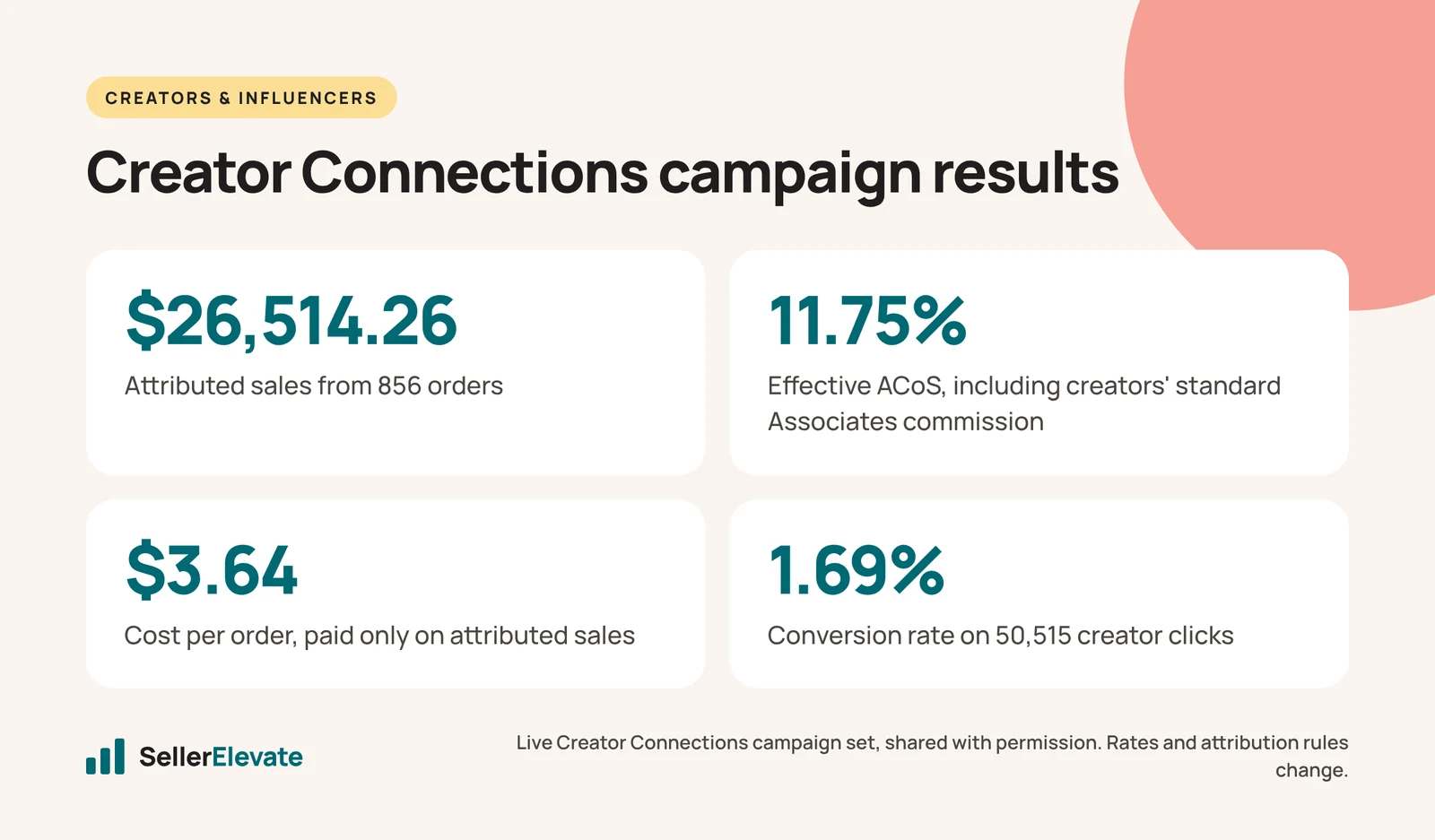
It can be. In one live campaign set, 856 orders cost $3.64 each at an 11.75% effective ACoS, between two and five times cheaper per order than the same volume through Sponsored Products. You pay only for attributed sales, but traffic converted at 1.69% and few accepted creators ever published content.
Key takeaways
- Creator Connections charges only when an attributed order completes, so 49,659 non-converting clicks in this campaign set cost nothing.
- Effective ACoS was 11.75% against a 10% bonus because creators keep their standard Associates commission on top.
- Creator traffic converted at 1.69%, far below typical search traffic, so compare cost per order rather than cost per click.
- Acceptance is not participation: in one campaign, 800 creators were targeted, 45 accepted and 3 published anything.
- Attribution runs on a 24-hour window after the click, so real impact is probably understated.
Amazon Creator Connections is Amazon’s answer to the TikTok Shop affiliate model, and the economics are unlike anything else on the platform.
Here is a real campaign set, with the numbers that matter and the ones that get quoted incorrectly.
What did the Creator Connections campaigns actually deliver?
| Attributed sales | $26,514.26 |
| Commission paid | $3,116.19 |
| Orders | 856 |
| Clicks | 50,515 |
| Effective ACoS | 11.75% |
| Cost per order | $3.64 |
| Cost per click | $0.06 |
Six cents a click, on Amazon, in a year where sponsored CPCs are climbing 10 to 15%.
Except that framing is slightly misleading, and the reason why is the most important thing on this page.
You don't pay for clicks. You pay for sales.
Creator Connections is a commission model. You set a bonus commission on selected ASINs, creators opt in and publish, and you are charged only when an attributed order completes. Amazon takes no platform fee. If a creator sends ten thousand clicks and nobody buys, you pay nothing.
In this campaign set, 49,659 clicks did not convert. We paid for none of them.
That is the structural difference from Sponsored Products, where you buy every click whether it converts or not. It is not a cheaper version of PPC. It is a different instrument, and it fails in a different direction — on PPC you can waste money on clicks; here you can waste months on creators who never publish.
One detail worth knowing: the 11.75% effective ACoS is higher than the 10% bonus we set, because creators also keep their standard Associates commission on top of the brand-funded bonus. Roughly 10% plus around 2% base. Model that in before you set a rate.
The honest comparison against PPC
Six cents a click sounds like it demolishes Sponsored Products. It doesn’t, because the clicks are not the same clicks.
Creator traffic converted at 1.69%. Amazon search traffic typically converts at 10 to 15% because a shopper who types “collagen powder” has already decided they want collagen powder. Someone who taps a link in a creator’s video has decided nothing.
So compare at the level that matters — cost to acquire 856 orders:
| Route | Clicks needed | Cost |
|---|---|---|
| Creator Connections (1.7% CVR, $0.06/click) | 50,515 | $3,116 |
| Sponsored Products at 10% CVR, $1.00 CPC | 8,560 | $8,560 |
| Sponsored Products at 10% CVR, $1.50 CPC | 8,560 | $12,840 |
| Sponsored Products at 8% CVR, $1.50 CPC | 10,700 | $16,050 |
Even on a like-for-like basis, adjusting fully for the intent gap, this channel came in between two and five times cheaper per order than buying the same volume through search.
That is a real result, and it holds up under scrutiny rather than relying on the six-cent figure doing the work.
How many accepted creators actually publish content?
Here is what the campaign dashboard shows underneath the totals: how many creators were targeted, how many accepted, and how many actually submitted content.
| Targeted | Accepted | Submitted content |
|---|---|---|
| 800 | 45 (5.6%) | 3 (6.7% of accepted) |
| 800 | 83 (10.4%) | 10 (12.0%) |
| 200 | 62 (31.0%) | 7 (11.3%) |
| 200 | 48 (24.0%) | 2 (4.2%) |
| 200 | 72 (36.0%) | 17 (23.6%) |
Read the first row again. Eight hundred creators targeted, forty-five accepted the campaign, three published anything at all.
Acceptance is not participation. A creator opting into your campaign costs them nothing and commits them to nothing, so acceptance rates tell you almost nothing about whether content will exist. Across these campaigns, between 4% and 24% of accepting creators actually submitted, with a median of about 11%.
This is the same power law we see running TikTok Shop affiliate programmes, where four videos out of 2,449 affiliates produced most of the revenue. Creator channels concentrate hard. Plan for it rather than being surprised by it.
Practically: judge a campaign on published content and attributed orders, never on creator sign-ups. And do not read a small campaign as proof the category behaves that way — one of the campaigns in this set produced 114 clicks and zero orders across a full year.
What is Amazon Creator Connections good at, and what isn't it?
Good at: paying only for results, generating volumes of top-of-funnel traffic that would be unaffordable through search, producing content you may be able to reuse, and reaching shoppers who were not searching for your category at all. For a product that demonstrates well on video, it is one of the most underused tools Amazon offers.
Not good at: control. You cannot select individual creators inside the campaign, so there is no normal one-to-one outreach workflow. Reporting is aggregate, and campaign orders do not appear as individually linked orders in your order management. Attribution runs on a 24-hour window after the click, which means anyone who thinks about it overnight is not counted — your real impact is probably understated, but you cannot prove it.
If you need specific creators, that is a separate direct-outreach job. Most brands running this properly do both.
How do you set up Creator Connections without losing money?
Start with the profit model, not the creator list.
Work out the maximum commission your SKU can carry after landed cost, referral fee, FBA, returns and any coupon running alongside. Remember Amazon calculates commission on the net price after discounts, and that creators stack their base rate on top of your bonus. Then set your rate below that ceiling rather than at whatever the category average is.
For context, brands typically layer 10 to 50%, and competitive categories like beauty and supplements commonly sit at 20 to 25%. We ran 10% and it worked, which says as much about the product as the rate.
Run a bounded test on one product for sixty days before rolling it across the catalogue. Measure attributed orders, contribution after all variable costs, and whether any creator-product pairing repeats. Repeatability is the thing worth finding. A single viral video is luck; a creator who converts for you twice is a channel.
One correction worth making
A lot of Creator Connections write-ups, including the first version of ours, describe click volume as customers. Fifty thousand clicks is not fifty thousand customers. It is fifty thousand taps, 856 of which became orders.
The distinction matters, because the 1.69% conversion rate is not a disappointment — it is the defining characteristic of the channel and the thing you have to plan around. Cheap cold traffic at volume, converting at a fraction of search. That is the trade, and it is a good one at these prices.
Figures are from live campaigns and shared with permission. Commission rates, attribution windows and eligibility change — check your own campaign setup in Seller Central before modelling anything on these numbers.
Frequently asked questions
How does Amazon Creator Connections pricing work?
It is a commission model. You set a bonus commission on selected ASINs, creators opt in and publish, and you are charged only when an attributed order completes. Creators also keep their standard Associates commission, so effective cost runs above your bonus. Rates and eligibility change, so check your campaign setup in Seller Central.
Is Creator Connections cheaper than Sponsored Products?
Per click, by far: this campaign set paid $0.06. But creator traffic converted at 1.69%, so the fair comparison is cost per order. At $3.64 per order it came in between two and five times cheaper than buying the same 856 orders through Sponsored Products at the CPCs and conversion rates modeled in the post.
What commission rate should I set for Creator Connections?
Start from your profit model: the maximum commission your SKU can carry after landed cost, referral fee, FBA, returns and any coupon. Amazon calculates commission on the net price after discounts. Brands typically layer 10 to 50%, beauty and supplements commonly sit at 20 to 25%, and this campaign ran 10%.
Why do so few creators post after accepting a campaign?
Accepting costs a creator nothing and commits them to nothing. Across these campaigns, only between 4% and 24% of accepting creators submitted content. Judge a campaign on published content and attributed orders, never on sign-ups, and run a bounded sixty-day test on one product before rolling out.
Get the honest version of your numbers
A free account audit from the person who would actually run your account.