How do I know if my Amazon rank depends on advertising?
Halve ad spend on one established ASIN for two weeks and leave everything else alone. If sales fall roughly in line with spend, that is normal. If organic rank falls too, paid traffic was holding up your position. A mature product should have organic sales carrying half to two thirds of revenue.
Key takeaways
- Halving ad spend on one established ASIN for two weeks shows whether organic rank holds or was being propped up by paid traffic.
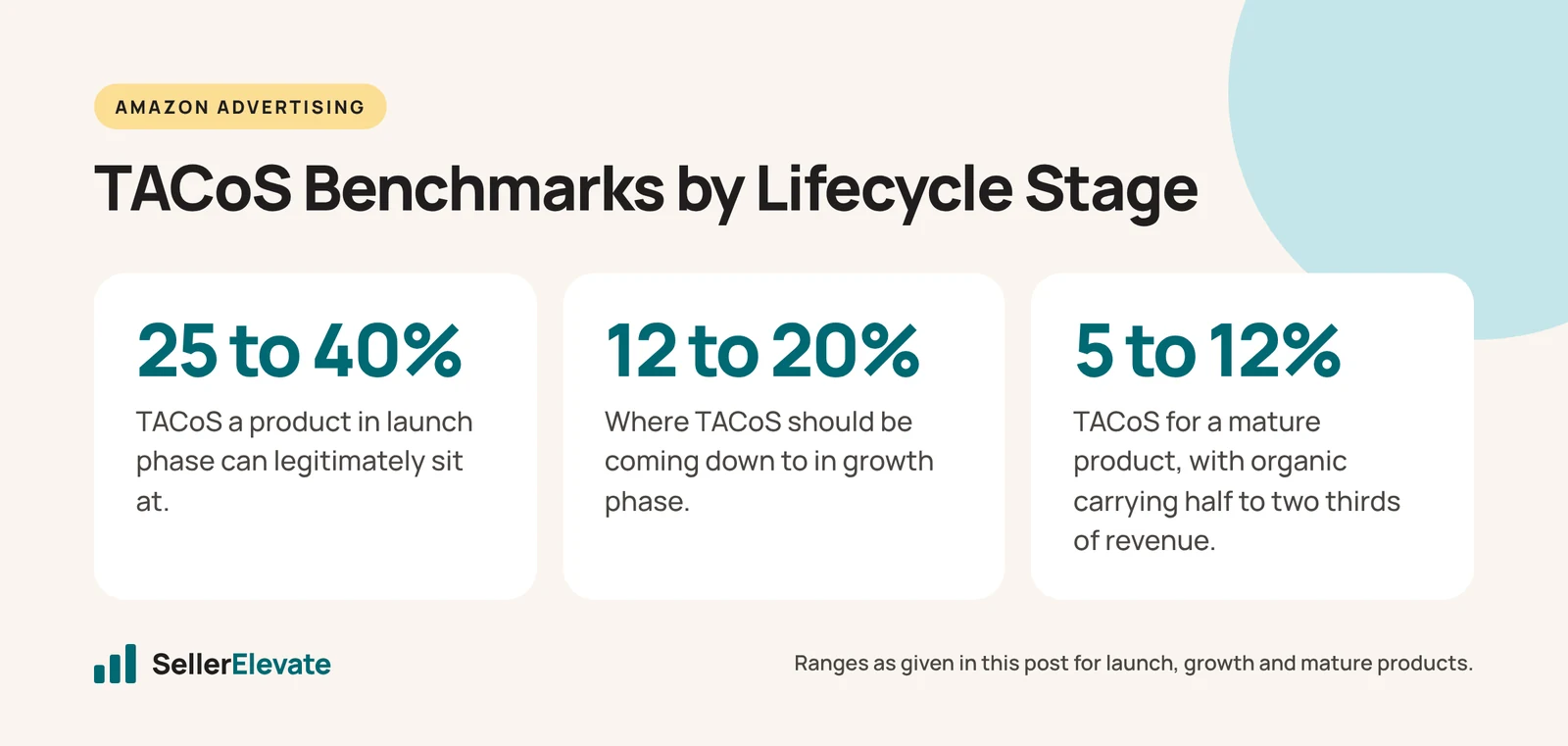
- TACoS of 25 to 40% is normal at launch, 12 to 20% in growth, and 5 to 12% for a mature product.
- Amazon has not confirmed any honeymoon period for new ASINs, so treat early visibility as an audition and launch only when the listing is ready.
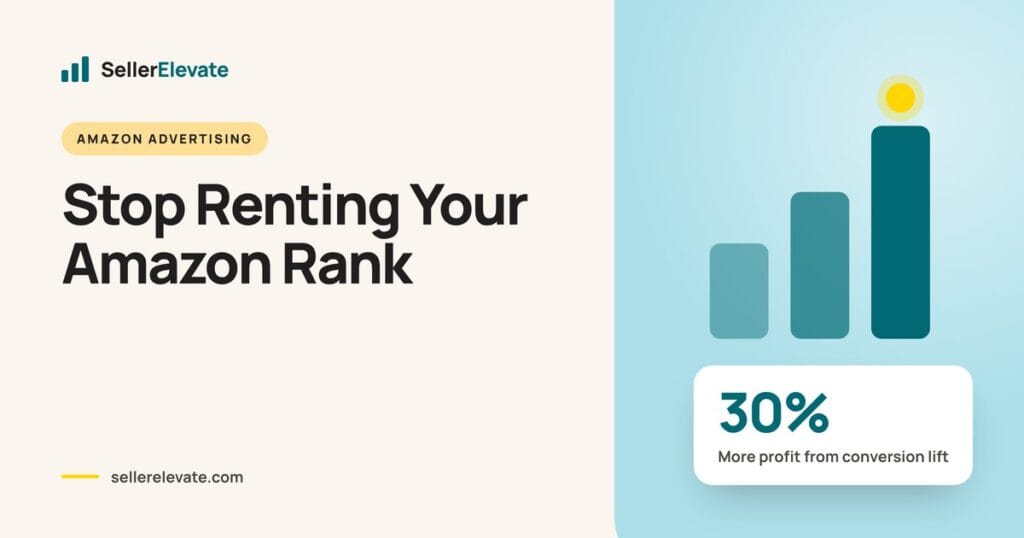
- In the post's example, lifting conversion from 12% to 12.6% raised net profit from $4,000 to $5,200, a 30% gain with the same ad spend.
- The Brand Referral Bonus pays back an average of around 10% of the product price on external sales tracked with Amazon Attribution.
Here is a test that takes two weeks and tells you more about your Amazon business than any dashboard.
Halve your advertising spend on one established ASIN. Leave everything else alone. Watch what happens to organic rank and total sales.
If sales fall roughly in line with the ad spend, that is normal and fine — the ads were doing the work you paid them to do. If organic rank falls too, you have found something more serious. Your position in search was being held up by paid traffic, and the moment you stop paying, it goes.
That is renting, not owning. And plenty of accounts have been renting for years without knowing it.
What does owning your organic rank look like?
The clearest signal is the mix between paid and organic revenue, read against where the product is in its life.
A product in launch phase can legitimately sit at a TACoS of 25 to 40% — you are buying visibility deliberately because nothing else will produce it. In growth phase that should be coming down to 12 to 20%. A mature product should be at 5 to 12%, with organic sales carrying somewhere between half and two thirds of revenue.
If you are three years in and still spending like a launch, that number is telling you something specific, and it is not “increase the bids.” It is that the ads never converted into rank you get to keep.
The mechanism is straightforward. Amazon rewards momentum: sales velocity relative to your category, conversion rate, recency. Paid sales do contribute to that momentum, which is why advertising a new product works. But if paid is the only thing producing velocity, the moment it stops the velocity stops, and rank follows within weeks.
When does ad dependency get set for a new ASIN?
Most of the time, in the first month.
There is a long-running debate about Amazon’s so-called honeymoon period. It is worth being honest about what is actually known, because the internet states it with more confidence than the evidence supports.
What Amazon has confirmed: nothing. There is no official documentation describing preferential treatment for new ASINs.
What is widely observed: new listings get sampled more generously than their non-existent sales history would justify, because the algorithm has a cold-start problem. It does not know where to rank you, so it shows you and watches what shoppers do. Estimates of how long this lasts vary enormously — 15 to 30 days, two to four weeks, 30 to 45 days, or gradually decaying across 90 days depending on who you ask and which category they sell in.
The framing that is actually useful: it is not a gift of visibility. It is an audition. The algorithm is sampling shopper response and adjusting in real time. If your listing converts, sampling continues and rank climbs. If it does not, the visibility evaporates within days and a low baseline gets set that is expensive to undo later.
Which produces one practical rule: launch when everything is ready, not when the inventory lands. A mediocre main image, zero reviews and unstructured campaigns on day one means spending your most valuable sampling window teaching Amazon to demote you.
On reviews specifically, Vine remains the cleanest early source — up to 30 units for a flat $200 enrolment fee per parent ASIN. One change worth knowing: since 12 February 2026, Vine reviews on variations with functional differences no longer aggregate up to the parent, so each functional variation now stands on its own review count. If you launch a range, plan for that.
Why does fixing conversion beat raising ad budget?
A small conversion improvement moves profit far more than most sellers expect, and the leverage is largest exactly where it feels least affordable.
Take an account running 20,000 clicks a month at $1.00 CPC, so $20,000 in ad spend, converting at 12%, with $10 of contribution margin per unit.
That is 2,400 orders, $24,000 of contribution, and $4,000 of net profit after advertising.
Now improve conversion by 5% relative — 12% to 12.6%. Nothing else changes. Same clicks, same spend, same margin.
2,520 orders, $25,200 of contribution, $5,200 net profit. A 5% conversion improvement produced 30% more profit.
Now run the same maths on a healthier account with $20 of margin per unit. Net profit goes from $28,000 to $30,400 — an 8.6% gain from the same 5% conversion lift.
The uncomfortable implication: conversion work pays off most dramatically for the accounts that can least afford to invest in it. When advertising is eating most of your contribution, every incremental order drops almost entirely to the bottom line, because the spend is fixed. The brands feeling most squeezed are the ones with the most to gain from fixing the page rather than the bids — and they are usually the ones being told to increase budget instead.
External traffic, and the part people miss
Amazon rewards brands that bring shoppers in from outside. That much is widely repeated. What gets left out is that Amazon will literally pay you for it.
Through the Brand Referral Bonus, brand-registered sellers earn back an average of around 10% of the product price on sales originating from external traffic tracked with Amazon Attribution tags. That is a direct reduction in your acquisition cost on every externally-driven sale, on top of whatever the traffic does for your ranking signals.
So driving traffic from Meta, TikTok, Google or influencers is not only a ranking play. It is a channel where Amazon subsidises part of your customer acquisition, and a surprising number of brands running external campaigns have never set up Attribution to claim it.
What we would check first
Run the spend test. Halve ad spend on one established ASIN for two weeks and watch organic rank. It is the cheapest diagnosis available.
Check your organic share against your product’s lifecycle stage. Mature products should have organic carrying half to two thirds of revenue. If yours doesn’t, the ads have been buying sales rather than position.
Work out what a 5% conversion lift is worth on your own numbers. Contribution per unit, times orders, minus fixed ad spend, then rerun it with conversion 5% higher. The thinner your margin, the more alarming that number will be — in a useful way.
Check whether Amazon Attribution is set up. If you are running any external traffic without it, you are giving up roughly 10% back on those sales for no reason.
If your rank falls whenever you ease off the advertising, that is diagnosable and usually fixable. It is one of the first things we look at in a free account audit.
Frequently asked questions
What is a good TACoS for an Amazon product?
It depends on lifecycle stage. A launch product can legitimately sit at 25 to 40% TACoS, a growth-phase product should come down to 12 to 20%, and a mature product should be at 5 to 12%, with organic sales carrying half to two thirds of revenue. Still spending like a launch years in means the ads never turned into rank you keep.
Is the Amazon honeymoon period real?
Amazon has confirmed nothing, and there is no official documentation of preferential treatment for new ASINs. What is widely observed is that new listings get sampled more generously because of a cold-start problem, with estimates ranging from 15 to 30 days to a gradual decay across 90 days. Treat it as an audition and launch only when everything is ready.
Why does improving conversion rate boost Amazon profit so much?
Because ad spend is fixed, extra orders drop almost entirely to profit. On 20,000 clicks at $1.00 CPC with $10 of margin per unit, lifting conversion from 12% to 12.6% raises net profit from $4,000 to $5,200, a 30% gain. With $20 of margin, the same lift adds 8.6%, so thin-margin accounts gain the most.
What is the Amazon Brand Referral Bonus?
It is a program where brand-registered sellers earn back an average of around 10% of the product price on sales from external traffic tracked with Amazon Attribution tags. It lowers acquisition cost on every externally driven sale from Meta, TikTok, Google or influencers. Without Attribution set up, you give up that bonus. Check Seller Central for the current terms.
Get the honest version of your numbers
A free account audit from the person who would actually run your account.