What is Amazon Retail Ad Service?
Amazon Retail Ad Service is Amazon selling its advertising technology to other retailers, so they can run a retail media network on their own sites. Advertisers manage those campaigns in the Amazon Ads console, but products are only eligible on a retailer where they are already available for checkout, so distribution comes first.
Key takeaways
- Amazon introduced Retail Ad Service at CES in January 2025, built on AWS, and it appears in Amazon Ads as a beta option to advertise products across retailers.
- Your products are only eligible on a retailer where they are already available for checkout, so the real bottleneck is distribution, not advertising.
- The US beta launched with four retailers: iHerb, Oriental Trading, Weee! and Tilly's.
- Asda in the UK is the first announced deployment outside the US, on a phased rollout from Q4 2026.
- Brands already selling on a participating retailer should test it; everyone else should note it rather than restructure around it.
Open the campaign creation flow in Amazon Ads and you may see a tile you did not expect: Advertise products across retailers, still marked beta.
Click it and you get a list of websites that are not Amazon. iHerb. Weee! Oriental Trading. Your Sponsored Products campaign, running on somebody else’s store, with the shopper checking out there rather than on Amazon.
This is Amazon Retail Ad Service, and eighteen months after launch it is both more strategically significant and more practically limited than the announcement suggested.
What is Amazon Retail Ad Service?
Amazon introduced it at CES in January 2025. The product is not really an advertising feature — it is Amazon selling its advertising technology to other retailers, built on AWS, so those retailers can run a retail media network on their own sites without building one.
The retailer controls the experience: which ad formats appear, where they sit across the site and app, how many are shown, and what happens after the click. Amazon supplies the engine and, more importantly, the demand.
From your side as an advertiser, nothing changes operationally. Available retailers appear in your Amazon Ads console or through the API. You create and manage campaigns in the same workflow, with reporting in the same place. A shopper on Weee! sees your product, clicks, and buys it on Weee!.
The pitch to retailers is straightforward, and iHerb stated it plainly at launch: instant access to a pool of 1,200 brands already buying Amazon Ads, rather than recruiting an advertiser base from scratch.
The catch nobody leads with
Your products are only eligible on a retailer where they are already available for checkout.
If you do not sell on Weee!, you cannot advertise on Weee!. If you are not listed on iHerb, the iHerb inventory is not available to you regardless of how much you spend on Amazon.
That single rule changes what this is. It is not a new customer acquisition channel you can switch on. It is an advertising layer on top of distribution you already have — which means the bottleneck was never the advertising. It is getting listed with those retailers in the first place.
For most brands, the honest sequence is: win the distribution, then the ad inventory becomes available. Not the reverse.
Which retailers use Amazon Retail Ad Service?
Eighteen months on, the footprint is still narrow.
The US beta launched with four retailers, deliberately spread across categories: iHerb in health and wellness, Oriental Trading in party and craft supplies, Weee! in Asian grocery, and Tilly’s in surf and skate fashion. That spread reads as a test of whether one ad engine works across very different retail contexts, rather than a land grab.
The first deployment outside the US was announced roughly eighteen months later, with Asda in the UK, on a phased rollout from Q4 2026. As of mid-2026 it was not yet serving ads on Asda.com. If you see a source claiming a Q4 2024 Asda date, that is an error.
So this has not exploded. It has advanced carefully, and the interesting question is where it goes rather than what it delivers today.
Why does Amazon Retail Ad Service matter?
Three things make this worth paying attention to even while the retailer list is short.
Retail media infrastructure is being commoditised. Target, Walmart, Nordstrom, Home Depot, Best Buy, Macy’s and Lowe’s all built their own retail media networks. Every mid-sized retailer now wants one and most cannot justify building it. Amazon is offering the finished thing, which puts direct pressure on the third-party vendors — Criteo among them — who had been selling exactly that.
Retailers are accepting Amazon tags on their own sites. This is a genuine shift. Not long ago most retailers would not put their data anywhere near AWS, let alone run their competitor’s ad tech in their storefront. The economics of retail media have changed that calculation.
Your Amazon advertising capability becomes portable. If this scales, the campaign structure, keyword research and bidding discipline you built for Amazon start working on other retailers’ sites, through one console with unified reporting. That is a meaningful change for any brand selling across multiple channels, and it is the reason to understand it now rather than later.
Is it worth testing?
For most brands right now, honestly, no — because the eligibility rule means most brands cannot.
Where it is worth attention:
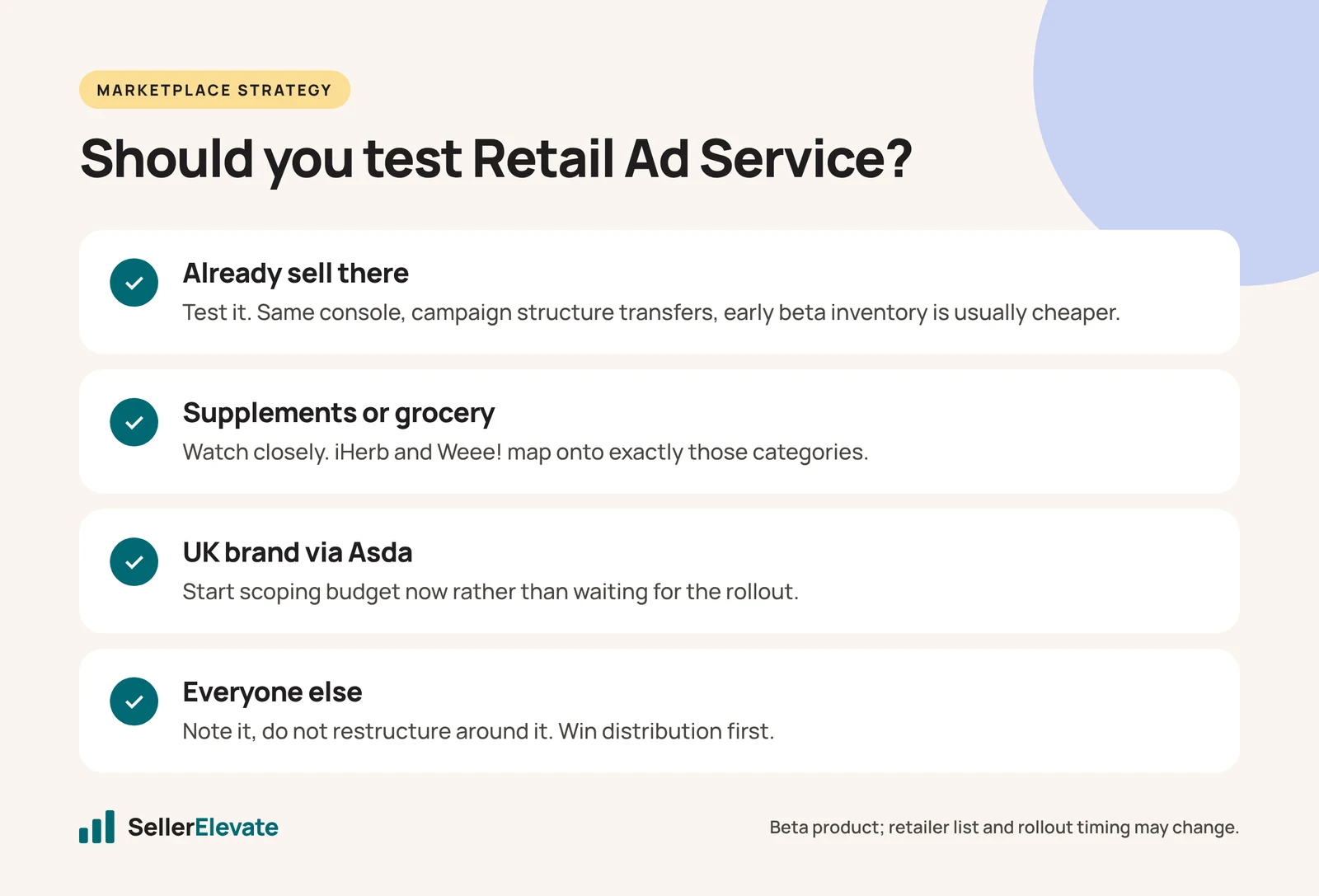
If you already sell on one of the participating retailers, test it. The reporting sits in a console your team already knows, the campaign structure transfers, and being early in a beta with a small advertiser pool usually means cheaper inventory than the same placement will cost in two years.
If you sell supplements or grocery, watch it particularly closely. iHerb and Weee! map onto exactly those categories, and they are two of the four live retailers. A supplements brand already listed on iHerb has an unusually clean opportunity here.
If you are a UK brand selling through Asda, start scoping budget rather than waiting. Once the rollout is live, the unified reporting is the reason to prioritise that inventory over a generic retail media buy.
Everyone else: note it, do not restructure around it. Four US retailers and one announced UK grocer is not a channel yet. It is a signal about where retail media is heading.
What we would do about it now
Get your Amazon account in a state where this is easy to switch on if a retailer you sell through appears. That means campaign structure you can replicate, keyword research that is not Amazon-specific, and creative that works outside an Amazon detail page.
And treat the distribution question as the real one. If iHerb or Weee! matter to your category, the useful project is getting listed and performing there — the advertising follows. Building an ad strategy for inventory you are not eligible to buy is planning for someone else’s business.
We watch platform changes like this so clients do not have to decide whether each one matters. Most do not. This one is small today and worth understanding, which is a different thing from worth acting on.
Frequently asked questions
Can I advertise on iHerb or Weee! through Amazon Ads if I don't sell there?
No. Your products are only eligible on a retailer where they are already available for checkout. If you are not listed on iHerb, that inventory is not available to you regardless of how much you spend on Amazon. The honest sequence is to win the distribution first, and then the ad inventory becomes available.
Which retailers use Amazon Retail Ad Service?
The US beta launched with four retailers spread across categories: iHerb in health and wellness, Oriental Trading in party and craft supplies, Weee! in Asian grocery, and Tilly's in surf and skate fashion. Asda in the UK was announced as the first deployment outside the US, on a phased rollout from Q4 2026.
How do you run ads through Amazon Retail Ad Service?
Operationally nothing changes. Available retailers appear in your Amazon Ads console or through the API, under a beta option to advertise products across retailers. You create and manage campaigns in the same workflow, with reporting in the same place. The shopper sees your product on the retailer's site, clicks, and buys it there rather than on Amazon.
Is Amazon Retail Ad Service worth testing?
For most brands right now, no, because the eligibility rule means most brands cannot use it. If you already sell on a participating retailer, test it, since early beta inventory is usually cheaper. Supplements and grocery brands should watch closely, UK brands selling through Asda should start scoping budget, and everyone else should simply note it.
Get the honest version of your numbers
A free account audit from the person who would actually run your account.