Can I still create a new ASIN for a brand I don't own on Amazon?
Only with the brand's permission if the brand is in Brand Registry. Since June 1, 2026, creating ASINs for enrolled brands requires a Reseller role assigned by the brand's Brand Administrator. Flagged sellers get 30 days to provide a letter of authorization or invoices from the brand or an authorized distributor, or remove the listings.
Key takeaways
- Since June 1, 2026, creating a new ASIN for a Brand Registry brand requires a Reseller role assigned by that brand's Brand Administrator.
- Sellers who receive notices get 30 days to provide a letter of authorization or invoices, and sources report non-compliance can lead to suspension of the whole account.
- Since July 29, 2026, brands assign roles using Account IDs instead of Merchant Tokens.
- Sources disagree on whether the June 1 wording targets vendors or third-party sellers, so assume it applies to both.
- Brands can use the Reseller role to stop new unauthorized ASINs, but it does not remove sellers from existing listings on its own.
Not without the brand’s permission, if the brand is enrolled in Brand Registry. Since June 1, 2026, creating a new ASIN for a Brand Registry brand requires a Reseller role assigned through Brand Registry, and sellers flagged without one are being asked for a letter of authorization or invoices from the brand or an authorized distributor.
For brands, this is the most useful catalog-control tool Amazon has handed over in years. For resellers and wholesalers, it means the relationship with the brand now has to exist on paper and inside Amazon’s systems, not just in your purchase history.
What exactly is the new ASIN creation rule?
The core of it, as reported by EcomCrew and Canopy Management: an account must hold a formally assigned Reseller role in Brand Registry before it can create new ASINs for any brand enrolled in the program. The Brand Administrator assigns that role. It is separate from the Brand Representative role, which is for the brand’s own internal accounts and staff.
There is one inconsistency you should know about. EcomCrew and Canopy describe the June 1 wording as applying to vendors in the US store, meaning first-party suppliers. Amazon Sellers Lawyer describes it as applying to third-party sellers on Amazon.com, and a later EcomCrew article says resellers must hold the role. We could not open Amazon’s own policy page to settle it. In practice, third-party sellers have been receiving deactivation notices since May, so we would assume the rule applies to you whichever account type you use. Confirm in Seller Central or Vendor Central before acting.
Key facts as of October 2026:
| Item | What the sources report |
|---|---|
| Effective date | June 1, 2026 |
| Who it affects | Accounts creating ASINs for Brand Registry brands without an assigned Reseller role |
| Who assigns the role | The brand’s Brand Administrator |
| Evidence asked for on notices | Letter of authorization from the brand, or invoices from the brand or an authorized distributor |
| Notice period | 30 days to fix or remove |
| Worst case | Suspension of the whole account, not just the listings (Amazon Sellers Lawyer, Canopy) |
| Since July 29, 2026 | Roles are assigned using Account IDs instead of Merchant Tokens |
None of the sources say how many invoices you need or how recent they must be.
Does it affect ASINs that already exist?
It can. EcomCrew reports sellers receiving deactivation notices for ASINs that had existed for years. NovaData traced the first notices to May 5, 2026, with the main triggers being branded products listed as “generic” to get around Brand Registry, duplicate ASINs, and variation families stuffed with unrelated products. It also reported home, beauty and grocery as the first categories hit.
If one of your ASINs is deactivated and you have FBA stock on it, EcomCrew’s advice is to create a removal order so the inventory is not disposed of.
Enforcement has not been consistent. One seller on the Seller Forums described sending the same letter of authorization and invoices for 30 listings of one brand: 21 were reinstated and 11 rejected. If you are rejected with documents you know are valid, resubmit rather than assume the answer is final.
I'm a reseller. What should I ask the brand for?
Ask for the role, not just the letter. A letter of authorization helps you answer a notice. The Reseller role is what lets you create listings in the first place.
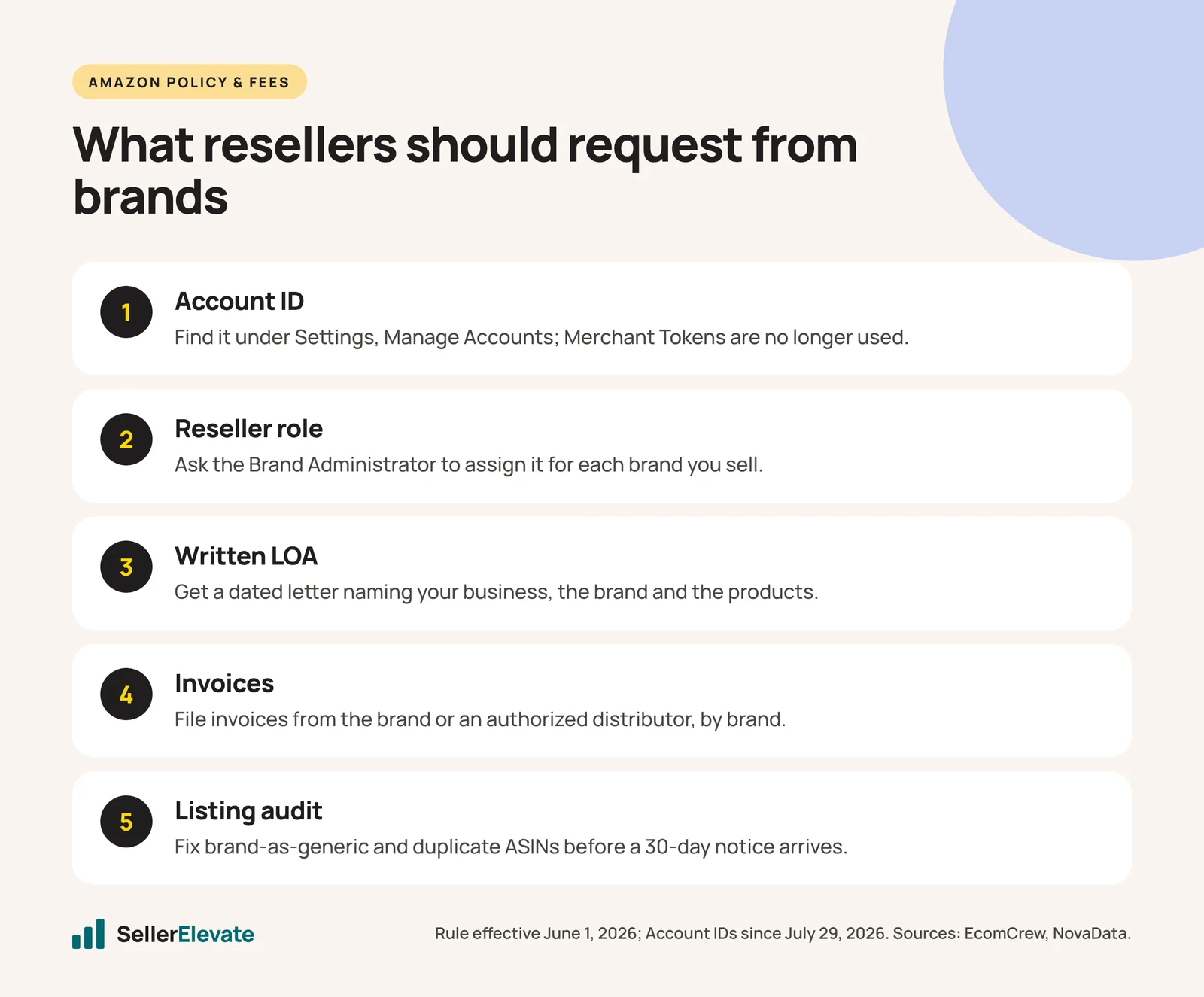
- Find your Account ID. Since July 29, 2026, brands assign roles by Account ID, a single worldwide identifier. EcomCrew gives the path as the gear icon, then Settings, then Manage Accounts. Do not send your old Merchant Token.
- Ask the brand’s Amazon contact to assign you the Reseller role in Brand Registry for the specific brand names you sell.
- Get a signed letter of authorization anyway. It should name your business, the brand and the products or scope, and be dated.
- Keep supplier invoices organized by brand. Invoices must come from the brand or an authorized distributor. Keep the distributor’s own authorization if you can get it.
- Audit the ASINs you created. Any listing you created for a Brand Registry brand without a role is a candidate for a notice. Fix it before Amazon asks, or move to selling on the brand’s own ASIN.
- Check for brand-as-generic listings. If you ever listed a branded item as “Generic” or with a missing brand, change it or remove it. NovaData reports this was the top trigger.
If the brand will not assign the role, that tells you something about the long-term future of that product line for you on Amazon.
I'm a brand owner. How do I use this to clean up my catalog?
This is where the rule earns its keep. You now decide who can create listings under your brand.
| Step | What to do | Why |
|---|---|---|
| 1. Map | List every ASIN under your brand and every seller on each | You cannot control what you have not found |
| 2. Decide | Split sellers into authorized partners and everyone else | The role should follow your distribution agreements |
| 3. Assign | Give Reseller roles only to authorized partners, by Account ID | Stops new unauthorized ASINs at the source |
| 4. Consolidate | Report duplicate and brand-as-generic ASINs | Concentrates reviews and sales on your listings |
| 5. Fix contracts | Close the wholesale leak that supplies unauthorized sellers | Enforcement without this keeps repeating |
Two cautions. First, the role controls ASIN creation. It does not, by itself, stop someone selling against an existing ASIN, so you still need distribution control and, where there is a real violation, our listing hijacker removal process. Second, do not assign roles to anyone you would not want editing your catalog. We made the wider case in someone is already selling your brand on Amazon: most unauthorized sellers are supplied by an authorized partner upstream, so start with the contract.
If you are not yet in Brand Registry, none of this protection applies to you. That makes trademark registration the first step.
What about bundles and private-label sellers?
We have not seen any source address bundles specifically, so treat this as our reading rather than a rule. A bundle that contains another company’s branded product still involves that brand. If the brand is in Brand Registry, expect the same scrutiny, and expect “Generic” or your own brand name on a bundle of someone else’s goods to look like the brand-as-generic pattern NovaData describes. Before creating new bundles, ask the brands involved for a Reseller role or written permission.
Private-label sellers with their own Brand Registry are not affected for their own brand. Canopy notes own-brand sellers enrolled with the default Brand Representative role are not the target. The rule only becomes relevant to you if you also resell other brands.
How does this fit with the other 2026 changes?
It is one piece of a pattern. Amazon is shifting control of listings toward brand owners and toward its own systems at the same time. The Featured Offer eligibility gate removal brings more sellers into the Buy Box race, which makes controlling who can list your brand more valuable. The 75-character title limit and AI rewrites mean the brand owner, with the 14-day review, gets the say on content. And List Price validation ties reference prices to Featured Offer sales, so an unauthorized seller undercutting you can affect your strikethrough.
What we'd do this week
Brands: export your brand’s ASIN list, find every seller on it, assign Reseller roles to authorized partners using Account IDs, and report duplicates.
Resellers: send each brand your Account ID with a written request for the Reseller role, file your invoices by brand, and fix any brand-as-generic listings before a notice arrives.
Both: check Account Health for ASIN creation policy warnings now. A 30-day notice that lands in mid-November leaves no room before Black Friday.
Frequently asked questions
What is the difference between the Reseller role and the Brand Representative role?
The Brand Representative role is for a brand's own internal accounts and employees. The Reseller role is for external sellers with a legitimate selling agreement, such as distributors and authorized retailers. Both are assigned by the Brand Administrator in Brand Registry, and since June 1, 2026 the Reseller role is what allows an outside account to create ASINs for the brand.
How do I find my Amazon Account ID for a Reseller role request?
EcomCrew gives the path in Seller Central as the gear icon, then Settings, then Manage Accounts. Since July 29, 2026, brands assign selling roles by Account ID, a single worldwide identifier, rather than by the Merchant Token used before. Send the brand your Account ID with your request.
What happens to my FBA inventory if an ASIN is deactivated?
Create a removal order. EcomCrew advises sellers with FBA stock on deactivated ASINs to arrange removal so the inventory is not disposed of. Do this early in the 30-day notice period, especially in Q4, when removal processing and carrier capacity can be slower than usual.
Can I appeal if my letter of authorization was rejected?
Yes, and it is often worth it. One seller on the Seller Forums reported sending the same documents for 30 listings of one brand, with 21 reinstated and 11 rejected. That suggests outcomes vary by reviewer. Resubmit clear, dated documents that name the brand and products.
Sources
- EcomCrew: Amazon tightens ASIN creation rules, the June 2026 policy update (May 29, 2026)
- Canopy Management: Amazon ASIN creation, Brand Registry and vendor policy 2026 (June 30, 2026)
- Amazon Sellers Lawyer: Amazon ASIN creation policy changes (June 3, 2026)
- EcomCrew: Amazon replaces Merchant Tokens with Account IDs for Brand Registry selling roles (August 7, 2026)
- NovaData: Amazon ASIN creation policy crackdown (May 22, 2026)
- Amazon Seller Forums: ASIN creation crackdown thread (2026)
Get the honest version of your numbers
A free account audit from the person who would actually run your account.