Can I still sell my Amazon account or use revenue-based financing?
Not in the old way. Since August 24, 2026, Amazon's seller agreement bars transferring your rights or obligations under it and pledging them, including future disbursements, as collateral. Business sales reportedly need Amazon's review, and financing secured on Amazon payouts now conflicts with the agreement. Amazon's own lending is reported as unaffected.
Key takeaways
- Amazon's updated Business Solutions Agreement took effect on August 24, 2026.
- The new wording covers transferring rights or obligations under the agreement and separately bans pledging them, including future disbursements.
- Genuine ownership changes reportedly need a Seller Central case and documents, with one source estimating 2 to 4 weeks.
- Revenue-based financing, merchant cash advances and lender sweeps over Amazon payouts are the most exposed arrangements.
- Sources disagree on existing loans and on merger carve-outs, so review your agreements with a lawyer.
Since August 24, 2026, Amazon’s Business Solutions Agreement says you may not transfer your rights or obligations under the agreement, and may not pledge them, including your future Amazon disbursements, as collateral. In practice, you can no longer simply sell a seller account to someone else, and financing that takes your Amazon payouts as security now conflicts with the contract you signed to sell on Amazon.
You can still sell a business, and you can still borrow. But the structure of both has to change, and if you already have a revenue-based loan or a sale in progress, you should look at it now rather than after Amazon notices. Everything here reflects reporting as of October 2026. We are an Amazon agency, not a law firm; review your own agreements with a lawyer who knows Amazon deals.
What exactly changed in the seller agreement?
Trade press first reported the update in late May, and it took effect on August 24, 2026. We could not read the updated agreement text directly (Seller Central requires a login), so here is how the trade press reports it:
- EcomCrew’s first report in May summarized it as: “sellers can no longer transfer or pledge their rights to receive sales revenue from Amazon to third parties.”
- AMZ Prep’s August roundup describes the updated BSA as prohibiting “transferring rights or obligations under the agreement and pledging those rights, including future Amazon disbursements, as collateral.”
- EcomCrew’s August follow-up points out the important shift in wording: the ban now covers a transfer of your rights or obligations under the agreement, not just the agreement as a document, and it names pledging separately for the first time.
That last point is the one that matters. Older language could be read as stopping you from handing the contract to someone else. The new language reaches the money: the right to receive disbursements.
Can I still sell my Amazon business?
Yes, but not by handing over a login. Selling the account itself, meaning the seller account and its rights moved to a new owner, is what the agreement now blocks without Amazon’s involvement.
Reports describe a formal route for genuine ownership changes. SellerSprite’s guide says acquisitions are permitted when they are documented and approved through Amazon’s review, and estimates 2 to 4 weeks for processing. My Amazon Guy and EcomCrew both describe the same basic process: open a Seller Central case and submit documents such as business licenses and change certificates.
The sources do not agree on everything. EcomCrew’s August piece says it found no change-of-control or merger carve-out in the amendment itself. SellerSprite describes legitimate M&A as allowed with Amazon’s review. Our read: assume you need Amazon’s sign-off for any change in who owns or operates the account, and do not close a deal until you have it.
Here is how common deal structures look under the new terms, based on the reporting:
| Structure | Risk under the August 24 terms | Notes |
|---|---|---|
| Selling login access to the account to a new owner | High | This is what the change targets. Mismatches between registered and actual operators can trigger suspension or held funds. |
| Sale of the company that owns the account, with Amazon notified and approved | Lower | Open the case before closing. Expect documents and time. |
| Asset sale: brand, trademark and inventory move; buyer opens or uses its own account | Lower | The seller account itself does not transfer. Plan the listing and Brand Registry handover. |
| Aggregator buying many accounts | High unless each goes through Amazon’s process | Each account is its own approval. |
Can I still use revenue-based financing?
This is where most brands are exposed, often without realizing it.
According to EcomCrew’s August report, the types of financing affected include revenue-based financing facilities, merchant cash advances, credit lines with a security interest in Amazon disbursements, and arrangements that automatically sweep settlement proceeds to a lender. My Amazon Guy lists the same categories.
What still appears to be fine:
- Amazon’s own lending. SellerSprite reports that Amazon Lending and Amazon’s business credit line operate inside Amazon’s system and are unaffected.
- Financing that does not pledge Amazon-specific revenue. My Amazon Guy notes that traditional financing that does not take Amazon payouts as collateral is not the target.
What is unclear is existing loans. EcomCrew’s August piece warns that sellers with current facilities may face suspension or fund holds, and also notes that UCC Article 9 provisions may preserve a lender’s security interest regardless of the contract language. My Amazon Guy says the change does not automatically prohibit existing loans, but sellers need to check whether their structure conflicts. That disagreement is exactly why this needs a lawyer, not a blog post.
The practical risk for a brand is not legal theory. It is what Amazon does when it sees it. Section 3 of the agreement is the suspension and termination section, and held disbursements are one of the most painful things that can happen to a brand in Q4. Our post on suspensions and video identity checks covers how quickly holds happen and how to respond.
Who is most affected?
Brands planning an exit in the next 12 months. Valuations and timelines both depend on the account carrying over cleanly. A buyer’s lawyer will now ask how the account transfers, and “we hand over the password” is no longer an answer.
Brands with revenue-based loans or cash advances. If your lender takes a cut of every disbursement or holds a security interest in your Amazon payouts, the structure needs review.
Aggregators. SellerSprite estimates about five major aggregators remain active and deal volume at around 10% to 20% of the 2021 pace. Those are its estimates, but the direction is clear: a business model built on buying accounts just got more paperwork per deal.
Anyone running an account they do not legally own. Partnership setups where one person’s company holds the account and another person runs it should be documented properly. My Amazon Guy flags operator mismatches as a suspension trigger.
What we'd do this month
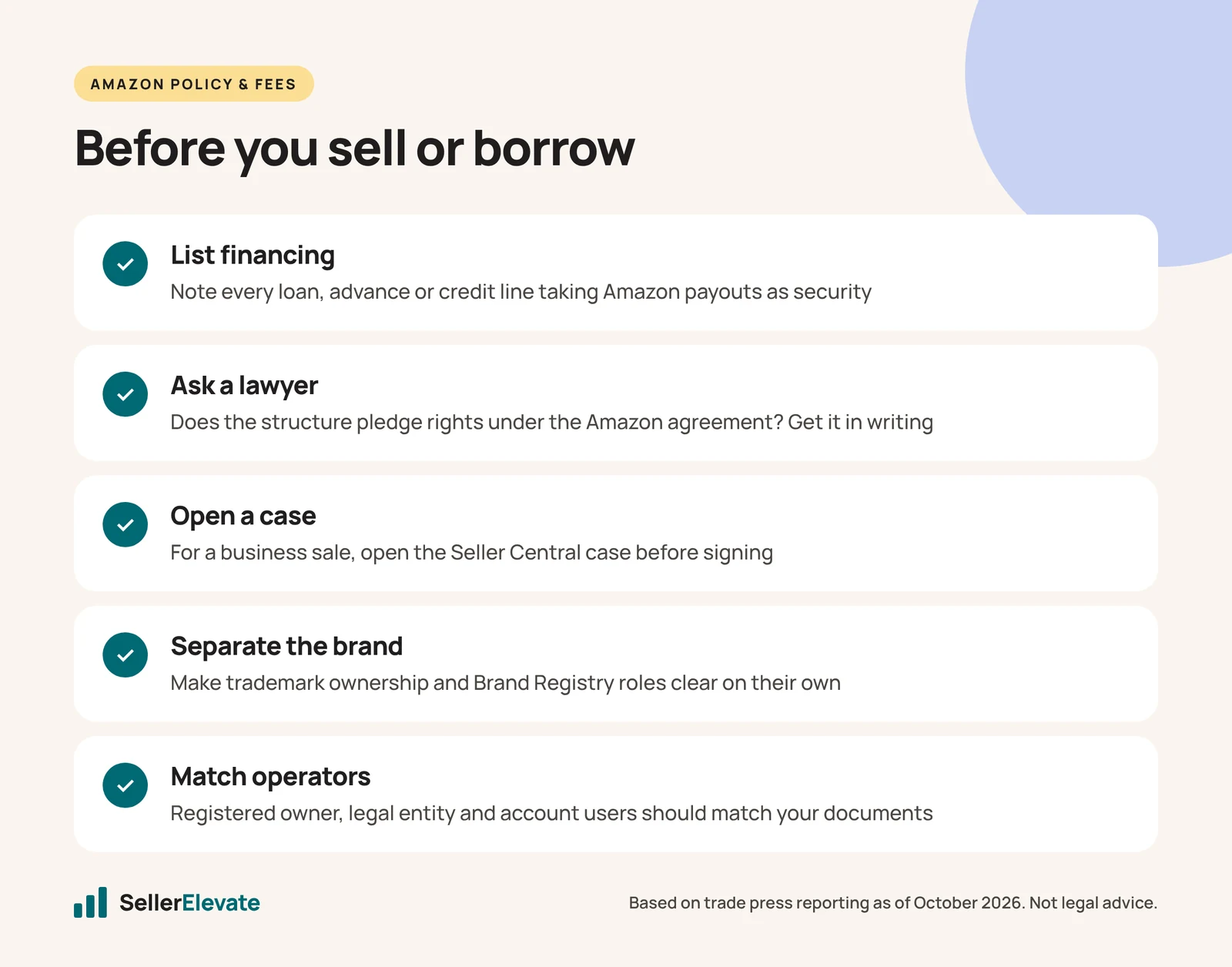
- List every financing arrangement. Loans, cash advances, credit lines and any lender that receives payments directly from Amazon disbursements. Note which ones take Amazon payouts as security.
- Send that list to your lawyer. Ask one question: does this structure pledge rights under the Amazon agreement? Get the answer in writing.
- Ask lenders about restructuring. Ask whether they offer a version that does not take Amazon disbursements as collateral.
- If you are selling, open the Seller Central case first. Before signing, not after. Prepare the purchase agreement, new registration documents, change certificates and proof of ownership.
- Separate the brand from the account in your deal plan. Make sure trademark ownership and Brand Registry roles are clear and transferable on their own. If the mark is held by a founder personally or an old entity, fix that before a buyer finds it; our trademark registration team can help.
- Check who operates the account. The registered owner, the legal entity and the people logging in should line up with your documentation.
- Keep account health clean during any review. A deal in review is not the time for a policy warning. Our account audit looks for the issues that tend to surface under scrutiny.
What this means if you are not selling or borrowing
Nothing changes in your daily operations. But it is a reminder of a point we make often: your Amazon account is not an asset you fully control. It is a contract that Amazon can change with notice. The more of your business value depends on that one account, the more you should know about how its terms are moving. Other 2026 changes, from the end of commingling to new FBM delivery rules, point the same way: Amazon wants to know exactly who is selling, who is shipping and who gets paid.
Frequently asked questions
Does the ban affect Amazon Lending?
Reportedly not. SellerSprite says Amazon Lending and Amazon's business credit line operate inside Amazon's own system and are unaffected. My Amazon Guy also notes that traditional financing that does not take Amazon payouts as collateral is not the target. Confirm with your lender and lawyer before relying on either.
Is buying an Amazon seller account still allowed?
Buying login access to an existing account is what the change targets. Reports say a genuine acquisition can go through Amazon's review if you open a Seller Central case and submit documents such as business licenses and change certificates. Do not close a deal before Amazon has approved the change.
What happens if I keep a loan secured on my Amazon payouts?
Sources disagree. EcomCrew warns of possible suspension or fund holds and notes UCC Article 9 may still preserve a lender's security interest. My Amazon Guy says existing loans are not automatically prohibited but may conflict. Because the outcome depends on your loan's structure, ask a lawyer for a written opinion.
Is an asset sale safer than selling the account?
It carries lower risk under the new terms, because the seller account itself does not move. The brand, trademark and inventory transfer, and the buyer sells through its own account. You still need to plan the Brand Registry and listing handover so the buyer can manage the catalog.
Sources
- EcomCrew: Amazon updates seller agreement to block account transfers and revenue pledging (May 28, 2026)
- EcomCrew: Amazon’s new contract terms target seller financing deals (Aug 16, 2026)
- SellerSprite: Amazon freezes revenue assignment, what the August 24 BSA change means (Aug 2, 2026)
- My Amazon Guy: Amazon revenue pledging faces new restrictions (Aug 14, 2026)
- AMZ Prep: Amazon August 2026 updates (Sep 4, 2026)
Get the honest version of your numbers
A free account audit from the person who would actually run your account.