Do I need FNSKU labels on my FBA inventory now that commingling has ended?
If you are a reseller, yes. Since March 31, 2026, every unit you send to FBA needs an FNSKU label, and unlabeled units are treated as defective. Brand owners with the Brand Representative role in Brand Registry can keep shipping on valid manufacturer barcodes, and Amazon tracks those units to them.
Key takeaways
- Amazon ended FBA commingling in the US on March 31, 2026.
- Only brand owners with the Brand Representative role and valid GTINs can ship on manufacturer barcodes; everyone else labels every unit.
- Authorized resellers are not exempt, because the exemption follows the Brand Representative role, not a distribution agreement.
- Unlabeled units are treated as defective, and Amazon ended its US prep and labeling service on January 1, 2026.
- For brands, the change makes it easier to trace bad units to the seller who sent them.
If you are a reseller, yes: every unit you send to FBA now needs an FNSKU label, and units that arrive without one are treated as defective. If you are the brand owner with the Brand Representative role in Brand Registry, you can keep shipping on your manufacturer barcode, and Amazon tracks your units as yours.
Amazon ended FBA commingling on March 31, 2026. Six months later we still see wholesale and online arbitrage sellers getting caught by it, and we still see brands that have not noticed how much it helps them. This post covers both sides, as of October 2026. Check the current labeling requirements in Seller Central before your next shipment.
What did commingling mean, and what changed on March 31?
Commingling was Amazon’s practice of pooling identical products from different sellers. In Amazon’s own words, quoted by PPC Land: “Commingling is when we fulfill customer orders using exact product matches from the closest available inventory.” If five sellers sent in the same UPC with no Amazon sticker, a customer could receive any of their units, whichever was closest.
That was fast for Amazon and cheap for sellers. It was also how one seller’s counterfeit or damaged unit ended up in another seller’s customer’s hands, with the complaint and the account health hit landing on whoever’s offer the customer bought.
From March 31, 2026, in the US:
| Seller type | What you can ship to FBA (as of October 2026) |
|---|---|
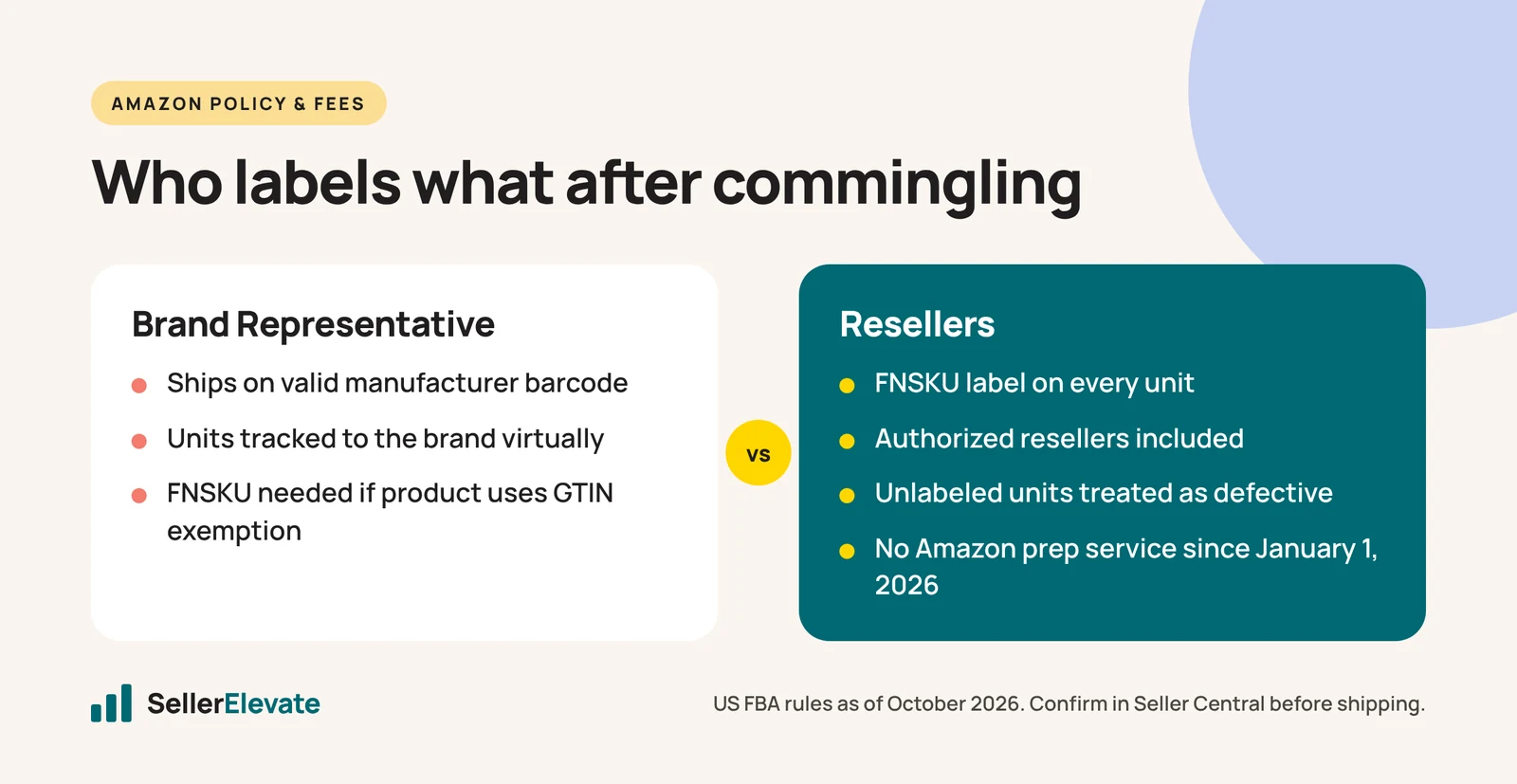
| Brand owner with Brand Representative role in Brand Registry, product has a valid GTIN (UPC, EAN, ISBN, JAN) | Manufacturer barcode, no FNSKU sticker needed. Amazon tracks units to you virtually. |
| Brand owner whose product has no manufacturer barcode, or uses a GTIN exemption | FNSKU label on every unit |
| Authorized reseller or distributor without the Brand Representative role | FNSKU label on every unit |
| Wholesale, online arbitrage and retail arbitrage sellers | FNSKU label on every unit |
Two details trip people up. Being an “authorized” reseller does not exempt you; the exemption follows the Brand Representative role, not the paperwork with the brand. And according to PPC Land, the change applies to the US marketplace and fulfillment network.
What happens if units arrive without FNSKU labels?
They are classified as defective. PPC Land reports that non-compliant units are also ineligible for Amazon reimbursement. Beancount’s July guide puts the practical result as “delayed sales eligibility and likely additional fees to fix it.”
You also cannot pay Amazon to fix it at the dock. Amazon ended its FBA prep and labeling services in the US on January 1, 2026, which covered everything from polybags to FNSKU labeling. Labels have to be on before the box leaves you or your prep center.
The cost of doing it properly is small per unit. Beancount estimates $0.20 to $0.50 per unit for reseller labeling. On a $25 wholesale item with a few dollars of margin, that is real but manageable. On a $9 item with $1.50 of margin, it can be the difference between a product worth stocking and one that is not.
Why is this quietly good news for brands?
Most coverage treats this as a reseller headache. For brand owners, it is one of the more useful changes Amazon has made in years, for three reasons.
Bad units now trace back to the seller who sent them. Under commingling, a counterfeit unit from an anonymous reseller could ship against your offer and earn you an “inauthentic” complaint. With every reseller unit carrying its own FNSKU, Amazon can tie a defective or fake unit to the account that sent it. Your units, tracked under your manufacturer barcode, stay yours.
Resellers now carry a cost you do not. Labeling, plus the prep that Amazon no longer does, adds cost and work to every reseller unit. Brand Representatives skip the stickers. On thin-margin listings, that can thin out the number of resellers willing to stay on your listings. We would not promise it clears your listing of unauthorized sellers, but it shifts the economics in your favor.
Your own data gets cleaner. If you have been fighting inauthentic complaints you could not explain, you now have a cleaner way to separate your inventory from everyone else’s. If complaints continue, that is a signal worth investigating with the tools in our listing hijacker removal work, not a mystery you have to live with.
There is a catch. The manufacturer barcode exemption only works if you actually hold the Brand Representative role. Plenty of brands registered years ago through an agency or a former employee and are not sure who holds what role today. Check it.
What should brands check this month?
Here is the short list we run with brand clients:
- Confirm your Brand Registry role. In Brand Registry, confirm that the selling account shipping your FBA inventory holds the Brand Representative role. If it does not, your units need FNSKU labels too.
- Confirm every SKU has a valid manufacturer barcode. Products listed under a GTIN exemption need FNSKU labels even for brand owners. Make a list of any SKU that falls into this group.
- Check your inbound settings. Make sure SKUs set to ship on manufacturer barcodes are the ones that qualify, and that FNSKU-labeled SKUs are labeled at the factory or prep center, not “later.”
- Brief your prep center or 3PL. If they previously relied on Amazon’s prep and labeling service, they need to apply labels themselves now. Ask them to confirm in writing.
- Review inauthentic or condition complaints since March 31. Sort them by date. If they dropped after commingling ended, you have your answer about where they came from. If they did not, look at which other sellers are on your listings.
- List who else sells your ASINs. Every reseller now ships on their own FNSKU. Note who they are; it is useful context for pricing, MAP enforcement and any distribution cleanup. Our post on who can create ASINs for your brand covers the related listing-control rules.
What should resellers check before the next shipment?
If you resell, the job is mainly process:
- Label every unit, every shipment. No exceptions for “known good” brands or authorized lines.
- Print to spec. My Amazon Guy notes that Amazon barcodes need black ink on white, non-reflective label stock with removable adhesive, and warns that labels on glossy film, curved bottles or scuff-prone surfaces may fail scanning.
- Price the label into your buy cost. Use the $0.20 to $0.50 range as a starting point and replace it with your real cost. Recheck any SKU where the margin is already thin.
- Track cost per lot. Beancount points out that the change pushes sellers toward lot-level costing, because units are no longer pooled. Your accounting should know what each lot cost you, labels included.
- Plan for no Amazon prep. If a product also needs polybagging or other prep, that has to happen before it ships. The same rule applies to inventory moving from AWD into FBA; see whether AWD is still worth it in 2026.
What we'd do this week
For a brand: spend 20 minutes confirming your Brand Registry role and your barcode list, then pull your inauthentic complaints from the last year and compare before and after March 31. If something looks off, we cover role and listing control as part of our account audit.
For a reseller: label every unit, print on the right stock, and recalculate margin on your lowest-margin lines with labeling included. Defective units are expensive, and with Amazon’s prep service gone there is no one at the other end to fix them for you.
Frequently asked questions
How much does FNSKU labeling cost per unit?
Beancount estimates $0.20 to $0.50 per unit for reseller labeling. Your real cost depends on whether you label in-house or use a prep center, and on volume. On low-priced, thin-margin items that range can decide whether a product is still worth stocking, so recalculate margin with labeling included.
Can Amazon still label my units for me?
No. Amazon discontinued FBA prep and labeling services in the US on January 1, 2026, covering items from polybags to FNSKU labels. Labels have to be applied before inventory ships, by you, your supplier or a prep center. Units that arrive without required labels are treated as defective.
Does the commingling change apply outside the US?
According to PPC Land's March 2026 report, the change applies to the US marketplace and fulfillment network. If you sell in other Amazon marketplaces, check the labeling rules in that marketplace's Seller Central before shipping, because the requirements and timelines may differ.
I am an authorized distributor. Do I still need FNSKU labels?
Yes, unless your account holds the Brand Representative role in Brand Registry for that brand. Reports are clear that authorized resellers must label every unit sent to FBA after March 31, 2026. A distribution agreement with the brand does not create the exemption on its own.
Sources
- PPC Land: Amazon ends FBA commingling on March 31, what really changes for sellers (Mar 24, 2026)
- Beancount: Amazon ending stickerless commingled inventory, FBA sellers guide (Jul 28, 2026)
- My Amazon Guy: Amazon FNSKU barcodes required for resellers (Feb 6, 2026, updated Sep 11, 2026)
- AMZ Prep: Amazon January 2026 updates (updated Sep 25, 2026)
Get the honest version of your numbers
A free account audit from the person who would actually run your account.