What should I do when TikTok Shop creators don't post after receiving samples?
Follow up on a fixed schedule after delivery, at roughly day 5 to 7, day 14 and day 21 to 30. Block further samples to creators who have not posted from earlier ones. Approve new requests against clear criteria, and track posting rate and cost per posting creator for every cohort.
Key takeaways
- Non-posting after samples is the biggest leak in most TikTok Shop sampling programs.
- Follow up two or three times after delivery, across DM and email, with useful talking points rather than pressure.
- Do not send a second sample to a creator who has not posted for the first.
- Track posting rate, cost per posting creator and revenue per sample for each cohort.
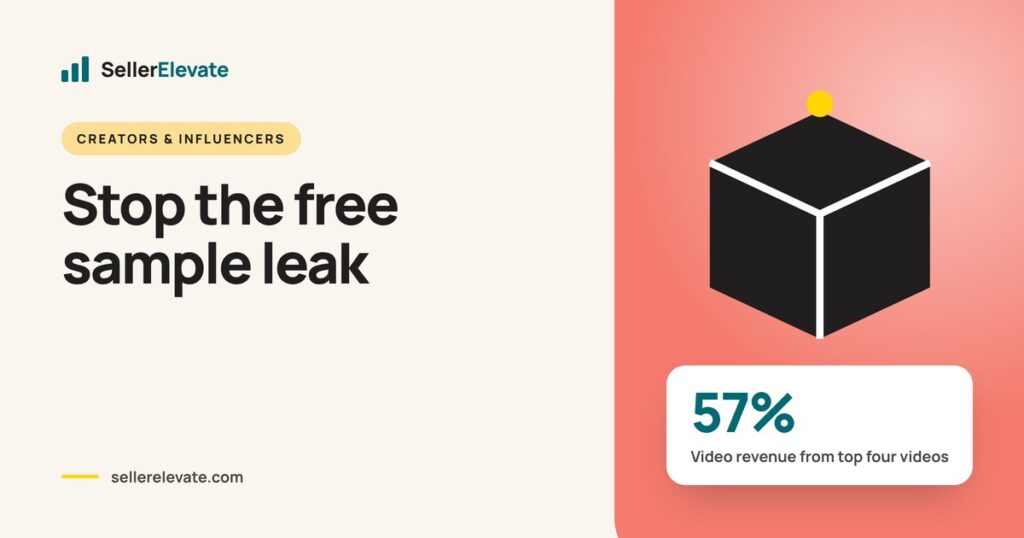
- A few creators drive most results; one client's top four videos drove about 57% of video revenue.
When a creator takes your TikTok Shop sample and never posts, you usually cannot get the product back, but you can stop it happening again. Follow up on a fixed schedule after delivery, stop sending to creators who have not posted from previous samples, and approve new samples against clear criteria instead of saying yes to every request.
Hubfluence puts it bluntly: “A creator can accept your sample, receive the product, and never post, and that is the single biggest leak in most sampling programs.” Most brands put their effort into getting acceptances and then go quiet. Here is the follow-up cadence, approval rules and tracking we would use.
Why do creators take samples and not post?
From the creator’s side, the reasons are mostly ordinary:
- They requested too many samples. A busy creator might have dozens of products waiting, and yours is not at the top.
- The product did not fit their content once they held it. It looked better on the product page than in their hands.
- The commission is not worth a video. If a competitor pays more for the same type of content, that video gets made first.
- Nobody reminded them. Hubfluence’s point about acceptances applies after delivery too: creators are busy, things get buried, and they meant to come back and did not.
- Some are collecting free products. A minority request samples with no intention of posting. These are the ones your approval rules should screen out.
The first four are fixable with better selection and follow-up. The fifth needs a filter.
How should you follow up after the sample arrives?
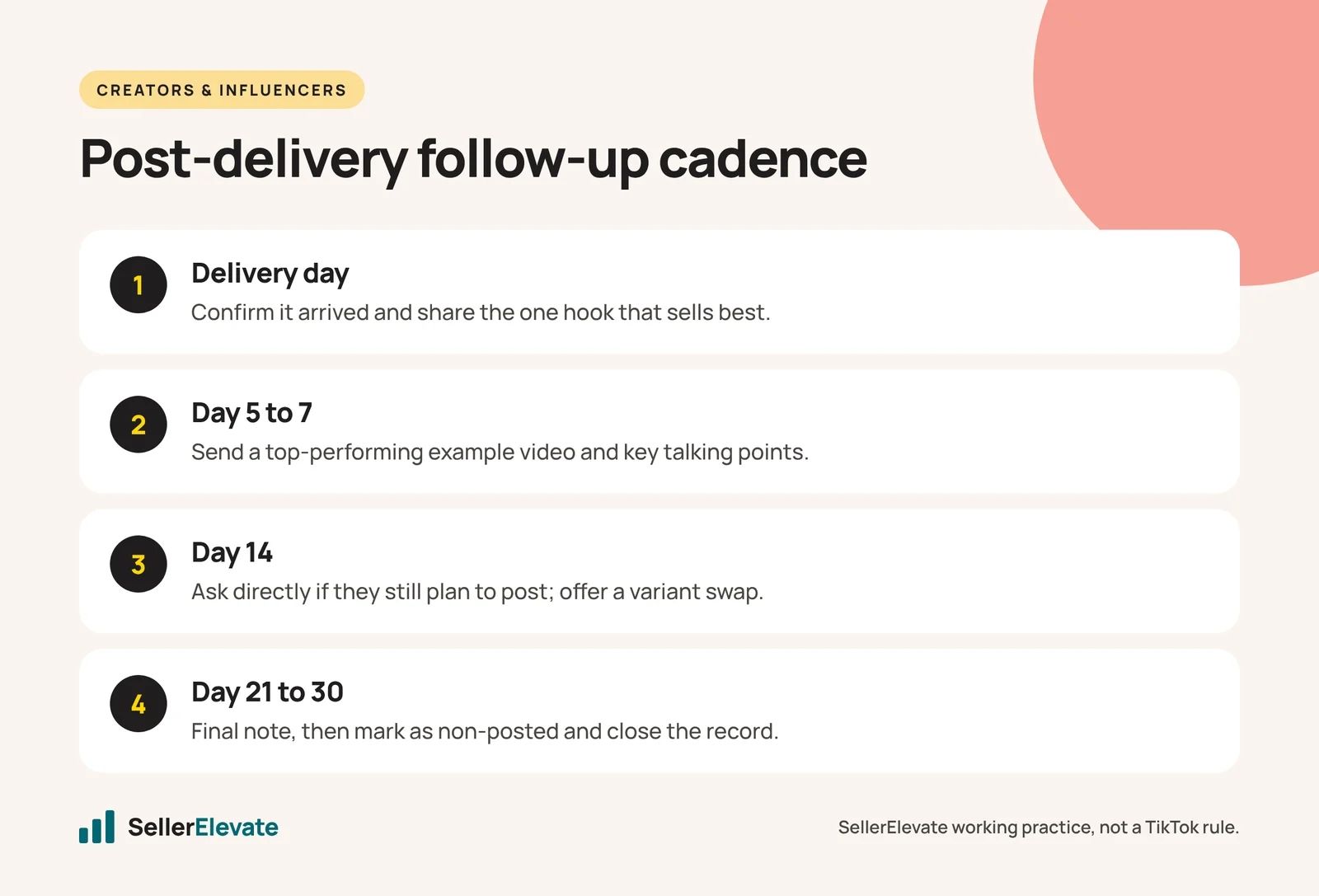
Most brands send no follow-up after shipping. Hubfluence recommends following up two or three times and spacing touches across DM and email. We apply the same rule after delivery, on a fixed schedule:
| When | Message | Goal |
|---|---|---|
| Day of delivery | Short check that it arrived, plus the one-line hook that sells best | Get the product opened |
| Day 5 to 7 after delivery | Share a top-performing video from another creator and the key talking points | Make the video easy to make |
| Day 14 | Ask directly if they still plan to post, and offer to swap the product variant if it did not fit | Get a yes, a no, or a reason |
| Day 21 to 30 | Final note; if no answer, mark as non-posted and close | Free up your attention |
A template for the day 5 to 7 message:
Hi [name], hope the [product] arrived in good shape.

In case it helps, here's what's been converting for other creators:

- Hook: [first line that works]

- Show: [the moment or feature that sells it]

- Mention: [offer, commission rate, any current promo]

Here's one example: [link]

Any questions about the product, just reply here.
Keep it short and useful. The aim is to remove the work of figuring out what to say, not to pressure.
The schedule above is our working practice, not a TikTok rule. Racklify’s guidance to creators uses a similar rhythm in reverse, suggesting they follow up with brands if they do not hear back in 7 to 10 business days.
Which creators should get samples in the first place?
Approval criteria do more than follow-up. Before approving a sample request, check:
- Have they posted for any previous sample from you? If not, no second sample until they post the first.
- Recent shoppable videos. Look at their last ten or so posts. Are they making product videos with shop links, or just requesting samples?
- Category fit. Do they already post about products like yours, to an audience that buys them?
- Sales history on TikTok Shop. Check what their profile in your affiliate tools shows about past GMV and products sold.
- Content quality. Would you be happy running their video as an ad?
Approve automatically only for creators who have already posted for you. Everyone else gets a manual check. We go deeper on this in our post on vetting TikTok Shop affiliates before sending samples.
How many samples should you send?
Fewer than most brands think, but more than one or two per month. Two published views:
- Amplisell estimates brands at $0 to $12.5K a month in GMV send about 30 free samples per month, generating about 180 pieces of creator content, and that larger brands send far more. It also notes the 80/20 rule: many creators post once or not at all.
- KOL Sprite argues “ten well-defined samples often teach more than 50 scattered units,” and recommends writing stop rules before the first unit ships.
Both are right. Send in small cohorts with a clear purpose, measure the posting rate of each cohort, and only expand once you know who posts and who sells.
Our own data shows why the top performers matter so much. Across 2,449 TikTok affiliates for one client, the top four videos drove about 57% of video revenue. Most samples will not produce your best videos; a few will. The job is to find those creators and send them more, not to spread samples evenly.
What should you track?
A simple sheet is enough. For each sample:
- Creator handle
- Date approved and date delivered
- Follow-up dates sent
- Posted (yes / no) and date of first post
- Number of videos posted
- GMV attributed
- Status: active, non-posted, blocked
From this you get the numbers that matter:
- Posting rate = creators who posted / samples delivered
- Cost per posting creator = total sample cost / creators who posted
- Revenue per sample = attributed GMV / samples delivered
A hypothetical example: you send 40 samples of a $12 cost product, with $6 shipping each, for $720 in total. If 14 creators post, your cost per posting creator is about $51. If you tighten approvals and follow up on schedule, and the next cohort of 40 gets 20 posting, it drops to $36. Same spend, more content.
Hubfluence notes that manual tracking falls apart across 50 to 500 samples a month. At that volume, use a creator management tool or a shared sheet that one person owns.
What we'd do this week
- Pull every sample shipped in the last 60 days and mark posted or not.
- Send the day 14 message to everyone who received a sample more than two weeks ago and has not posted.
- Block repeat requests from creators with an unposted sample until they post.
- Write your approval criteria down so whoever approves requests uses the same rules.
- Set your next cohort size based on how many creators you can follow up with properly.
- Send more to the creators who posted and sold. Offer them a second product, a higher commission or a paid add-on.
Timing matters too heading into Q4; see our BFCM creator sample timeline for when samples need to ship. If you want help running creator programs end to end, that is part of our social media marketing and TikTok Shop management work.
Frequently asked questions
Can I get my samples back from creators who don't post?
Usually not in practice. Free samples are typically sent with no return arrangement, and chasing returns costs more than the product. Treat unposted samples as a sunk cost, mark the creator as non-posted, and stop approving further samples for them until they post.
How long should I wait for a creator to post after receiving a sample?
We give creators around 21 to 30 days after delivery, with check-ins at day 5 to 7 and day 14. After that, close the record as non-posted. Q4 products may need a tighter window, since content has to go live before the promotion starts.
Should I auto-approve TikTok Shop sample requests?
Only for creators who have already posted for you. Everyone else should get a manual check of recent shoppable videos, category fit, past TikTok Shop sales and content quality. Auto-approving every request is how free-sample collectors drain stock before you notice the pattern.
How many free samples should a small TikTok Shop brand send?
Amplisell estimates brands at $0 to $12.5K a month in GMV send about 30 free samples a month. Smaller, well-defined cohorts teach more than scattered sends, so start with a group you can follow up on properly and expand once you know your posting rate.
Sources
Get the honest version of your numbers
A free account audit from the person who would actually run your account.