How many reviews make an Amazon niche too competitive?
No single count decides it. A niche where five or more top-10 listings have about 500 reviews or fewer is usually open; one where every leader has 10,000 or more is usually closed. Check review velocity, ratings, brand concentration and cost per click too, because those decide whether you can actually win sales.
Key takeaways
- Jungle Scout's guide suggests at least 5 of the top 10 products should have 500 reviews or less.
- Review velocity matters more than the total: a fast-growing 400-review listing is a bigger threat than a slow 4,000-review one.
- Leaders rated under about 4.3 stars with repeated, fixable complaints signal an opening.
- If one brand holds most of the top 10, treat the niche as closed for a first product.
- A niche can pass every review test and still fail on cost per click against your margin.
There is no single review count that makes a niche too competitive, but a useful warning line is when most of the top 10 listings carry thousands of reviews and are still adding them fast. A niche where five or more page-one products sit under about 500 reviews is usually open to a new brand; a niche where every top product has 10,000 or more is usually closed unless you bring a real product advantage.
The count alone is a weak signal, though. Review totals tell you how long a product has been selling, not how hard it will be to take sales from it today. Below is the fuller check we use.
Where do the common review thresholds come from?
Most review rules of thumb trace back to a handful of product research guides. Two are worth knowing because so many sellers repeat them.
Jungle Scout’s validation guide (updated April 10, 2025) sets these page-one tests:
- At least 5 products in the top 10 have 500 reviews or less.
- At least 3 sellers in the top 10 have a Best Sellers Rank of 5,000 or better.
- Page one collectively sells at least 2,500 units.
- No single seller controls more than 75% of the market share.
- Keyword demand of at least 8,000 exact match searches in the US.
BowTied Amazon’s niche guide (August 30, 2021) takes the other end: in established categories “the top 10 items can have 10,000+ reviews,” which the author treats as a moat a beginner cannot cross. The example niche that passed had items ranging from “a few hundred to a few thousand reviews.”
Both are reasonable starting points. The problem is that sellers stop there. A 500-review threshold says nothing about whether those 500 reviews arrived over five years or five weeks, whether the ratings are 4.8 or 3.9, or whether one brand owns half of page one.
Why is review count alone misleading?
Three situations come up often in our product research work.
Old, slow incumbents. A listing with 4,000 reviews collected since 2018 that now adds a handful a month looks intimidating and is often beatable. Shoppers do not read the total as much as sellers think; they read the stars, the recent reviews and the images.
Young, fast incumbents. A listing with 400 reviews that launched three months ago and is adding over 100 a month is the real threat. It passes the “under 500” test and is actively taking share.
Concentrated niches. Page one might have plenty of low-review listings, but if one brand holds four of the top six spots and wins most of the clicks, the low counts are not an opening. They are variations of the same winner.
The review count is a lagging indicator. What you want to know is how fast the leaders are moving now and whether shoppers are unhappy with them.
What should you check instead of a review cutoff?
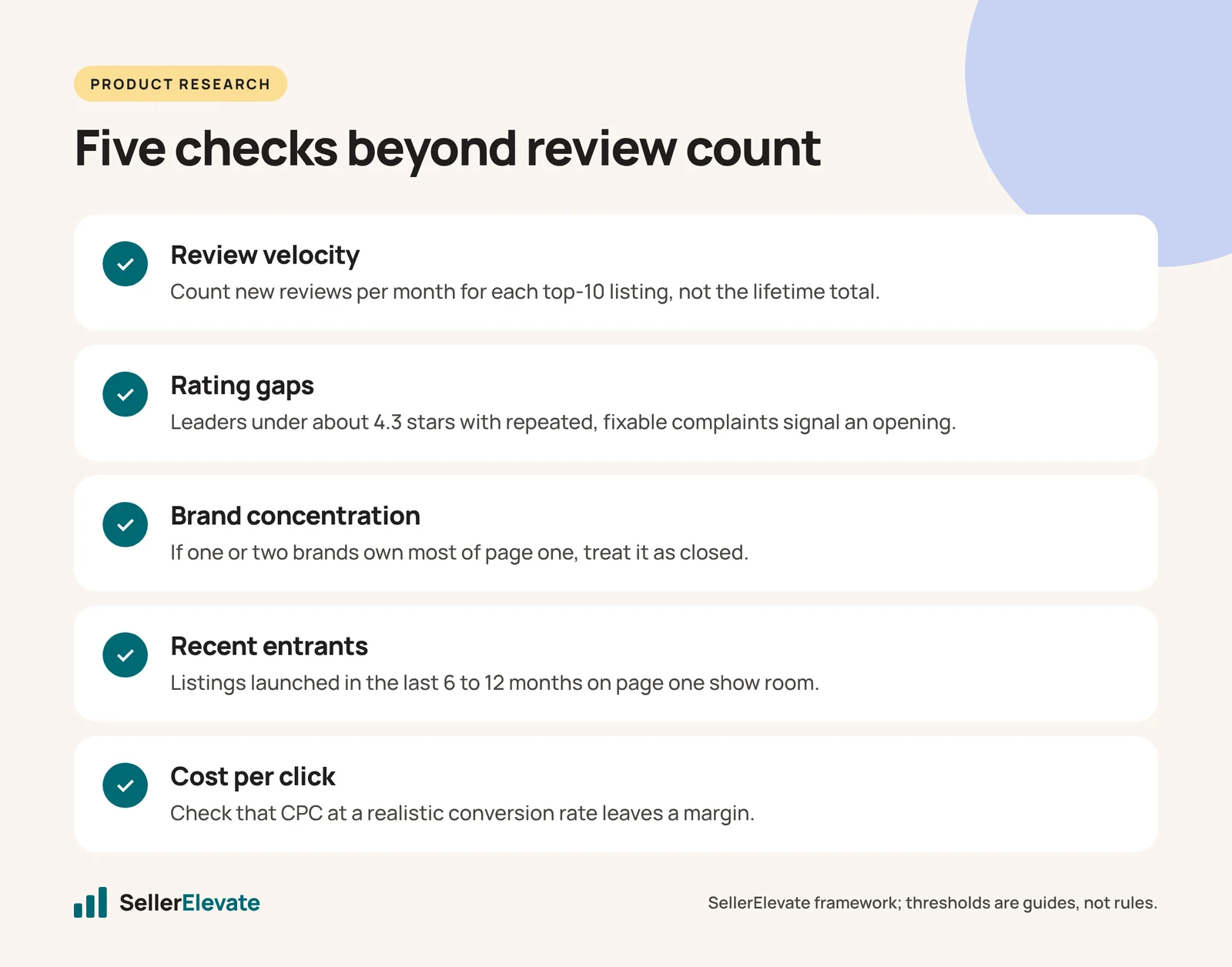
We replace the single threshold with five checks. Run them on the top 10 organic results for your main keyword.
| Check | What to look at | Open niche | Closed niche |
|---|---|---|---|
| Review velocity | New reviews per month for each top-10 listing, from a review tracker or by counting recent dated reviews | Leaders adding slowly; newer entrants growing | Leaders adding hundreds a month |
| Rating gaps | Star rating and the most common complaints in 1 to 3 star reviews | Several leaders under about 4.3 stars with repeated, fixable complaints | Leaders at 4.6 and above with scattered complaints |
| Brand concentration | How many distinct brands are in the top 10 and how click share splits | Six or more brands, no one dominant | One or two brands own most spots or clicks |
| Recent entrants | Listings launched in the last 6 to 12 months that reached page one | Several | None, or only big brands |
| Ad cost per click | Suggested bids for the main keywords against your margin | CPC you can afford at a realistic conversion rate | CPC that eats your margin before the sale |
The last check is the one most sellers skip. A niche can pass every review test and still be closed because the cost of buying page-one visibility is higher than your unit economics allow. We wrote about that dynamic in why ACoS keeps rising.
Amazon’s own Product Opportunity Explorer helps with two of these: it shows click share by product and brand concentration for a niche, plus a count of successful recent launches. Our guide to validating a niche with Product Opportunity Explorer walks through those screens.
How do you turn this into a decision?
Use these rules after you run the five checks.
- If the leaders are adding reviews quickly and rate above 4.6, pass on the niche unless your product is clearly different in a way shoppers search for.
- If the leaders have high counts but slow velocity and ratings under about 4.3, the niche is more open than it looks. Read the complaints. If you can fix the top two, it is a candidate.
- If one brand controls most of the top 10, treat it as closed for a first product, even if review counts are low.
- If several listings launched in the last year made page one, the niche still rewards new entrants. Study how they did it.
- If CPC on your main terms is more than you can pay at a 10% to 15% conversion rate while keeping a margin, move on regardless of reviews.
Here is a worked example with hypothetical numbers. Say you sell a $30 product with a 35% margin before ads, so about $10.50 per unit. If your main keyword costs $1.50 a click and you convert at 12%, each order costs about $12.50 in ad spend. You lose money on every advertised sale while you build reviews. That niche is too competitive for you even if the top 10 average 300 reviews.
Now change one thing: the CPC is $0.80. Each advertised order costs about $6.67, you keep about $3.83, and you can afford the review-building phase. Same review counts, different answer.
What mistakes make this worse?
- Counting ratings as reviews. Amazon shows ratings (stars with or without text). Compare like with like across listings.
- Looking only at the main keyword. A niche closed on its head term can be open on a specific use case or size. Check two or three long-tail terms before giving up.
- Ignoring variation pooling. One parent with 20 variations shares one review pool. A “12,000 review” listing might be a family of products where your exact variation sells weakly.
- Treating a gap as a plan. Spotting a 3.9-star leader is the start. You still need a supplier who can actually fix the complaint, which is where vetting comes in.
- Assuming reviews will come. Reviews take time to build without rule-breaking shortcuts. Plan the launch budget for the months it takes. Our post on competitive niche launches covers that budget.
What we'd do this week
Pick the one niche you are most serious about. Pull the top 10 organic listings for its main keyword and fill in the table above in a spreadsheet: reviews, rating, estimated new reviews per month, brand, launch date, and suggested CPC for the head term.
Then read 30 to 50 critical reviews across the top five listings and group the complaints. If one complaint shows up again and again and you can fix it at your target cost, you have the start of a product brief. If the complaints are scattered and the ratings are high, the niche is telling you the leaders are doing their job.
If you want help pressure-testing a niche before you place a purchase order, our product research service runs this same check alongside sales and fee modeling.
Frequently asked questions
Is a few thousand reviews too many to compete with?
Not on its own. A listing with 4,000 reviews collected over several years and a middling rating can be beatable, while a 400-review listing adding over 100 a month is a real threat. Look at how fast reviews are arriving, the star rating and the main complaints before treating any total as a barrier.
How do I measure review velocity?
Use a review tracking tool that records review counts over time, or sort a listing's reviews by most recent and count how many arrived in the last 30 days. Do this for each top-10 listing on your main keyword. Leaders adding hundreds a month are a sign the niche is actively contested.
Should I count ratings or written reviews?
Compare like with like. Amazon shows ratings, which include star-only ratings and written reviews. Most research tools report the total ratings figure. Use the same measure for every listing you compare, and remember that variations under one parent share a single pool.
Can a niche with low review counts still be too competitive?
Yes. If one brand owns most of page one, or cost per click is higher than your margin can absorb at a realistic conversion rate, low review counts do not help. For a $30 product with a 35% margin, a $1.50 click at a 12% conversion rate loses money on each advertised order.
Sources
- Jungle Scout: Seller Strategies: How To Validate Products (updated April 10, 2025)
- BowTied Amazon: How to Pick a Niche (August 30, 2021)
- SalesDuo: Amazon Product Opportunity Explorer guide (September 24, 2026)
Get the honest version of your numbers
A free account audit from the person who would actually run your account.