Why is my Shopify organic traffic down in 2026?
Usually two things at once: organic results lost 11 to 23 percentage points of click share to paid ads and AI answers between January 2025 and January 2026, and AI assistant visits often get logged as direct or referral. Check Search Console against Shopify analytics before deciding which problem you have.
Key takeaways
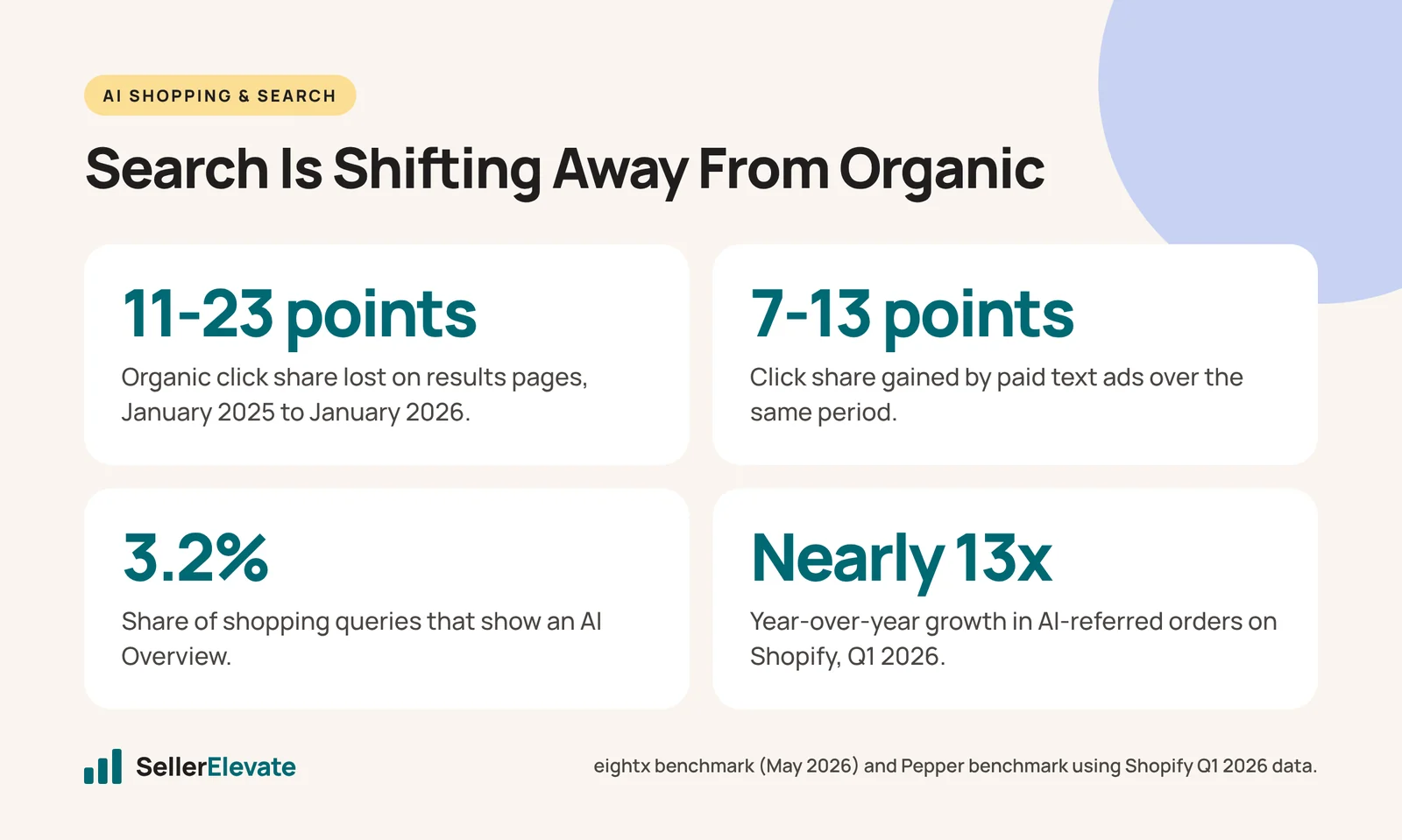
- Organic results lost 11 to 23 percentage points of search click share between January 2025 and January 2026, while paid text ads gained 7 to 13 points.
- AI Overviews appear in only 3.2% of shopping queries, so informational content is usually hit harder than product and collection pages.
- Visits from AI assistants often arrive as direct or referral traffic, so part of an organic drop can be a reporting artefact.
- AI-referred orders on Shopify grew nearly 13 times year over year in Q1 2026, from a small base.
- Compare revenue per organic session, not just sessions, to see whether you lost buyers or browsers.
Your Shopify organic traffic is most likely falling for two reasons at once: Google is answering more commercial questions on the results page and giving more of the click share to paid ads, and some of what looks like loss is a reporting change, with AI assistants sending visits that land in “direct” or “referral” instead of “organic search”. The fix is to separate the real loss from the measurement problem first, then rebuild around the pages AI tools cite and the channels you own.
Is organic search traffic really down, or is it my reporting?
Both, usually. Start with what the benchmarks say.
eightx’s 2026 benchmark, published 29 May 2026, pulls together several studies. Between January 2025 and January 2026, organic results lost 11 to 23 percentage points of click share on the search results page, while paid text ads gained 7 to 13 points. The same piece cites a Graphite analysis showing US organic search traffic down 2.5% year over year, and notes that AI Overviews appear in only 3.2% of shopping queries.
Those numbers point in slightly different directions, and that matters. If AI Overviews only show on a small share of shopping searches, they are not the whole story for a store whose traffic comes mostly from product and category terms. The bigger shift for many stores is that paid placements and shopping units are taking more of the page. AI Overviews hit hardest on informational content: buying guides, “how to choose” posts, care instructions.
Meanwhile, Webtonic’s statistics roundup cites research that 60% of US Google searches now end without a click to any website, and puts retail’s organic share of visits at about 41%, below the 53.3% average across all industries.
Now the reporting side. Visits from ChatGPT, Perplexity, Gemini and similar tools often arrive without a clean referrer. Depending on the app, they show up as direct traffic, as referral traffic, or not at all. So part of your organic decline may be shoppers who still found you through a search-like behavior, just not through Google.
How do I tell real loss from a reporting artefact?
Run these checks in order. Each takes a few minutes.
- Compare Search Console to Shopify analytics. Search Console counts Google clicks directly. If Search Console clicks are flat but Shopify shows organic sessions down, the gap is in attribution, not in Google.
- Split Search Console by page type. Filter for product pages, collection pages and blog posts separately. If the drop is concentrated in blog and guide content while collection pages hold, that is the AI Overview and zero-click pattern.
- Check impressions against clicks. Impressions steady while clicks fall means you still rank, but fewer people click. Impressions falling means you lost rankings, which is a different problem (technical issues, content, competitors).
- Look at direct and referral traffic. A rise in direct sessions landing on deep product URLs is a classic sign of untracked AI or app referrals. Nobody types a 60-character product URL.
- Add AI referrers as a channel. In your analytics, group referrals from chatgpt.com, perplexity.ai, gemini.google.com, copilot.microsoft.com and similar into one channel so you can watch the trend.
- Compare revenue, not just sessions. If organic sessions are down 20% but organic revenue is down 5%, you are losing low-intent informational visits and keeping buyers.
Here is how to read the result:
| What you see | Most likely cause | What to do first |
|---|---|---|
| GSC clicks down, impressions flat, blog pages hit hardest | Zero-click and AI Overviews on informational queries | Shift content effort to category and comparison pages |
| GSC clicks and impressions both down | Lost rankings | Technical and content audit before anything else |
| GSC flat, Shopify organic down, direct up | Attribution shift | Fix tracking; the demand has not gone |
| Organic sessions down, revenue roughly flat | Losing low-intent visits | Do not panic; protect money pages |
| Paid search costs up on your own brand terms | Ads taking the top of the page | Review brand bidding and Shopping feed quality |
What is replacing organic search traffic?
Three things are growing while classic organic shrinks.
AI assistants. According to Pepper’s benchmark, published 17 July 2026 and drawing on Shopify’s Q1 2026 merchant data, AI-referred orders on Shopify grew nearly 13 times year over year and AI referral sessions grew more than 8 times. The same piece reports AI-referred visitors converting roughly 50% better than organic search visitors, with a 14% higher average order value. It also cites Adobe data showing AI-referred traffic to US retail up 393% year over year. The base is still small for most stores, but it is the fastest-growing source you have. We look at the conversion question in more detail in does AI traffic convert.
Owned channels. Email and SMS lists do not depend on anyone’s results page. Every visitor you convert into a subscriber is a visitor you no longer have to win back through search.
Marketplaces. Shoppers who used to search Google for a product increasingly start on Amazon, Walmart or TikTok. If you are not listed there, someone else may be selling your category to your audience.
How do I get cited by AI search tools?
Pepper’s benchmark reports that branded web mentions correlate with AI visibility at 0.664, roughly three times more strongly than backlinks, and that citing real sources and adding statistics can lift visibility by up to 40% (from Princeton research on generative engine optimization). In practice that means:
- Category pages that answer questions. Add a short buying guide to the top collection pages: who each product is for, how they differ, sizes, materials, care. AI tools quote pages that answer comparison questions directly.
- Honest comparison content. “Product A vs Product B” and “best X for Y” pages, including where a competitor is the better fit. These are the questions shoppers now ask assistants.
- Complete product data. Structured data on product pages (price, availability, reviews, GTIN) and a clean Google Merchant Center feed. Missing attributes make you easy to skip.
- Mentions elsewhere. Reviews, press, Reddit threads and creator content where people name your brand. We cover this in AEO and GEO for product brands.
What mistakes make the decline worse?
- Writing more blog posts on informational topics. This is exactly the content AI Overviews absorb. More of it rarely helps.
- Cutting SEO entirely. Product and collection pages still rank and still convert. Neglect them and the drop becomes real.
- Panic-buying brand search ads without checking whether you were losing those clicks in the first place.
- Judging on sessions alone. Revenue per organic session is the number that tells you whether you lost buyers or browsers.
What we'd do this week
- Pull 16 months of Search Console data, split by product, collection and blog URLs. Identify where the drop actually sits.
- Create an “AI assistants” channel grouping in your analytics and backfill as far as your data allows.
- Rewrite the top five collection pages with a short comparison section and FAQ, written for a shopper who asks an assistant “which one should I buy”.
- Audit your Merchant Center feed for missing attributes and disapproved products.
- Add an email capture offer to your highest-traffic organic landing pages.
- Check whether your top products are on Amazon or Walmart, and who is selling them if you are not.
If you want a second pair of eyes on the marketplace side, our free audit looks at where your category’s demand is going and whether your listings are ready for it.
Frequently asked questions
How do I track ChatGPT traffic to my Shopify store?
Create a custom channel grouping in your analytics that collects referrals from chatgpt.com, perplexity.ai, gemini.google.com, copilot.microsoft.com and similar domains. Some AI visits still arrive without a referrer, so also watch direct sessions landing on deep product URLs, because few shoppers type those addresses by hand.
Should I stop writing blog posts?
Not entirely, but stop adding generic informational posts, which are exactly what AI Overviews absorb. Put the effort into collection pages with buying guidance, honest comparison pages, and content that earns mentions and citations elsewhere. Keep maintaining product and collection pages, which still rank and convert.
Does AI-referred traffic convert?
According to Pepper's 2026 benchmark, AI-referred visitors convert roughly 50% better than organic search visitors, with a 14% higher average order value. Volumes are still small for most stores, so track it as its own channel and judge it on revenue, not sessions.
Is a 2.5% drop in organic traffic normal?
It is in line with the Graphite analysis cited by eightx, which found US organic search traffic down 2.5% year over year. A much larger drop, especially with falling impressions in Search Console, points to lost rankings that need a technical and content audit.
Sources
Get the honest version of your numbers
A free account audit from the person who would actually run your account.