What is the difference between ACP and UCP?
ACP, from OpenAI and Stripe, lets AI assistants like ChatGPT complete a checkout with a merchant using feeds you submit. UCP, from Google with Shopify and major retailers, is a merchant-hosted standard covering discovery to orders, published at /.well-known/ucp. For most sellers the platform handles both, and your job is product data.
Key takeaways
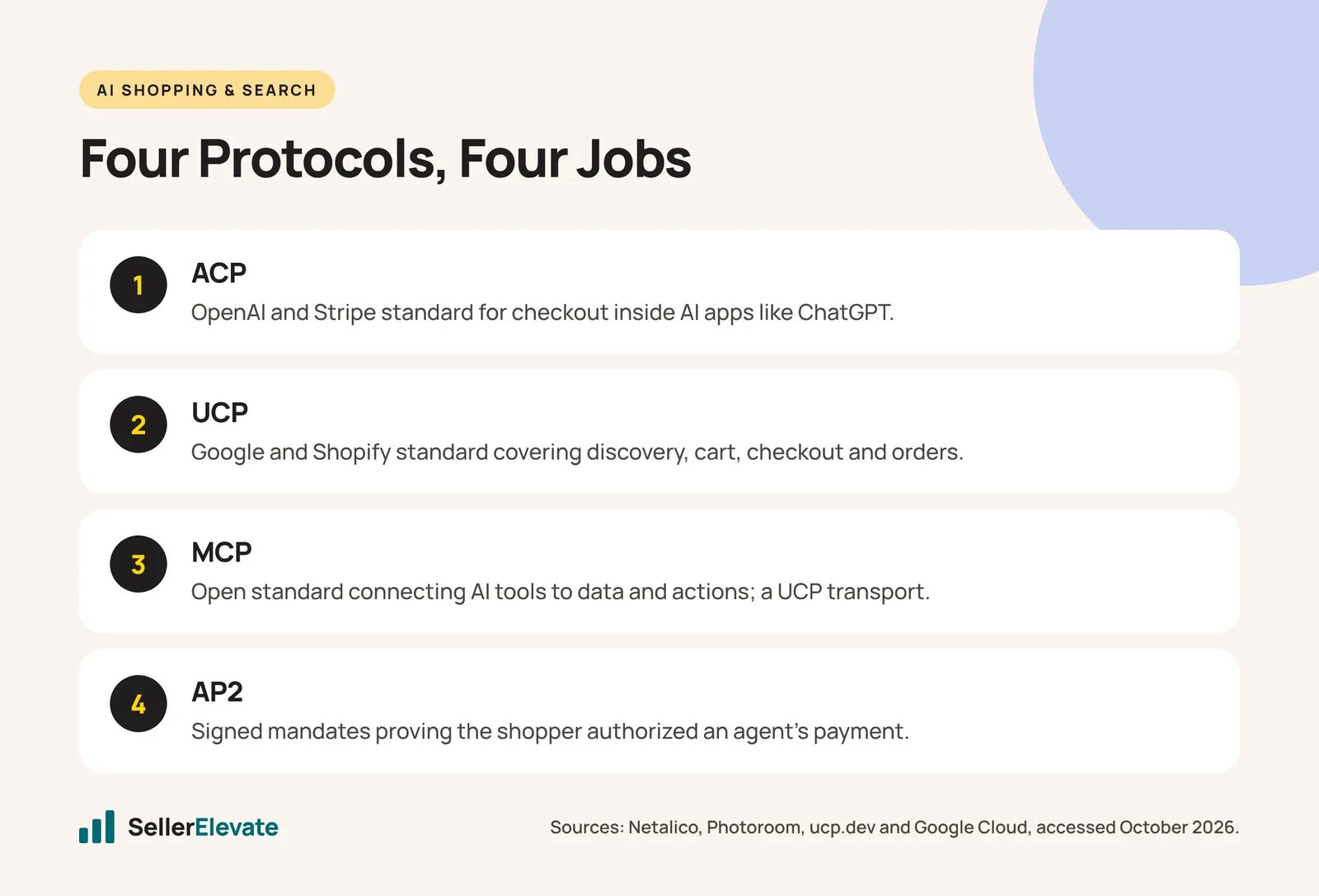
- ACP was built by OpenAI and Stripe and launched in September 2025 to handle checkout inside AI apps like ChatGPT.
- UCP was announced by Google with Shopify, Etsy, Wayfair, Target and Walmart in January 2026 and covers the full journey from catalog to orders.
- AP2, announced by Google on 16 September 2025, proves a shopper authorized an agent's payment using signed mandates; payment providers handle it.
- MCP connects AI tools to data and actions and is one of the transports UCP supports.
- Whether an agent recommends your product depends on complete, accurate, fresh product data, not on the protocol.
ACP is how ChatGPT-style assistants complete a checkout with a merchant; UCP is Google’s broader standard for how any AI agent discovers what a store can do and buys from it. MCP and AP2 sit underneath both: MCP connects AI tools to data and actions, and AP2 proves a shopper actually authorized an agent to pay. For most brands, the platform you sell on handles the plumbing, and your job is product data.
Below is one section per acronym: who built it, what it does for a seller, and whether you need to act.
What is ACP, and does it affect my store?
Who built it: OpenAI and Stripe. Netalico dates the launch to September 2025, and Inriver notes Stripe’s documentation now also credits Meta. It is open source under an Apache 2.0 license.
What it does: The Agentic Commerce Protocol defines how an AI assistant talks to a seller to start and complete a checkout. Payment details pass as secure tokens, so the assistant never holds the shopper’s card. ChatGPT was the first platform to implement it, and Stripe the first payment provider, through its Shared Payment Token. Participation with a platform like ChatGPT requires approval; it is not automatic.
How it works in practice: ACP is platform-mediated. You (or your platform) send product feeds to the AI app, which indexes them. Prices are only as fresh as your last sync.
The cost: Netalico reports that ChatGPT Instant Checkout charges a 4% referral fee on top of standard Shopify and Stripe fees. Treat that as the figure as of the source’s publication and confirm the current rate before you model margins.
What changed in 2026: Photoroom reports that in March 2026 OpenAI shifted its focus from in-chat checkout toward product discovery, while Stripe continues to maintain the protocol. So ACP still matters, but ChatGPT may send shoppers to your site more often than it completes the purchase itself.
Do you need to act? If you are on Shopify, Etsy, WooCommerce or BigCommerce, Netalico says those platforms support ACP, so you work through your platform’s settings. If you run a custom stack, you would integrate through Stripe or apply directly.
What is UCP, and how is it different from ACP?
Who built it: Google, co-developed with Shopify, Etsy, Wayfair, Target and Walmart. It was announced at the NRF retail conference in January 2026. Sources disagree on the exact day (Let’s Data Science says 11 January, Shopifreaks 12 January), which does not change anything for you. More than 20 organizations endorsed it, including Visa, Mastercard, Stripe, Adyen, PayPal, Best Buy and The Home Depot.
What it does: The Universal Commerce Protocol covers the whole shopping journey, not only checkout. According to ucp.dev, its building blocks include catalog search, cart, checkout (with tax and discounts), identity linking through OAuth 2.0, order tracking and returns, and even lodging and food ordering.
How it works: UCP is merchant-hosted. You publish what your store can do in a file at /.well-known/ucp on your own domain, and agents discover it. Product data is pulled live from your systems rather than synced from a feed.
Where it shows up: Google’s AI Mode in Search and Gemini, with checkout from eligible US retailers while the shopper researches. Photoroom says Shopify sellers can opt in from their admin.
Do you need to act? Shopify merchants: turn it on and fix your product data. Everyone else: read our guide to making a non-Shopify store UCP-ready.
What are MCP and AP2?
These are not shopping protocols in themselves. They are the infrastructure the shopping protocols use.
MCP (Model Context Protocol): an open standard, introduced by Anthropic, that lets AI applications connect to external tools and data through one standard interface. In commerce, an MCP server can give an agent access to your inventory, search or order tools. UCP lists MCP as one of its supported transports, alongside REST and Google’s Agent2Agent (A2A) protocol. If you have seen tools that let you manage Seller Central or ad accounts through an AI assistant, those often run on MCP. We wrote about one in managing Amazon through Claude.
AP2 (Agent Payments Protocol): announced by Google on 16 September 2025 with more than 60 organizations, per Google Cloud’s announcement. It solves one question: how does a merchant know the shopper really approved this purchase? AP2 uses signed “mandates”. An Intent Mandate records what the shopper asked for, including limits like a maximum price. A Cart Mandate records the exact items and price the shopper approved. If a dispute arises, there is a verifiable record.
Do you need to act? No. Photoroom notes AP2 is already built into payment processors and networks including Visa and Mastercard. Your payment provider handles it.
Which protocols should a seller care about? A comparison
| ACP | UCP | MCP | AP2 | |
|---|---|---|---|---|
| Built by | OpenAI and Stripe | Google with Shopify and retailers | Anthropic (open standard) | Google with payments partners |
| Launched | September 2025 | January 2026 | Before both | 16 September 2025 |
| What it covers | Checkout inside AI apps | Discovery to checkout to orders | Connecting AI to tools and data | Proof the shopper authorized payment |
| Where you see it | ChatGPT | Google AI Mode, Gemini | Many AI assistants | Behind the scenes at checkout |
| Who implements it | Your platform or Stripe | Your platform, or you on custom stacks | Developers and tool vendors | Payment providers |
| Seller action | Enable via platform; check fee | Enable or build; clean data | Usually none | None |
Inriver’s advice on choosing is sensible: follow your demand first. Look at where your buyers already use agents, then check what your stack can support. The protocols coexist, and Inriver expects most businesses with meaningful volume to run both ACP and UCP eventually.
What actually decides whether an agent picks your product?
Not the protocol. The protocol only lets the agent talk to you. Whether it recommends you depends on the data it gets.
Inriver puts it plainly: an agent comparing your product to a competitor’s does not weigh your brand story. It compares completeness, accuracy and freshness, and drops the candidate with gaps. Google added dozens of new product attributes for conversational commerce with the UCP launch.
A practical data checklist:
- Every variant has its own price, stock status, GTIN and image.
- Attributes are filled in, not just titles and descriptions: material, dimensions, compatibility, age range, care.
- Shipping times and return policy are stated in structured fields, not only in a footer.
- Prices and stock update in near real time across your site, feeds and marketplaces.
- Reviews are visible and marked up with structured data.
Hypothetical example: two sellers list a 12-inch cast iron skillet. One lists weight, oven-safe temperature, induction compatibility and pre-seasoning. The other has a lifestyle description and a title. When a shopper asks an assistant for “an induction-safe skillet under 6 pounds”, only one of them can be matched.
What we'd do this week
- Find out which protocols your platform already supports. On Shopify, check the agentic and sales channel settings; see our post on Shopify agentic storefronts.
- If ChatGPT checkout is on, model the referral fee against your margin at your average order value.
- Run a product data audit on your top 20 SKUs using the checklist above.
- Add an AI referrer channel to your analytics so you can see whether any of this produces orders.
- Do not build anything custom until your data passes the audit. A custom UCP endpoint serving thin data is wasted engineering.
Marketplace sellers face the same principle inside Amazon and Walmart’s own assistants, which is why our listing optimization work now starts with attribute completeness.
Frequently asked questions
Does ChatGPT charge a fee on Instant Checkout sales?
Netalico reports a 4% referral fee on ChatGPT Instant Checkout, on top of standard Shopify and Stripe fees. Fees can change, so confirm the current rate in your platform settings before modeling margins at your average order value, and compare it with your other channels.
Do I need both ACP and UCP?
Eventually, perhaps. The protocols coexist and neither locks you out of the other, and Inriver expects most businesses with meaningful volume to run both. Start with whichever surface your buyers already use, and with whatever your commerce platform already supports.
Is MCP a shopping protocol?
No. MCP is a general standard for connecting AI applications to external tools and data. In commerce it can give an agent access to inventory, search or order tools, and UCP supports it as a transport alongside REST and Agent2Agent.
Is ACP still relevant after OpenAI's March 2026 change?
Yes, but its role has shifted. Photoroom reports OpenAI moved its focus from in-chat checkout toward product discovery in March 2026, while Stripe continues to maintain ACP. Expect ChatGPT to send more shoppers to your site rather than complete every purchase itself.
Sources
- Netalico: ACP vs UCP (January 2026)
- Photoroom: Agentic commerce protocols explained (10 August 2026)
- Inriver: ACP or UCP, how to choose (undated)
- Google Cloud: Announcing the Agent Payments Protocol (AP2) (16 September 2025)
- Universal Commerce Protocol: ucp.dev (accessed October 2026)
- Let’s Data Science: Google launches UCP (January 2026)
Get the honest version of your numbers
A free account audit from the person who would actually run your account.