Is Amazon AWD worth it in 2026?
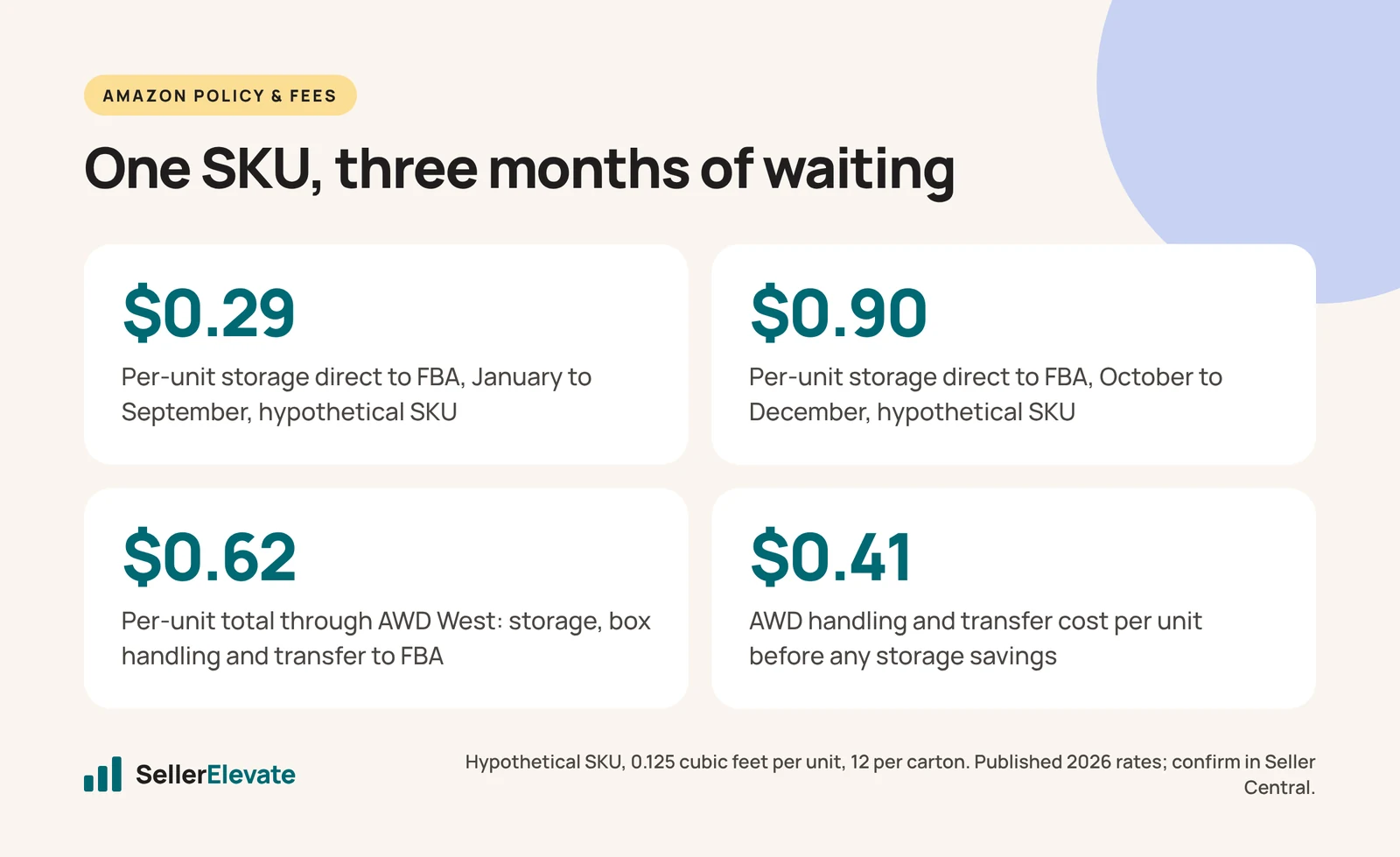
For standard-size, steady sellers that would otherwise sit in FBA through Q4, usually yes. In our hypothetical SKU, three months of Q4 waiting cost $0.90 per unit in FBA and $0.62 through AWD. Off-peak, AWD's handling and transfer fees of about $0.41 per unit outweigh its cheaper storage.
Key takeaways
- AWD West-region storage rose to $0.57 per cubic foot per month on January 15, 2026, about 19% higher.
- Box processing is now $1.40 each way and transfer to FBA $1.40 per cubic foot, so moving units through AWD has a fixed cost.
- Since July 31, 2026, AWD accepts sortable items only, so oversize SKUs need another plan.
- Inventory moving from AWD to FBA must arrive fully prepped, because Amazon ended US prep services on January 1, 2026.
- In our hypothetical SKU, AWD beat direct-to-FBA during Q4 but not in off-peak months.
Amazon Warehousing and Distribution is still worth it in 2026 for a specific kind of SKU: standard-size, steady-selling, and stocked deep enough that units would otherwise sit in FBA through Q4. For most other SKUs, the 2026 fee increases, the end of Amazon’s prep service and the new sortable-only rule have made the case thinner than it was a year ago.
The honest answer depends on how long your units wait before they sell and which months they wait in. Below we lay out what changed, then run one hypothetical SKU through three options: AWD, a third-party warehouse (3PL), and sending straight to FBA. All fees are as of October 2026 and drawn from published rate summaries; confirm current rates in Seller Central before you move inventory.
What changed for AWD in 2026?
Four changes matter.
Storage went up, most in the West. From January 15, 2026, base AWD storage rose to $0.57 per cubic foot per month in the West region, up from $0.48, an increase of about 19%. Other regions rose to $0.48 from $0.43, according to eStore Factory’s rate breakdown.
Moving inventory got more expensive. Box processing rose to $1.40 per box for both inbound and outbound, from $1.35. Transportation from AWD to FBA rose to $1.40 per cubic foot from $1.15, about 22%, or $1.26 under Amazon-managed distribution.
Prep is now entirely on you. Amazon discontinued FBA prep and labeling services in the US on January 1, 2026. AMZ Prep reports that inventory routed from AWD into FBA must arrive fully prepped and labeled to FBA standards, and that “AWD will not act as a downstream prep or correction layer.” If your units go into AWD unprepped, they come out unprepped and get flagged at FBA.
Oversize is out. Since July 31, 2026, AWD accepts sortable items only. AMZ Prep’s September write-up says units must be under 18 x 14 x 8 inches and under 20 pounds, measured on the sellable unit including retail packaging. Small bulky, large bulky and extra-large items are excluded. Existing oversize stock in AWD keeps replenishing until it sells through, but replacement stock has to go through Send to Amazon.
Discounts still exist but are harder to keep. Smart Storage rates require at least 70% of your inventory to move from AWD to FBA through auto-replenishment over the last 90 days.
How do AWD, a 3PL and direct-to-FBA compare on one SKU?
Here is a hypothetical SKU, so you can swap in your own numbers:
- Standard-size, 12 units per carton, 1.5 cubic feet per carton (0.125 cubic feet per unit)
- Each unit waits about three months in storage before it sells
- Inbound freight from your factory is roughly the same in every option, so we leave it out
Rates used: FBA standard-size storage of $0.78 per cubic foot off-peak and $2.40 in October to December. Sellerboard’s July comparison puts the ranges at about $0.78 to $0.87 off-peak and $2.25 to $2.40 in Q4, so we used the low end off-peak and the high end in Q4. AWD at the West rate of $0.57, $1.40 per box each way and $1.40 per cubic foot to FBA. For the 3PL, Sellerboard’s survey ranges of $18 to $25 per pallet per month and $5 to $15 per pallet to receive; we assumed 480 units per pallet at the top of both ranges.
| Cost per unit, 3 months of waiting | Direct to FBA, Jan to Sep | Direct to FBA, Oct to Dec | AWD (West) | 3PL |
|---|---|---|---|---|
| Storage | $0.29 | $0.90 | $0.21 | $0.16 |
| Box or pallet handling | none | none | $0.23 | $0.03 |
| Transfer to FBA | none | none | $0.18 | not included (quote it) |
| Total | $0.29 | $0.90 | $0.62 | $0.19 plus outbound |
Three things stand out.
Off-peak, AWD loses for this SKU. Moving one unit through AWD costs about $0.41 in handling and transfer before storage savings. At $0.78 versus $0.57, the storage saving is about $0.03 per unit per month. It would take more than 15 months of waiting to earn back the $0.41. Nobody should hold standard-size inventory that long.
Through Q4, AWD wins. At $2.40 in FBA versus $0.57 in AWD, the saving is about $0.23 per unit per month, so the same $0.41 is recovered in under two months. Three months of Q4 waiting costs $0.90 in FBA and $0.62 through AWD.
A 3PL looks cheapest on paper and is not. Our 3PL line leaves out outbound handling, freight to FBA, setup fees and monthly minimums; Sellerboard puts the average minimum around $517. It also notes invoices often run 20% to 50% above quotes within six months. For a brand doing modest volume, the 3PL line can end up above AWD once everything is billed.
Change the SKU and the answer changes. Denser products make FBA storage cheaper per unit. Fewer units per carton make AWD’s per-box fees heavier. That is why the per-unit model matters more than the headline rate.
What does AWD give you that the fee table does not show?
The fee table misses two things, one in AWD’s favor and one against it.
In its favor: capacity. When FBA capacity limits are tight, AWD inventory can auto-replenish into FBA without you planning every shipment around your limit. If a stockout would cost you sales and rank during peak, avoiding it is worth more than a few cents of storage. Our post on FBA capacity limits for Q4 2026 covers that side.
Against it: shrink and control. Sellerboard cites seller reports of AWD inventory loss of 5% to 10%. We have not seen Amazon publish a figure, so treat it as a reported range, but it is a reason to reconcile AWD inventory monthly and file claims promptly. Our reimbursement recovery work exists because these losses rarely get flagged on their own.
Who should use AWD in 2026, and who should not?
| Use AWD if | Skip AWD or use it less if |
|---|---|
| Standard-size and sortable | Oversize (no longer accepted) |
| Steady sales you can forecast | Lumpy, seasonal or launch-stage sales |
| Units would sit in FBA during Q4 | Units sell within a few weeks of arrival |
| You can stay above 70% auto-replenishment for Smart Storage rates | You move stock manually and lose the discount |
| Your factory or prep center ships fully FBA-prepped cartons | You relied on Amazon to prep or label |
| Many units per carton | Few units per carton (per-box fees dominate) |
What we'd do this quarter
- Run the per-unit model on your top five SKUs. Use your real cubic feet, units per carton and average days on hand. If the AWD total does not beat direct-to-FBA in at least the Q4 months, do not use it for that SKU.
- Check sortable status. Any SKU over 18 x 14 x 8 inches or 20 pounds as a sellable unit needs a new plan now.
- Check prep at the source. Every carton going into AWD should be FBA-ready, labeled and prepped, because nothing gets fixed on the way out. If you are a reseller, that includes FNSKU labels on every unit; see our post on the end of commingling.
- Check your auto-replenishment share. If you are below 70%, you are paying base rates, not Smart Storage rates.
- Plan the January exit. After December, FBA storage drops back. Do not carry Q4-depth inventory into the new year by default.
- Reconcile monthly. Compare AWD received, transferred and on-hand. File discrepancies quickly.
If you sell FBM and are weighing a move into FBA for Business buyers, our post on the new Business Hour Delivery Rate explains why that question is live this month. If you want a second opinion on your inventory setup, it is part of our account management work, and we will tell you if the answer is to keep things simple.
Whichever storage route you pick, track lost and damaged units closely, because claim windows are short. Our guide to Amazon’s FBA reimbursement policy covers what you can still recover.
Frequently asked questions
What are Amazon AWD storage fees in 2026?
Base AWD storage is $0.57 per cubic foot per month in the West region and $0.48 elsewhere, effective January 15, 2026. Smart Storage and Amazon-managed rates are lower but require you to keep at least 70% of inventory moving to FBA through auto-replenishment over 90 days. Confirm current rates in Seller Central.
Can I send oversize products to AWD?
Not anymore. Since July 31, 2026, AWD accepts sortable items only: units under 18 x 14 x 8 inches and under 20 pounds, measured on the sellable unit with packaging. Oversize stock already in AWD keeps replenishing until it sells through, but replacement stock must go through Send to Amazon.
Does AWD prep my inventory before it goes to FBA?
No. AMZ Prep reports that inventory moving from AWD into FBA must already be prepped and labeled to FBA standards, and that AWD will not act as a prep or correction layer. With Amazon's US prep services ended on January 1, 2026, prep has to happen at your factory or prep center.
Is a 3PL cheaper than AWD?
Sometimes on storage, not always in total. Sellerboard's survey puts 3PL storage at $18 to $25 per pallet per month, but you also pay receiving, outbound handling, freight to FBA, setup fees and minimums averaging around $517. It also reports invoices often running 20% to 50% above quotes within six months.
Sources
- eStore Factory: Prepare for 2026 Amazon AWD fee increases (Nov 5, 2025)
- AMZ Prep: Amazon January 2026 updates (updated Sep 25, 2026)
- AMZ Prep: Amazon AWD now accepts sortable items only (Sep 25, 2026)
- Sellerboard: FBA vs AWD vs 3PL, how to model the real cost (Jul 30, 2026)
Get the honest version of your numbers
A free account audit from the person who would actually run your account.