Is buying Amazon reviews illegal?
In the US, yes in practice. Since October 21, 2024, the FTC's consumer review rule bans buying fake reviews, including AI-generated ones, and incentives tied to positive sentiment, with civil penalties of up to $53,088 per violation. It also breaks Amazon policy and can cost you the account. This is not legal advice.
Key takeaways
- Amazon sued an alleged review-selling network in August 2026 whose sites sold verified-purchase reviews at $30 each.
- Amazon and the Better Business Bureau won a permanent injunction against a fake-review operator on June 22, 2026.
- The FTC rule, effective October 21, 2024, names AI-generated fake reviews and allows civil penalties of up to $53,088 per violation.
- Reviews now only share across variations Amazon considers functionally the same, ending the trick of borrowing a parent's reviews.
- Vine and Request a Review are the direct, compliant ways to ask for reviews; more real orders do the rest.
Amazon does not publish how well it detects AI-written reviews, but it does say its systems look at account relationships, review timing and language patterns, and it is suing the people who sell fake reviews. Buying reviews is not just against Amazon’s rules: since October 21, 2024, a Federal Trade Commission rule bans buying fake reviews, including AI-generated ones, with civil penalties of up to $53,088 per violation.
So the real question for a brand is not “will I get caught?” but “what is the downside if I do, and what works instead?” This post covers what changed in 2026, what the law says in plain terms, and the compliant routes we use with clients. It is not legal advice; if you are worried about something already done, talk to a lawyer.
What is Amazon doing about fake reviews in 2026?
Three moves this year show the direction.
Suing review sellers. In August 2026, Amazon sued Bangladesh-based Md Alo Hossain and others it alleges are connected to BuyAmzReviewsVotes.com and SellersSoft.com, in Seattle, as reported by beBOLD (August 12, 2026). The sites allegedly sold verified-purchase reviews at $30 each ($25 each for 100 or more), ratings without text at $18, helpful votes at $0.55 and product Q&As at $7. They also offered “reviews scheduled over time to reduce the chance of detection.”
Winning in court with the Better Business Bureau. On June 22, 2026, Amazon and the BBB secured a permanent injunction against a fake-review operator in King County Superior Court in Washington, including monetary relief, attorney’s fees and transfer of the defendant’s website domains, according to Davis Wright Tremaine, the firm that represented them. It was the first joint lawsuit between the two.
Changing how reviews are shared across variations. Amazon now shares reviews only between variations it considers functionally the same, such as color, size or pack count. Flavors, primary scents, bundles, different models and performance specs no longer pool reviews. EcomCrew dates the change from February 12, 2026, with a gradual rollout through May 31, 2026; beBOLD describes it as a May 2026 change. Either way, it is now in effect. It closes an old trick: parking a new product under a well-reviewed parent to borrow its rating.
The point of all three: Amazon is going after the supply side (the brokers), and once a broker’s records are in a lawsuit, the buyers are much easier to find.
Can Amazon detect fake or AI-written reviews?
Not perfectly, and Amazon does not claim to. In its own explainer, Amazon says it blocked more than 200 million suspected fake reviews worldwide in 2022, using signals that include risky behavior patterns, review history, anomalies in the timing of reviews, grammar and language patterns, and relationships between accounts mapped with graph neural networks. Its data science lead was candid that “the difference between an authentic and fake review is not always clear for someone outside of Amazon to spot.”
For AI-written reviews specifically, we have not seen Amazon publish a detection method or accuracy figure. So we will not tell you it catches every one. What we can say:
- Language is only one signal. A broker can generate fluent text, but the reviewer accounts, purchase patterns and timing still have to look real. That is where most networks get caught.
- Brokers keep records. When Amazon sues a broker, it can seek its customer lists. A review bought in 2024 can become a problem in 2026.
- The cost of being wrong is the account. A suspension on a brand’s main ASINs can cost more in one month than every review you could ever buy. Our suspension and reinstatement team sees the aftermath.
Is buying reviews illegal?
In the US, buying fake reviews breaks a specific federal rule, not just Amazon policy. The FTC finalized its Trade Regulation Rule on the Use of Consumer Reviews and Testimonials on August 14, 2024, and it took effect on October 21, 2024. Among other things, it prohibits:
- Reviews that misrepresent that they are by someone who does not exist, “such as AI-generated fake reviews.”
- Paying or giving other incentives conditioned on a review expressing a particular sentiment, positive or negative.
- Undisclosed reviews by your own officers, managers or employees.
- Suppressing negative reviews through threats or intimidation.
- Buying or selling fake social media indicators such as followers or views.
The rule gives the FTC power to seek civil penalties of up to $53,088 per violation, and the agency has started acting on it. On December 22, 2025, it sent warning letters to 10 companies, flagging practices such as paying employees to solicit five-star reviews from friends and family and getting reviews from people who never used the product, according to Arnold & Porter.
Note what is in scope. It is not only “pay a stranger for a five-star review.” Family members reviewing your product without disclosure, a rebate only for happy customers, and an AI tool that drafts reviews posted under made-up names all fall into the same rule.
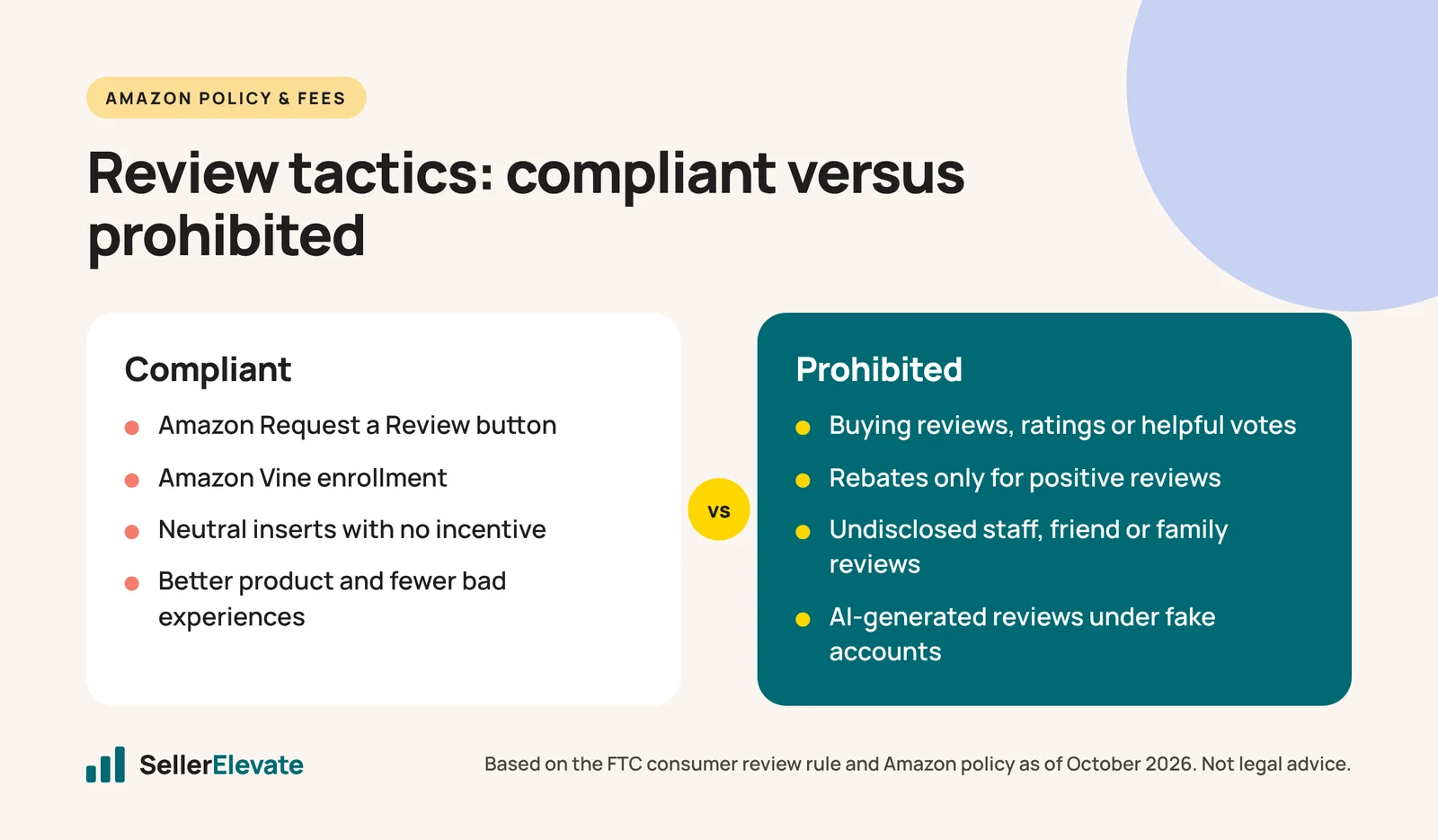
Which review tactics are still safe, and which get brands sued?
Here is how we sort the tactics we get asked about most often. For inserts and incentives, EcomCrew’s insert card guide (January 2026) sums up the rule: review requests must be neutral, and discounts, free items, refunds or other benefits tied to reviews are not allowed.
| Tactic | Where it stands |
|---|---|
| Amazon’s Request a Review button | Allowed. Amazon’s own tool |
| Amazon Vine | Allowed. Amazon runs it and labels the reviews |
| Neutral product inserts that do not ask for a positive review or offer anything | Generally allowed under Amazon policy; keep the wording neutral |
| Better product, packaging and instructions that reduce bad experiences | Always allowed, and the most durable fix |
| Free product or refund in exchange for a review | Prohibited |
| Rebate or gift only for 4- or 5-star reviews | Prohibited by Amazon and the FTC rule |
| Friends, family or staff reviewing without disclosure | Prohibited |
| Buying reviews, ratings or helpful votes from a service | Prohibited, and the services are being sued |
| AI-generated reviews posted under fake or borrowed accounts | Prohibited; the FTC rule names AI-generated fake reviews directly |
| Moving a new product under a well-reviewed parent to borrow reviews | Now largely ineffective after the variation change, and a policy risk |
We covered the sanctioned routes in more detail in the only two sanctioned ways to get Amazon reviews. The short version: Vine and Request a Review are the only levers that directly ask for reviews, and everything else that works is about selling more units to real customers.
That last part is where most brands should put the effort. More real orders produce more real reviews. When we used Amazon Creator Connections for one client, it drove 856 orders at a $3.64 cost per order (the write-up is here). That is not a review tactic, but every one of those buyers was a real customer with a real chance to review.
What we'd do this week
- Audit your variation families. Check which children no longer share reviews since the change and whether any now show zero or very few ratings. Decide whether to split, rebuild or prioritize them for Vine.
- Turn on Request a Review for eligible orders, manually or with a tool that uses Amazon’s own API.
- Enroll low-review ASINs in Vine, starting with the ones that matter most to revenue. Confirm current Vine fees and limits in Seller Central before you enroll.
- Read every insert, email and post-purchase message you send. Remove anything that asks for a positive review or ties a benefit to a review.
- Write down a rule for your team and any agency or freelancer: no paid reviews, no undisclosed staff or family reviews, no AI-written reviews. If someone offers a “safe” review service, the answer is no.
- If something was done in the past, stop it now and get legal advice before deciding anything else.
If you want a second look at your review profile and listings, start with a free audit.
Frequently asked questions
Can a real customer use AI to help write an Amazon review?
We have not seen Amazon publish a specific rule or detection method for AI-assisted reviews by genuine buyers. The FTC rule targets reviews that misrepresent that they are by someone who does not exist, such as AI-generated fake reviews. A brand should never draft reviews for customers, with or without AI, or post them under any account.
What did the FTC do about fake reviews in 2025?
On December 22, 2025, the FTC sent warning letters to 10 companies under its consumer review rule. According to Arnold & Porter, flagged practices included paying employees to solicit five-star reviews from friends and family and getting reviews from people who never used the product. Recipients had five business days to confirm compliance plans.
Why did some of my variations lose their reviews?
Amazon now shares reviews only between variations it considers functionally the same, such as color, size or pack count. Flavors, primary scents, bundles, different models and performance specs no longer pool reviews. EcomCrew dates the change from February 12, 2026 with rollout through May 31, 2026, so children with different formulations may now show few ratings.
Are product insert cards asking for reviews allowed on Amazon?
Neutral review requests are generally allowed, according to EcomCrew's January 2026 insert card guide. You cannot ask for positive or five-star reviews, and you cannot offer discounts, free items, refunds or other benefits tied to a review. Read every insert and post-purchase message against Amazon's Customer Product Reviews Policy before printing.
Sources
- beBOLD: Amazon fake review lawsuit 2026 (August 12, 2026, updated September 15, 2026)
- Davis Wright Tremaine: DWT wins fake review case for Amazon and BBB (June 22, 2026)
- EcomCrew: Amazon’s new review rules could strip listings of their social proof (2026)
- EcomCrew: Amazon insert cards, how sellers get banned (January 2026)
- Amazon: How AI spots fake reviews (2023)
- FTC: Final rule banning fake reviews and testimonials (August 14, 2024)
- Search Engine Land: FTC fake reviews rule (August 2024)
- Arnold & Porter: FTC warning letters over Consumer Review Rule (January 2026)
Get the honest version of your numbers
A free account audit from the person who would actually run your account.