Why did Amazon flag my product as a pesticide?
Your listing, images or packaging claim or imply that the product kills, repels or controls germs, mold, odor-causing bacteria or pests, which can make it a pesticide under EPA rules. Remove every such claim and appeal with evidence, or prove EPA registration, an establishment number for devices, or the treated-article exemption.
Key takeaways
- Under 40 CFR 152.15, implying a product works as a pesticide can make it a pesticide that needs EPA registration.
- Words like antibacterial, antimicrobial, mildew resistant and prevents cross-contamination commonly trigger Amazon's flag.
- The treated-article exemption only covers treatments that protect the product itself, using a registered pesticide.
- Pesticide devices need an EPA establishment number rather than a registration number.
- Check images and packaging as well as text, because claims left in an image keep the flag in place.
Amazon flags a product as a pesticide when the listing, images or packaging claim (or imply) that it kills, repels or controls germs, mold, odor-causing bacteria, insects or other pests, because under US law that kind of claim can make a product a pesticide regardless of what it is. To get it back, you either prove it is legally exempt or EPA-registered, or you remove every pesticidal claim from the listing, images and packaging and then appeal with evidence that you did.
Cutting boards, towels, socks, camping gear, pet beds, cleaning cloths and storage bags get flagged as a pesticide all the time. Here is why, which words cause it, and how to work through the appeal without getting stuck in a loop.
Why did Amazon flag my product as a pesticide?
Because of what you said, not what the product is. Under 40 CFR 152.15, a substance is a pesticide that needs registration if the seller “claims, states, or implies (by labeling or otherwise)” that it can or should be used as a pesticide. “Pests” in this context includes bacteria, viruses, mold and mildew, not only insects.
Amazon’s systems scan text and images for that kind of claim. In one seller forum thread, a cutting board was flagged after the seller edited the description. The trigger was the phrase “prevents cross-contamination.” The message read:
“This product has been identified as a pesticide product, pesticide device, or a product that contains pesticide claims. To be considered for reinstatement, please provide evidence of an EPA Registration number and/or EPA Establishment number or a certification that the product is exempt from EPA regulations.”
That message tells you the three exits: registration, establishment number (for devices), or exemption.
Which words trigger the pesticide flag?
From Amazon staff replies in the forums, the list is broad. In a thread about textile camping products, Amazon named claims such as “antimicrobial, antifungal, antibacterial, anti-mold,” “mildew resistant,” and even “prevents tampering from squirrels.” In the cutting-board thread, Amazon’s guidance listed words such as “removes, inhibits, destroys, repels, traps, eliminates or mitigates the growth of odor-causing bacteria, mold, mildew, pests and/or viruses.”
| Risky wording | Why it trips the flag | Safer direction (if true) |
|---|---|---|
| Antibacterial, antimicrobial, antiviral | Direct claim to control microorganisms | Describe the material: “bamboo fiber”, “non-porous surface” |
| Kills odor, kills germs, kills 99.9% | Claim to destroy pests | “Easy to wash”, “dishwasher safe”, “breathable” |
| Prevents cross-contamination, hygienic, sanitary | Implied germ control | “Separate boards for meat and vegetables”, “color-coded” |
| Mold-resistant, mildew-proof, anti-fungal | Claim to control fungi | “Quick-drying”, “water-resistant fabric” |
| Repels mosquitoes, insects, rodents, birds | Repellent claim | Remove, unless the product is EPA-registered |
| Silver ion, copper, “treated with” | Signals an antimicrobial treatment | Mention only if you qualify for the treated-article exemption and word it accordingly |
The “safer direction” column only works if the statement is true. Don’t swap one misleading claim for another.
Check everywhere: title, bullets, description, backend search terms, A+ content, every image (including infographics and packaging shots), the brand name if it includes “Germ” or “Bug,” and video. Sellers often clean up the text and leave the claim sitting in image four.
Does the treated-article exemption apply to me?
Maybe, and it is narrower than most sellers think. 40 CFR 152.25(a) exempts “an article or substance treated with, or containing, a pesticide to protect the article or substance itself,” for example paint treated to protect the paint coating, provided the pesticide used is registered for that use.
The two conditions that matter:
- The treatment protects the product, not the user. “Treated to protect the fabric from mildew odors” can fit. “Kills germs on your hands” or “protects your family from bacteria” does not.
- The treatment chemical is EPA-registered for that use. You need the registration number of the antimicrobial your supplier used, and documentation that it was applied to your product.
If both are true, your appeal can be a certification of exemption with that evidence. If you can’t get the treatment’s registration number from your supplier, you can’t claim the exemption, and the only route is removing the claims.
Two other categories to know: products that are actually pesticides (insect repellents, disinfectant sprays) need an EPA registration number. Pesticide devices, which work by physical means such as UV lights, ultrasonic repellers and traps, don’t need registration but, according to the EPA’s device guidance, must be produced in an EPA-registered establishment, with an establishment number in a format like “xxxx-PA-xx.” If you sell a device, ask your manufacturer for that number before you appeal.
How do I get the listing reinstated?
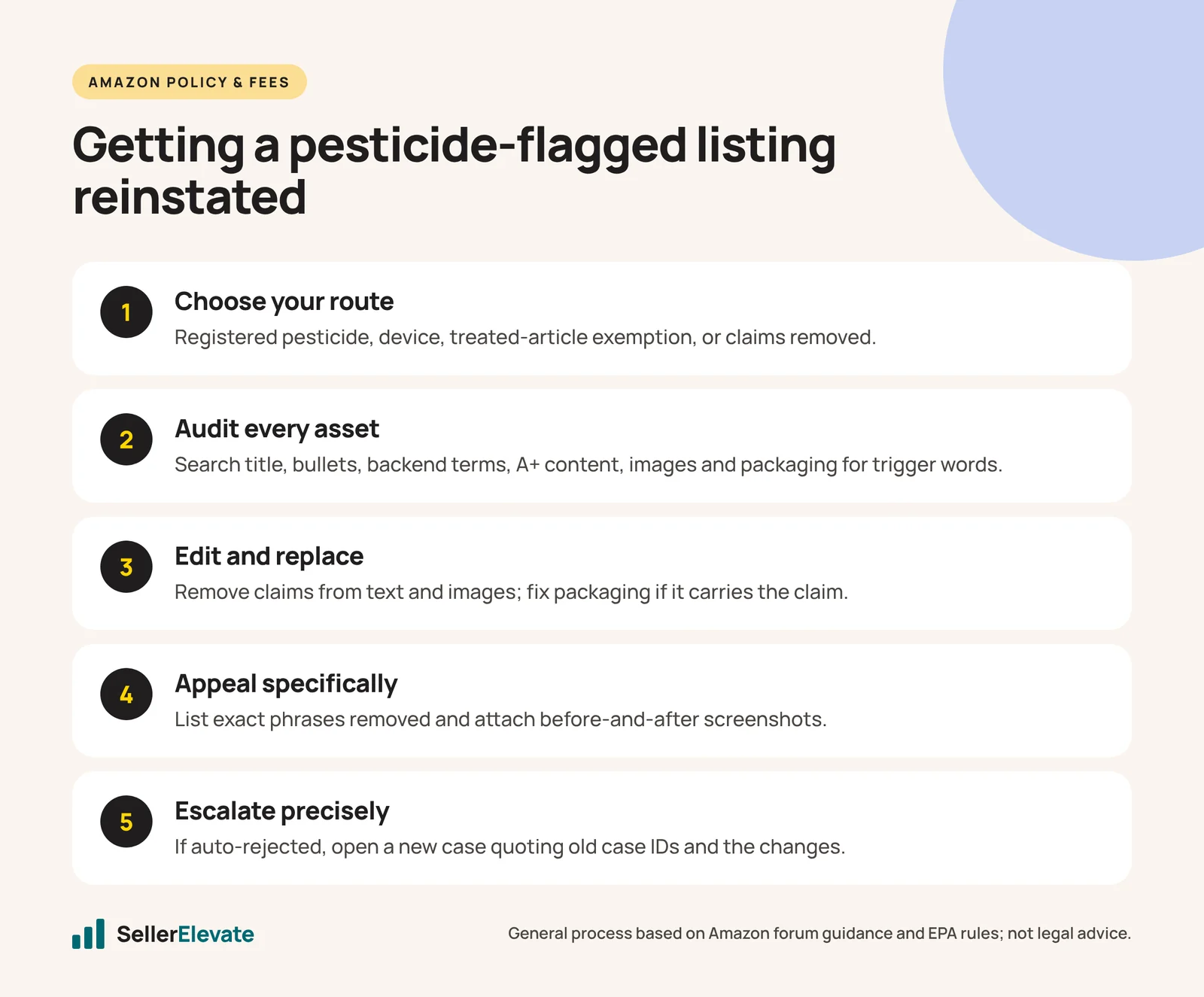
Use this order. Skipping steps is how sellers end up in the auto-reject loop.
- Decide your route. Registered pesticide, device with establishment number, treated-article exemption, or “not a pesticide, claims removed.” Most everyday products are the last one.
- Audit every asset. Export the listing, list every image, and search for the words in the table above. Check your packaging artwork too, because the images show it.
- Edit the listing. If the listing is locked, try a flat-file or “edit listing” update; in the forum case, the seller struggled to edit a suspended listing. If edits won’t save, open a case asking Amazon to allow edits so you can remove the claims, and quote the case ID from the notice.
- Replace images. New images without claims, including packaging shots. If the packaging itself carries the claim, you need new packaging or a compliant overlabel, and Amazon may ask for photos.
- Appeal with a short, specific note. Use the template below.
- If it is auto-rejected, open a new case quoting the old case IDs, list precisely what changed, and attach before-and-after screenshots.
Appeal template (claims removed)
ASIN [ASIN], case [case ID]. This product is a [plain product description]. It is not intended to kill, repel or control any pest and does not contain a pesticide. We have removed the following claims from the title, bullets, description, backend terms, A+ content and images: [list exact phrases removed]. Attached: screenshots of the updated listing, updated images, and packaging photos showing no pesticidal claims. Please reinstate the listing.
For the exemption route, replace the middle with: the treatment chemical, its EPA registration number, the supplier’s certification that it was applied to protect the article itself, and the revised claim wording.
What if the appeals keep getting rejected?
This happens. In a third forum thread, a seller who believed the products qualified for a FIFRA exemption said the compliance team “auto-rejected and did not read the appeal letter,” and Account Health suggested creating new listings with new ASINs and SKUs. The thread got no replies.
We would not take the new-ASIN route unless the old listing truly had no history worth keeping. Relisting the same product to dodge a compliance block can be treated as circumventing enforcement, and if the new listing repeats the old claims it will be flagged again.
What usually moves a stuck case:
- One precise change per resubmission, stated clearly. Repeating the same appeal gets the same result.
- Removing the claim from the packaging, not only the page.
- Asking Account Health for the specific phrase or image that is still flagging. A narrow question gets a narrower answer.
- A regulatory consultant or attorney if you genuinely sell a treated article and need the exemption documented properly.
What we'd do this week
- Search your whole catalog for the risky words, not just the flagged ASIN. Other listings are often next.
- Fix the flagged listing first, then the rest, starting with best sellers.
- Ask suppliers for the EPA registration number of any antimicrobial treatment you mention.
- Brief whoever writes your listings, human or AI: no germ, mold, odor-bacteria or pest claims without documentation.
- Appeal using the template, keeping a log of every case ID and change.
Copy that tripped this flag is often written by AI tools that love “antibacterial” and “hygienic.” Our listing optimization team rewrites listings to stay persuasive without these claims, and if the flag has hit your account health, our account suspension and reinstatement team handles the appeal. For a related problem, see what to do when your Amazon Account Health Rating drops below 200.
This is general information, not legal or regulatory advice. Confirm current Amazon policy in Seller Central and EPA rules with a qualified advisor.
Frequently asked questions
Can I say my product is antibacterial if the material is naturally antibacterial?
Not safely. Amazon flags antibacterial claims regardless of the reason behind them, because a claim to control bacteria can make a product a pesticide. Describe the material and its practical benefits instead, such as a non-porous surface or easy washing. Always keep the wording true to the product.
What is an EPA establishment number?
It identifies the registered facility where a pesticide or pesticide device was produced. EPA guidance shows a format like xxxx-PA-xx. Devices such as UV lights, ultrasonic repellers and traps need one even though they do not need product registration. Ask your manufacturer for it before appealing.
Should I create a new ASIN if my appeals keep failing?
We would not, unless the old listing has no history worth keeping. Relisting to avoid a compliance block can be treated as circumventing enforcement, and a new listing with the same claims will be flagged again. Fix the claims and resubmit precisely instead.
Do AI-written listings cause pesticide flags?
They often do. AI copy tools tend to add words like antibacterial and hygienic because they sound persuasive. Brief whoever writes your listings, human or AI, to avoid germ, mold, odor-bacteria or pest claims unless you hold documentation. Review every AI draft before it goes live.
Sources
- eCFR: 40 CFR 152.15, Pesticide products required to be registered (current as of October 2026)
- eCFR: 40 CFR 152.25, Exemptions for pesticides of a character not requiring FIFRA regulation (current as of October 2026)
- EPA: Pesticide Registration Manual, Chapter 13, Devices (accessed October 2026)
- Amazon Seller Forums: Product flagged as pesticide product (January 2025)
- Amazon Seller Forums: Textile listings removed due to pesticide (undated)
- Amazon Seller Forums: Restriction compliance team auto-rejects appeals (undated)
Get the honest version of your numbers
A free account audit from the person who would actually run your account.