Can a new Amazon listing outsell an older one with more reviews?
Yes. In a German cookware audit, GiPP's ten-month-old listing with 681 reviews sold 1,847 units against 957 for WMF's eleven-year-old listing with 3,536 reviews. The difference was keyword coverage: GiPP had 120 of 143 relevant keywords on page one, WMF's older listing 84. Price and brand can also substitute.
Key takeaways
- Listing age and review count are not destiny: two ten-month-old listings outsold an eleven-year-old listing from a household name.
- Of 500 keywords in the market, 143 carried 81% of all search volume.
- Sort keywords by relevancy first and volume second, because lower-volume terms like 'topf set induktionsgeeignet' show higher intent.
- The top relevancy keyword was 'tencere seti', Turkish for 'pot set', with 2,055 monthly searches and no competitor properly indexed.
- There are three ways to win a category: be findable, be trusted or be cheap, and you should pick deliberately.
Selling on a marketplace is not really about listing a product. It is about knowing exactly where you stand and, more usefully, where you are losing ground without noticing.
Below is a real competitive audit from the German cookware category: 500 keywords, 478,186 monthly searches, eleven competing listings. It is the kind of thing we build before touching a single bid, and it is worth walking through what it actually says — including the parts that contradict what most sellers assume.
The table
| Brand | Listing age | Reviews | Price | Units | Revenue | % of search volume on page 1 |
|---|---|---|---|---|---|---|
| WMF | 13 yrs 7 mos | 14,266 | €123.00 | 4,102 | €515,785 | 93% |
| Zwilling | 3 yrs 5 mos | 1,981 | €341.05 | 638 | €229,042 | 34% |
| Tefal | 2 yrs 12 mos | 2,895 | €219.98 | 955 | €210,081 | 70% |
| GiPP | 10 mos | 681 | €89.99 | 1,847 | €166,212 | 87% |
| Amazon | 6 yrs 5 mos | 58,233 | €74.99 | 1,886 | €141,431 | 50% |
| Redchef | 10 mos | 639 | €99.99 | 1,413 | €141,286 | 80% |
| WMF | 11 yrs 7 mos | 3,536 | €124.99 | 957 | €119,615 | 79% |
| KITCHEN | 1 yr 10 mos | 883 | €109.99 | 900 | €98,991 | 90% |
| SENSARTE | 1 yr 2 mos | 2,512 | €119.99 | 544 | €65,275 | 66% |
| Redchef | 1 yr 2 mos | 590 | €56.99 | 1,086 | €61,891 | 21% |
| La Moustache | 3 yrs 12 mos | 1,916 | €69.70 | 546 | €38,056 | 68% |
Do listing age and reviews decide Amazon rankings?
Look at GiPP. Ten months old. 681 reviews. It is outselling WMF’s eleven-year-old listing with 3,536 reviews — 1,847 units against 957, and €166,212 of revenue against €119,615.
Look at KITCHEN. Twenty-two months old, 883 reviews, and 90% of the category’s search volume appearing on page one — the second-highest coverage in the entire set.
The story sellers tell themselves is that incumbents win because they have been there longer and accumulated reviews. In this category the two ten-month-old listings are both beating an eleven-year-old one from a household name.
What separates them is not tenure. It is keyword coverage. GiPP has 120 of the 143 relevant keywords on page one. WMF’s older listing has 84.
But visibility is not the whole story either
Here is where an honest audit differs from a sales deck. If search coverage explained everything, the table would sort neatly. It doesn’t.
Across these eleven listings, the correlation between share of search volume on page one and units sold is about +0.4. Real, but far from deterministic. Two listings break the pattern hard, and both are instructive.
Zwilling has just 34% of search volume on page one and still produces €229,042 — second-highest revenue in the category. It does it by charging €341 against a category median of €109.99. Fewer units than most of the field, roughly three times the median price. That is brand equity substituting for search presence, and it is a legitimate strategy if you have the brand to support it.
Redchef’s second listing has only 21% of search volume on page one and still moves 1,086 units — more than KITCHEN, which has 90% coverage. It does it at €56.99, the lowest price in the set. Price substituting for visibility.
So there are three ways to win here: be findable, be trusted, or be cheap. Most brands try to be findable because it is the only one of the three they can change this quarter. That is a reasonable choice, but it should be a choice, not an assumption.
Are 1P or 3P sellers winning this category?
The seller data behind the table (not shown above) adds a pattern. The two WMF listings, Tefal and Amazon’s own listing sell through Amazon Retail, with between 3 and 32 sellers on each ASIN, all Amazon-fulfilled vendor relationships. GiPP, Redchef, KITCHEN and SENSARTE are third-party sellers running one to four FBA offers.
The legacy European brands hold the shelf through distribution and name recognition. The challengers hold it through keyword coverage. Right now, in this category, the challengers are converting that coverage into units faster than the incumbents are converting their name into them.
Which Amazon keywords actually matter?
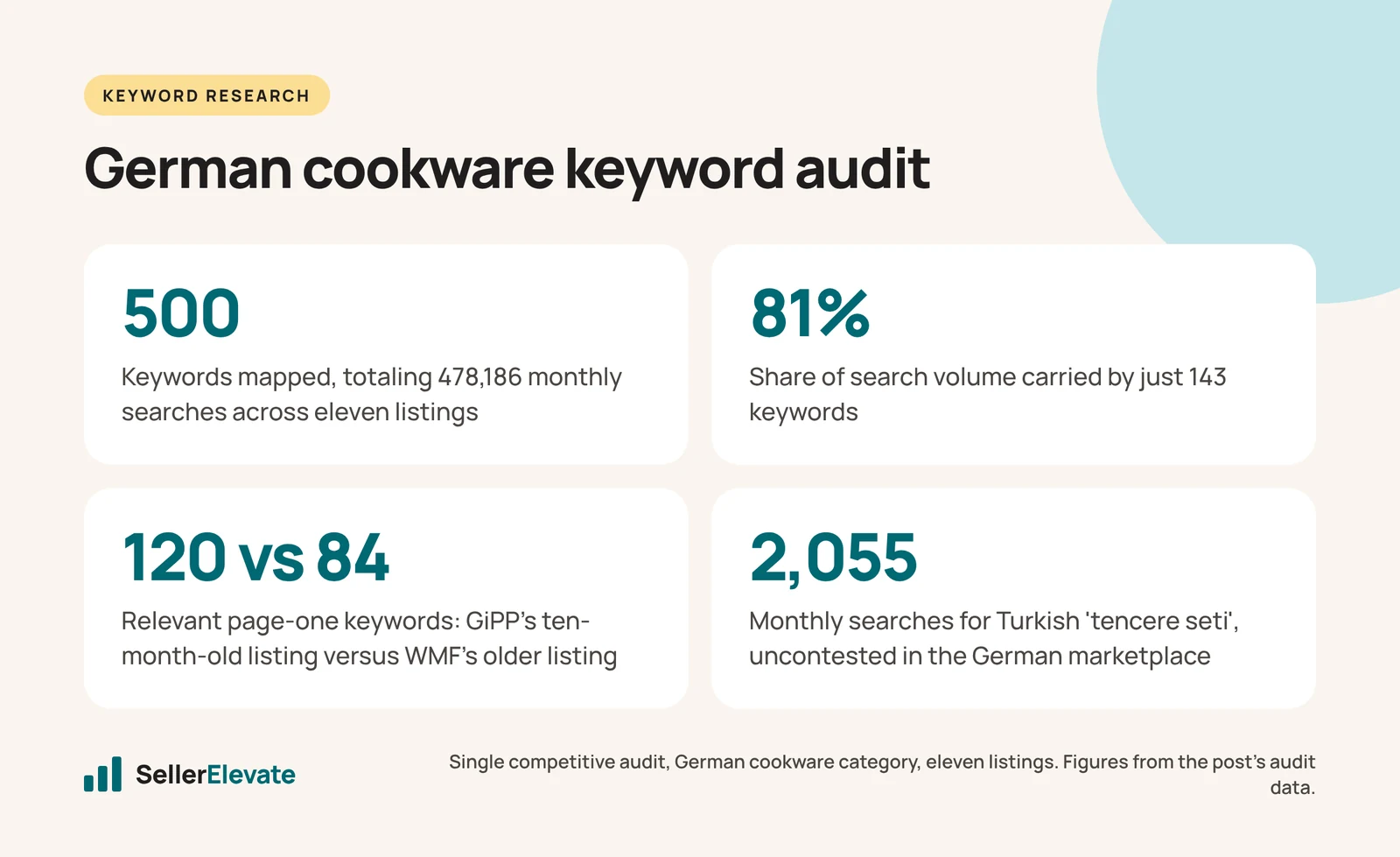
Of 500 keywords in this market, 143 carry 81% of all search volume. A single term, “topfset,” accounts for 56,374 searches — nearly 12% of the category on its own.
That concentration is why keyword lists sorted by search volume are so misleading. The head term looks irresistible and is contested by everyone with a budget. The audit sorts by relevancy first and volume second, which changes the picture completely: “topfset” scores 81% relevance, while “topf set induktionsgeeignet” at 1,321 searches scores 88%.
Fewer searches, higher intent. A shopper typing “induction-compatible pot set” has told you their hob type, which means they have told you whether your product fits. A shopper typing “pot set” has told you nothing.
This is what “which keywords actually generate revenue, not just high search volume” means in practice. Relevancy before volume, every time.
The finding nobody expects
Top of the relevancy-sorted list, at 88% relevance and 2,055 monthly searches, sits “tencere seti.”
That is Turkish for “pot set.” In the German marketplace.
Germany has a large Turkish-speaking population, and a meaningful number of them search Amazon in Turkish. None of the eleven competitors is properly indexed for it. It is 2,055 searches a month of genuine buying intent, in a category where the head term is contested by WMF and Zwilling, sitting there essentially uncontested.
You do not find that by brainstorming keywords. You find it by scraping what shoppers actually type and sorting by relevance rather than by what looks big.
What should you do with a competitive keyword audit?
Establish the benchmark before setting a target. Across the eleven listings: median review count 1,981, median listing age about three years, median price €109.99, median revenue €141,286. Now you know what “competitive” means here rather than guessing at it.
Find the gaps in coverage, not the gaps in effort. Every competitor’s page-one keyword count is visible above. The terms where three of eleven rank are cheaper to win than the terms where all eleven do.
Decide which of the three games you are playing. Findable, trusted or cheap. Pick deliberately, because trying to be all three at once is how brands end up with a premium price, thin coverage and no margin for discounting.
Then, and only then, set bids. Advertising into a category you have not mapped is how budgets get spent on the head term everyone else is also overpaying for.
This is what our free account audit produces, built on your category rather than a template. You keep it whether or not you work with us.
To build this kind of keyword list for your own product, follow our step-by-step Amazon keyword research method.
Frequently asked questions
What is a competitive keyword audit on Amazon?
It maps a category before any bids are set: the keywords shoppers use, their search volume and relevancy, and which competing listings rank on page one for them. This example covered 500 keywords, 478,186 monthly searches and eleven listings, showing where coverage gaps are cheaper to win.
Should I target Amazon keywords by search volume or relevancy?
Relevancy first, volume second. The head term 'topfset' had 56,374 searches but scored 81% relevance and is contested by everyone. 'Topf set induktionsgeeignet' had 1,321 searches and scored 88%, because a shopper naming induction compatibility has told you whether your product fits.
Does keyword coverage guarantee more sales on Amazon?
No. Across these eleven listings, the correlation between page-one search share and units sold was about +0.4: real but not deterministic. Zwilling had 34% coverage yet the second-highest revenue by charging a premium, and Redchef's cheaper listing sold 1,086 units on 21% coverage.
Should I target foreign-language keywords on Amazon Germany?
Check the data. In this audit the top relevancy term was 'tencere seti', Turkish for 'pot set', at 88% relevance and 2,055 monthly searches, and none of the eleven competitors was properly indexed for it. You find terms like that by scraping what shoppers type, not by brainstorming.
Get the honest version of your numbers
A free account audit from the person who would actually run your account.