Does delivery speed affect Amazon ranking?
Yes. Since Amazon's May 2025 ranking change, delivery speed carries more weight alongside customer satisfaction and external traffic, and it is one of four factors Amazon names for the Featured Offer. The date a shopper sees is set by where your inventory sits, so placement matters far more than how fast you pack orders.
Key takeaways
- Amazon delivered more than 13 billion items same-day or next-day globally in 2025, which sets the delivery expectation shoppers bring to every listing.
- Amazon names delivery speed and certainty as one of four Featured Offer factors, so a modestly higher price can still win with a better delivery promise.
- The delivery date is shown before the sale, so inventory placement near customers matters far more than picking and packing quickly.
- From 6 July 2026, Seller Fulfilled Prime requires 40% of Prime page views for standard-size items to show a one-day date, up from 30%.
- FBA fees rose about $0.08 per unit on average on 15 January 2026, and for oversized items two-day coverage can cost more than the margin it protects.
Open almost any Amazon product page today and you will see a version of this: a free delivery date several days out, and underneath it, in red, a same-day window with a countdown attached. Order within 5 mins.
That countdown is doing more work than it looks like it is doing.
The scale of the shift
Amazon delivered more than 13 billion items same-day or next-day globally in 2025. In the US alone, over 8 billion arrived within 24 hours — a 30% increase on the year before. Same-day delivery now reaches more than 2,300 US cities and towns, and one-hour delivery has gone live on roughly 90,000 products, currently skewed toward consumables and everyday essentials.
That is the baseline every shopper now measures your offer against, whether you fulfil through Amazon or not.
The familiar argument follows easily: people want things now, Amazon owns the impulse purchase, and a brand absent from the platform hands those shoppers to a competitor. All true, and we have written about why not selling on Amazon does not keep you off Amazon.
But there is a more useful point underneath it, and most sellers who are already on Amazon are missing it.
Is delivery speed an Amazon ranking factor?
In May 2025 Amazon replaced a ranking model dominated by sales velocity with a multi-factor one, in which customer satisfaction, delivery speed and external traffic all carry a larger share. Sales volume alone stopped being enough.
The same is true of the Featured Offer — the Buy Box. Amazon’s own public guidance names four things: competitive total price, delivery speed and certainty, order experience and seller performance, and stock availability. A modestly higher price can still win if the delivery promise is meaningfully better. A low price can lose outright if the item is out of stock or the delivery date is distant.
Notably, delivery speed now matters more than fulfilment type. Amazon began phasing out seller-level Featured Offer eligibility requirements globally in July 2026, and merchant-fulfilled sellers with strong metrics can compete. What is being judged is the promise on the page, not the logo behind it.
So “faster shipping improves conversion” understates it. Faster shipping improves the position you convert from.
What is the difference between proactive and reactive delivery speed?
This is the distinction that decides whether any of this is actionable for you.
Reactive speed is picking and packing quickly once an order lands. It feels like the thing to optimise, and it barely matters.
Proactive speed is having inventory close enough to the customer that the product page already shows a one-day or two-day date before anyone orders anything.
The delivery promise is generated before the sale, from where your stock physically sits. A shopper decides based on the date they can see. By the time your warehouse is picking fast, the decision has already been made.
Which means delivery speed is not really a logistics problem. It is an inventory placement problem, and it is one of the few conversion levers you can pull without touching your listing, your price or your ad spend.
What that means in practice
If you are on FBA, one-day and same-day eligibility is not automatic. Amazon decides based on where your inventory sits, your Prime status and sales performance. Splitting inbound shipments across regions rather than sending everything to one facility is what puts stock near more customers. Going out of stock does more damage than a slow delivery date, because an unavailable offer cannot win the Featured Offer at any price.
Note also that Amazon tightened storage limits from six months of forecasted sales to five, which for some sellers cut capacity substantially and cascaded straight into stock-outs and lost Buy Box share. Restock planning is now a Buy Box activity, not just a finance one.
If you are on Seller Fulfilled Prime, the bar moved on 6 July 2026 and it moved up. For standard-size items, 40% of Prime customer page views must now show a one-day delivery date, up from 30%. The two-day threshold rose from 70% to 75%. For extra-large items, 25% must show a two-day date, up from 15%. Amazon added a per-ZIP delivery promise tool so sellers can commit accurate dates by destination rather than failing a single national promise, and applied a grace period on speed metrics running to 17 October 2026.
Single-warehouse SFP sellers on either coast are the most exposed, because cross-country ground transit cannot produce national two-day coverage from one location. If that is you, the answer is a second warehouse or a move back to FBA, and both take months.
Whatever your model, on-time delivery rate is checked weekly now rather than monthly, and falling below threshold risks listing restrictions.
What does faster delivery cost Amazon sellers?
Speed has been priced in, and honestly it should be said out loud.
FBA fees rose again on 15 January 2026, adding about $0.08 per unit on average. More significantly, inbound defect fees jumped from a range of $0.02 to $0.07 up to $0.32 to $1.74 for standard items, which turns sloppy prep from an annoyance into a real line item. Peak surcharges ran from late October through mid-January.
For oversized and heavy categories in particular, the cost of two-day coverage can now exceed the margin it protects. That is a genuine strategic decision, not a formality: some products no longer pencil as Prime offers, and pretending otherwise is how a brand funds its own decline.
What we would actually check
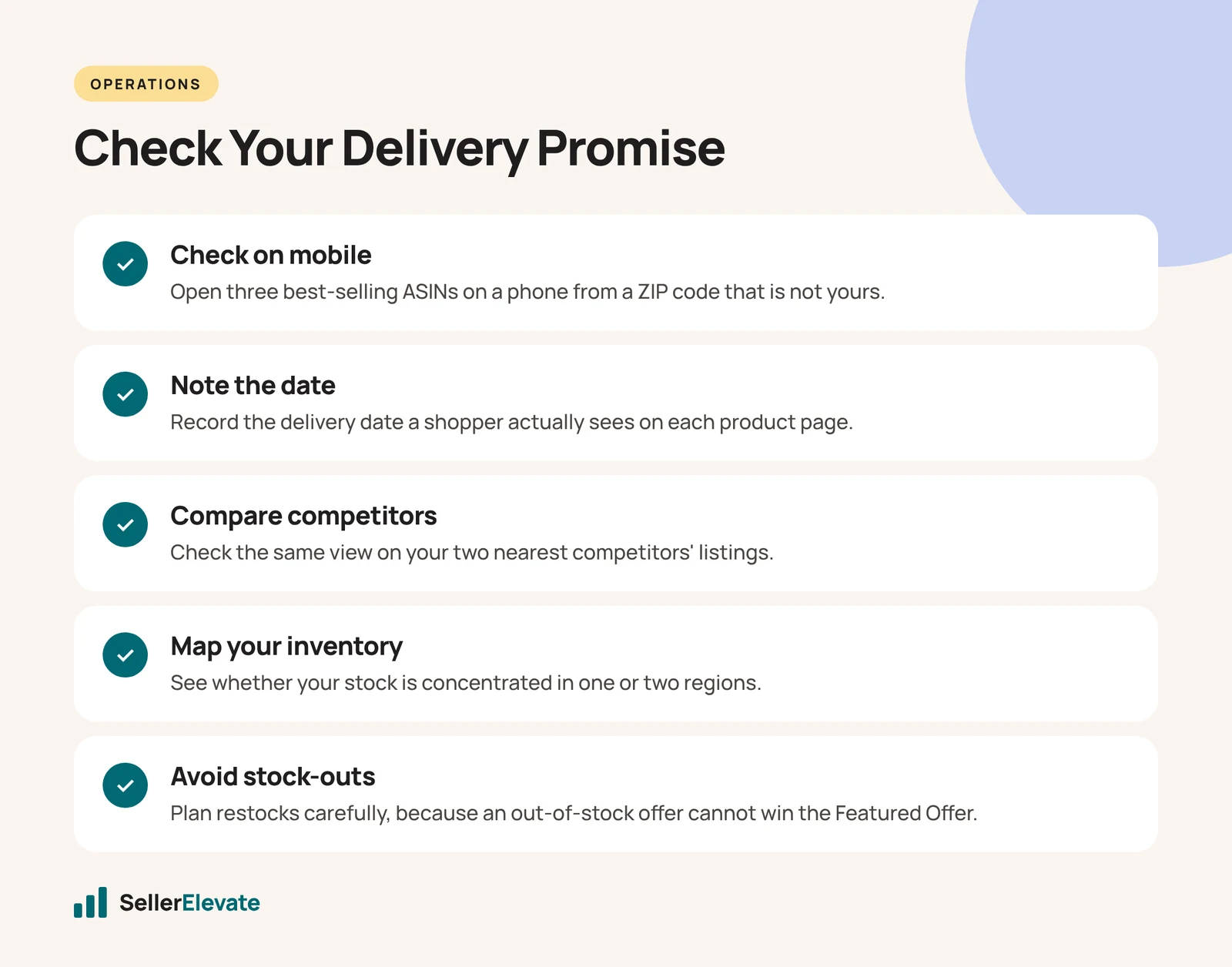
Pull up three of your best-selling ASINs on a phone, not a desktop, from a ZIP code that is not your own. What delivery date does a shopper see? Then check the same ASIN against your two nearest competitors.
If their date is better than yours, you are losing sales you will never see in a report, because the shopper never clicked. No amount of bid optimisation recovers that, and it will not show up as an advertising problem even though it will show up in your advertising numbers.
Then look at where your inventory actually is. If it is concentrated in one or two regions, your delivery promise is strong for a slice of the country and mediocre for the rest, and your conversion rate is an average of those two experiences.
That is usually a fixable problem. It is also one almost nobody looks at until someone points at it.
Delivery date, inventory distribution and Featured Offer share are part of what we look at in a free account audit — alongside the advertising, because in 2026 they are the same conversation.
Frequently asked questions
What decides whether my FBA product shows one-day delivery?
Amazon decides based on where your inventory sits, your Prime status and sales performance, so one-day and same-day eligibility is not automatic. Splitting inbound shipments across regions rather than sending everything to one facility puts stock near more customers. Staying in stock matters most, because an unavailable offer cannot win the Featured Offer at any price.
What are the new Seller Fulfilled Prime delivery requirements?
From 6 July 2026, 40% of Prime customer page views for standard-size items must show a one-day delivery date, up from 30%, and the two-day threshold rose from 70% to 75%. For extra-large items, 25% must show a two-day date, up from 15%. Amazon added a per-ZIP delivery promise tool. Check Seller Central for the current rule.
Can merchant-fulfilled sellers win the Buy Box on Amazon?
Yes, if their metrics are strong. Amazon began phasing out seller-level Featured Offer eligibility requirements globally in July 2026, and delivery speed now matters more than fulfillment type. Amazon judges the delivery promise on the page alongside competitive total price, order experience and seller performance, and stock availability.
How do I check if slow delivery dates are costing me sales?
Open three of your best-selling ASINs on a phone from a ZIP code that is not your own and note the delivery date shown, then compare your two nearest competitors. If their date is better, you are losing clicks that never appear in a report. Then check whether your inventory is concentrated in one or two regions.
Get the honest version of your numbers
A free account audit from the person who would actually run your account.