How do I respond to an intellectual property complaint on Amazon?
Classify it as trademark, copyright or patent, then decide whether it is valid. If your content caused it, fix the listing and appeal. If you sell genuine goods, dispute with invoices. Ask the rights owner for a retraction in parallel, and do not acknowledge or delete a complaint you can beat.
Key takeaways
- Every Amazon IP complaint is a trademark, copyright or patent claim, and each needs a different response.
- Choosing Acknowledge means agreeing you infringed and agreeing to delete the affected listings.
- A retraction only works when Amazon can match it to your case, so the rights owner must cite the ASIN and complaint ID.
- Deleting a listing does not remove the complaint from your account; fixing and appealing does.
Respond to an Amazon IP complaint by first working out whether it is valid, then choosing the matching route: fix the listing and appeal, dispute it with documents, or ask the rights owner for a retraction. The two moves that make it worse are clicking “Acknowledge” on a complaint you could have beaten, and sending an emotional appeal that does not address the specific claim.
Here is how we sort them and what we send.
What kind of IP complaint is this?
Every IP notice falls into one of three buckets, and each needs a different response. Traverse Legal’s breakdown of IP complaints on Amazon uses the same split we do.
| Complaint type | What it protects | Common trigger | Usual fix |
|---|---|---|---|
| Trademark (including counterfeit) | Brand names, logos, words that identify goods | Another brand’s name in your title, bullets or keywords; selling a branded item without proof of authenticity | Remove the mark from your content, or prove authenticity with invoices or authorization |
| Copyright | Photos, text, video, A+ content | Supplier images or copied descriptions | Replace the content with your own originals |
| Patent (utility or design) | How a product works or looks | Your product resembles a patented product | Legal analysis; content edits rarely help |
Write down three things from the notice before you do anything else: the ASIN, the rights owner and their contact details, and the complaint ID. You will need all three for every route below.
Is the complaint valid?
Be honest here, because the right answer depends on it.
It is probably valid if: you used another brand’s name in your title or search terms; you used images or text you did not create; you sell a branded product but cannot produce invoices from an authorized source; or your product closely copies a patented design and you have no legal opinion saying otherwise.
It is probably invalid if: you sell your own brand with your own content; you sell genuine branded goods with invoices that trace back to the brand or an authorized distributor; the complainant is not the owner of the mark they cite; or the complaint names a patent that does not cover your product.
There is a middle case we see often: compatibility products. If you sell an accessory that fits another brand’s product, you may refer to that brand only in a way that does not suggest affiliation. Goat Consulting suggests the format “Your Brand: Product compatible with [Trademarked Brand]” in its IP complaint appeal guide. Leading with the other brand’s name is what triggers complaints.
Should I appeal, dispute, acknowledge or ask for a retraction?
Amazon gives you response options in the notice. Goat Consulting describes three:
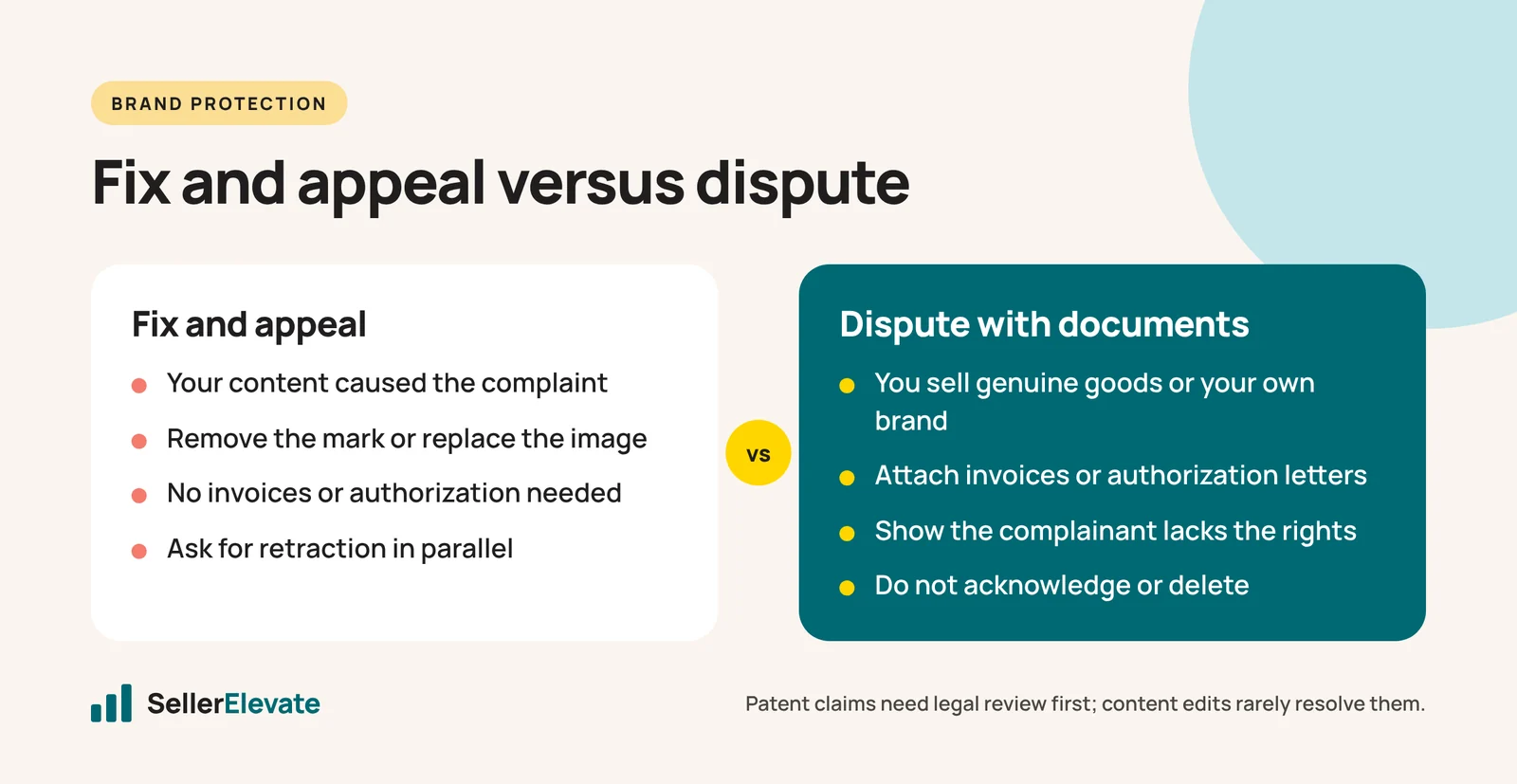
- Appeal: you correct the listing (remove the trademark, replace the image) and ask for reinstatement. No invoices or authorization letter needed.
- Dispute: you argue the complaint is wrong and support it with invoices, authorization letters or licensing agreements.
- Acknowledge: you agree with the violation and agree to delete the affected listings.
Then there is the route outside that menu: retraction. You contact the rights owner and ask them to withdraw the complaint. Content can be reinstated when Amazon receives the retraction. Traverse Legal adds a detail that trips people up: a withdrawal only works when Amazon can match it to your case, so the rights owner must reference the ASIN and the complaint ID.
Decision rules we use:
- If your content caused it (a brand name in your title, a supplier photo), fix the content, then appeal. Also ask for a retraction if the rights owner is a legitimate brand that is likely to respond.
- If you sell genuine goods with clean invoices, dispute with documents. Redacting prices on invoices is normal; removing supplier details is not.
- If the complaint is a patent claim, slow down. Traverse Legal’s advice is to consider pulling the listing while you evaluate, because listing edits rarely solve a real patent dispute. Get a patent attorney’s view before you argue non-infringement.
- If the complaint is valid and you have no rights, acknowledging may be correct. Just be sure. Acknowledging means agreeing that you infringed.
- If the complaint looks false or abusive, do not acknowledge it. Our post on getting a false IP complaint retracted covers that route in detail.
Valid appeals typically take one to seven business days for Amazon to review, according to Goat Consulting, though Amazon publishes no service level for this.
Why deleting the listing is often the wrong move
Sellers delete the listing because it feels like the complaint will disappear with it. It does not.
The complaint is tied to your account, not just the listing. Deleting the ASIN removes your chance to fix the content and appeal, so the notice stays on your record unresolved. Goat Consulting quotes Amazon’s position that multiple IP notices can lead to account deactivation and that Amazon terminates the accounts of repeat infringers in appropriate circumstances. One unresolved complaint is a problem you can carry. Several, stacked up because each was deleted instead of resolved, is how accounts get deactivated.
Deleting is reasonable in one situation: the complaint is valid, you have no rights, and you are choosing “Acknowledge” deliberately. Otherwise, keep the listing, fix it, and get the complaint resolved on the record.
A retraction request you can send
Keep it short, factual and polite. Do not threaten, and do not argue the law in the first message.
Subject: Request to withdraw complaint [complaint ID], ASIN [ASIN]
Hello,
Amazon notified us of your complaint [complaint ID] regarding ASIN [ASIN] on [date].
We have reviewed the listing and [removed the reference to your trademark from the title and search terms / replaced the images in question with our own photography / confirmed the units are genuine, purchased from (authorized distributor)].
If this resolves your concern, would you please submit a retraction to Amazon referencing complaint ID [complaint ID] and ASIN [ASIN]? Amazon can only reinstate the listing when the retraction matches the case.
Thank you,
[Name, company, store name]
Send it from a business email to the address in the notice. Log the date. If there is no reply in about a week, proceed with your appeal or dispute anyway; a retraction is a parallel track, not a reason to wait.
What we'd do this week
- Read the notice and classify it: trademark, copyright or patent.
- Audit the listing for the exact content cited and fix anything that is genuinely yours to fix.
- Pull invoices and authorization letters if authenticity is in question.
- Send the retraction request and submit the appeal or dispute the same day.
- Check every other ASIN for the same issue. If one listing had a competitor’s brand in the search terms, others probably do too.
- If you own the brand, start or finish Brand Registry. It is free, a pending trademark is enough to enroll, and it gives you tools to protect your own listings. Our trademark registration team can help with the filing.
If you have more than one IP complaint open, or a patent claim on a core product, that is the point to get help. Our account suspension and reinstatement team handles these, and we will tell you when the right answer is a lawyer rather than an appeal.
Frequently asked questions
How long does Amazon take to review an IP appeal?
Goat Consulting reports that valid appeals typically take one to seven business days, though Amazon publishes no official service level. Submitting a complete file the first time, with the complaint ID, ASIN and supporting documents, avoids the back-and-forth that adds delays.
Can I mention another brand on my listing if my product is compatible with it?
Yes, carefully. Lead with your own brand and make a factual compatibility statement, for example Your Brand: Product compatible with the other brand's product. Putting the other brand's name first, or in search terms, is a common trigger for trademark complaints.
What documents work for an IP dispute?
Invoices from the manufacturer or an authorized distributor, letters of authorization sent directly from the rights owner, licensing agreements, and Amazon order IDs if you bought through Amazon. Prices on invoices can be redacted, but supplier names, addresses and dates should stay visible so Amazon can trace the supply chain.
Do IP complaints affect my account health?
Yes. Amazon's position is that multiple IP notices can lead to account deactivation and that it terminates repeat infringers in appropriate circumstances. Resolving each complaint on the record, rather than deleting listings, keeps that risk lower and leaves a clean history if another complaint arrives.
Sources
- Goat Consulting: Amazon IP complaint appeal (undated)
- Traverse Legal: Responding to an IP complaint on Amazon (undated)
- Amazon: IP Accelerator (accessed October 2026)
Get the honest version of your numbers
A free account audit from the person who would actually run your account.