Why did my Meta ROAS drop in 2026?
Most likely because Meta changed how it counts conversions. In March 2026 click-through attribution was narrowed to link clicks, and conversions after likes, comments, shares, saves and video views moved to engage-through attribution. Common Thread found 7-day click ROAS dropped 13% across 50 accounts. Check total conversions and blended revenue before assuming a real decline.
Key takeaways
- Meta removed 7-day and 28-day view windows from the Ads Insights API on January 12, 2026.
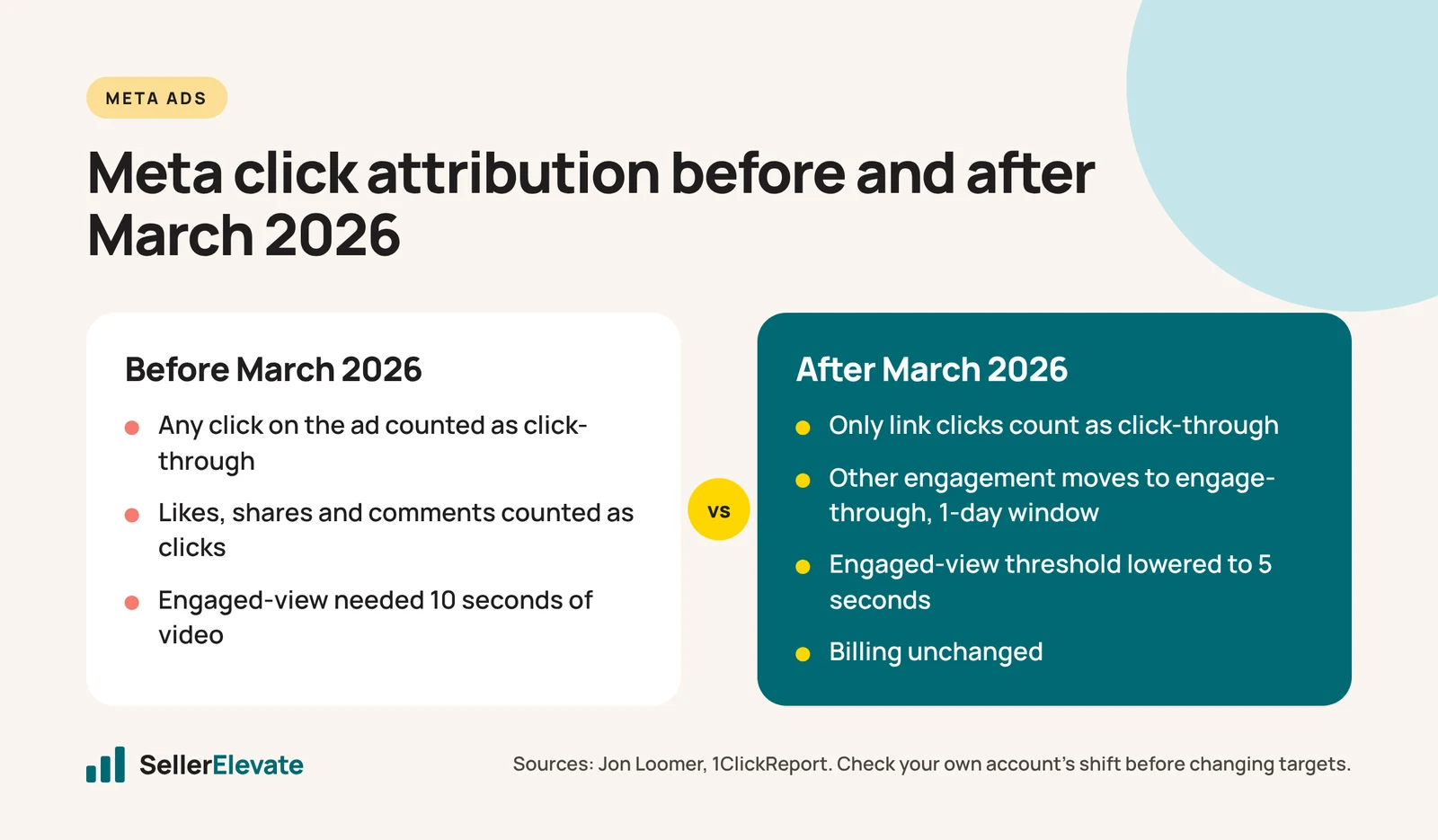
- In March 2026 click-through attribution was narrowed to link clicks, and other engagement moved to engage-through attribution with a 1-day default window.
- Common Thread Collective measured a 13% overnight drop in 7-day click ROAS across 50 high-spend accounts.
- Billing did not change, so a reported ROAS drop is not the same as a drop in sales.
- Report blended return, all three conversion types and new-customer count to founders.
If your Meta ROAS fell in March 2026 and nothing else changed, the most likely reason is how Meta counts conversions, not how many you made. Meta narrowed click-through attribution to link clicks only and moved conversions after likes, comments, shares, saves and video views into a new bucket called engage-through attribution, so the “7-day click” number you were watching got smaller.
That is not the whole story for every account, and this post covers how to tell a reporting change from a real decline. It also covers the earlier January change to view windows, and what to put in front of a founder who just wants to know whether Meta still works.
What changed in Meta attribution in 2026?
Two separate changes landed in the first quarter.
January 12, 2026: longer view windows removed from the API. PPC Land reported in October 2025 that Meta would remove the 7-day view and 28-day view attribution windows from the Ads Insights API, effective January 12, 2026. The same change limited some historical data: unique-count fields and hourly breakdowns to 13 months, and frequency breakdowns to 6 months. Aggregate metrics stay available for 37 months. Any dashboard or third-party tool that relied on 7-day or 28-day view numbers lost them.
March 2026: click-through narrowed, engage-through added. Jon Loomer explains that click-through attribution previously included “social clicks and other clicks on ad elements other than links.” Now it counts link clicks (plus actions like click to call, click to message and lead forms). Conversions after any other interaction moved to engage-through.
Here is how the three types line up now, using the defaults Loomer lists:
| Attribution type | What triggers it | Default window |
|---|---|---|
| Click-through | Link clicks to your site or app, plus call, message and lead-form actions | 7 days |
| Engage-through | Likes, reactions, comments, shares, saves, other non-link clicks, and engaged video views | 1 day |
| View-through | Saw the ad, no click or engagement | 1 day |
1ClickReport adds that the engaged-view threshold for video dropped from 10 seconds to 5 seconds, and that billing is not affected: you still pay on CPM or your optimization event.
Why did my Meta ROAS drop if sales didn't?
Because some conversions that used to be called click-through are now called engage-through. If your reports, rules or targets only look at click-through, those conversions vanished from your view even though Meta still reports them.
1ClickReport gives a simple illustration (their numbers, not real client data). Before the change: 500 click-through conversions, $25,000 in revenue, 2.5x ROAS. After: 350 click-through ($17,500, 1.75x) plus 150 engage-through ($7,500). Total attributed revenue is still $25,000. Only the label moved.
How big is the effect in practice? Common Thread Collective compared 50 high-spend accounts with $29.5M in combined spend, March 4 to 17 versus March 18 to 31, and found 7-day click ROAS dropped 13% overnight. They suggest rebenchmarking targets by roughly that much, so a 2.0x target becomes about 1.74x.
Sources differ slightly on timing. 1ClickReport says Meta announced the change on March 3 and began rolling it out later in the month; Common Thread’s data shows the break on March 18. If you compare periods, avoid straddling the second half of March.
Two caveats before you relax:
- 13% is an average across one agency’s accounts. Your shift depends on how much of your traffic engages without clicking. Video-heavy and Reels-heavy accounts tend to have more of it.
- A real decline can hide inside a reporting change. If your ROAS dropped 35%, attribution probably explains part of it, not all of it.
How do you compare before and after fairly?
The goal is to compare like with like, then check against numbers Meta does not control.
- Add the engage-through column back in. In Ads Manager reporting, include click-through, engage-through and view-through conversions. Compare the sum after the change with the old click plus view totals before it.
- Estimate the old click share. 1ClickReport suggests exporting your last 90 days with both link clicks and all clicks, then using link clicks divided by all clicks to estimate how much of your old click-through figure came from non-link clicks.
- Check your own backend. Total store revenue divided by total ad spend (often called MER or blended ROAS) does not care how Meta labels anything. If it held steady while Meta ROAS fell, the drop is mostly reporting.
- Compare the same weeks year over year where you can, to strip out seasonality.
- Fix your automated rules. Any rule that pauses ads below a click-through ROAS threshold is now stricter than when you wrote it. Lower thresholds or switch them to total conversions.
- Repair third-party dashboards. If a tool still shows 7-day or 28-day view columns, they stopped updating from the API on January 12, 2026.
One note for Amazon brands: if your Meta ads send shoppers to an Amazon listing, Meta’s pixel never sees the purchase at all. Judge those campaigns on Amazon’s own attribution data and on branded search and sales lift on Amazon, not on Meta-reported ROAS.
Did the change affect delivery, or only reporting?
Mostly reporting. 1ClickReport notes that billing did not change: you still pay on CPM or your optimization event. The change is in which bucket a conversion lands in and, for anyone looking only at click-through, whether it shows up at all.
There is one side effect worth welcoming. Common Thread points out that the narrower click definition lines up better with Google Analytics 4’s session attribution, since GA4 only sees people who actually reached your site. If your Meta and GA4 numbers never matched, the gap should be smaller now.
Common Thread also raised its own Meta 7-day click incrementality factor from 1.2x to 1.38x after the change. In plain terms, they now assume each reported click conversion stands for more real sales than before. If you use an incrementality multiplier in your planning model, revisit it rather than leaving the old one in place.
What should you report to a founder?
Founders do not need an attribution lecture. They need to know whether the money is working. We would put three numbers on one page:
- Blended return: total revenue divided by total marketing spend, this month versus the same month last year.
- Meta-reported conversions, all three types, with a one-line note that the definitions changed in March 2026.
- New-customer count from your store or Amazon data, since prospecting is usually what Meta is paid to do.
And one sentence of interpretation. A hypothetical example: “Meta’s reported ROAS is down 12% since March because of a counting change; blended return is flat and new customers are up, so we are holding budget.” If blended return is down too, say so plainly and say what you are testing next. Our post on five questions to answer before you scale covers the economics side of that conversation.
What we'd do this week
- Add engage-through and view-through columns to your default Ads Manager view.
- Pull March 4 to 17 versus March 18 to 31 for your account and measure your own shift instead of borrowing someone else’s 13%.
- Rebase ROAS targets and automated rules on the new definition.
- Build the one-page founder report above and agree on blended return as the headline number.
- Look at creative next. Attribution explains reported drops; it does not explain a real slowdown. If blended numbers fell, read our post on Meta Andromeda and creative volume.
If you want someone to audit the tracking and the reporting together, our social media marketing team handles Meta for ecommerce and Amazon brands.
Frequently asked questions
What is engage-through attribution on Meta?
Engage-through attribution counts conversions after someone interacts with your ad without clicking a link, such as liking, commenting, sharing, saving or other non-link clicks, plus engaged video views. Jon Loomer lists its default window as 1 day. It replaced Meta's older engaged-view attribution in March 2026, when click-through was narrowed to link clicks.
Does the attribution change affect what I pay Meta?
No. According to 1ClickReport, billing is unaffected and you still pay on CPM or your optimization event. The change only moves conversions between reporting buckets. If you watch click-through alone, some conversions seem to vanish, but Meta still reports them as engage-through or view-through.
Why did my third-party dashboard lose 28-day view data?
Meta removed the 7-day view and 28-day view attribution windows from the Ads Insights API effective January 12, 2026, as PPC Land reported. Tools that pull from the API cannot show those windows after that date. Rebuild dashboards on the current default windows and compare against your own store data.
How much should I lower my Meta ROAS target?
Measure your own shift rather than borrowing a figure. Common Thread suggested about 13% based on its accounts, turning a 2.0x target into roughly 1.74x, but video-heavy accounts may move more. Compare March 4 to 17 with March 18 to 31 in your account, then rebase targets and automated rules.
Sources
Get the honest version of your numbers
A free account audit from the person who would actually run your account.