Does traffic from ChatGPT convert?
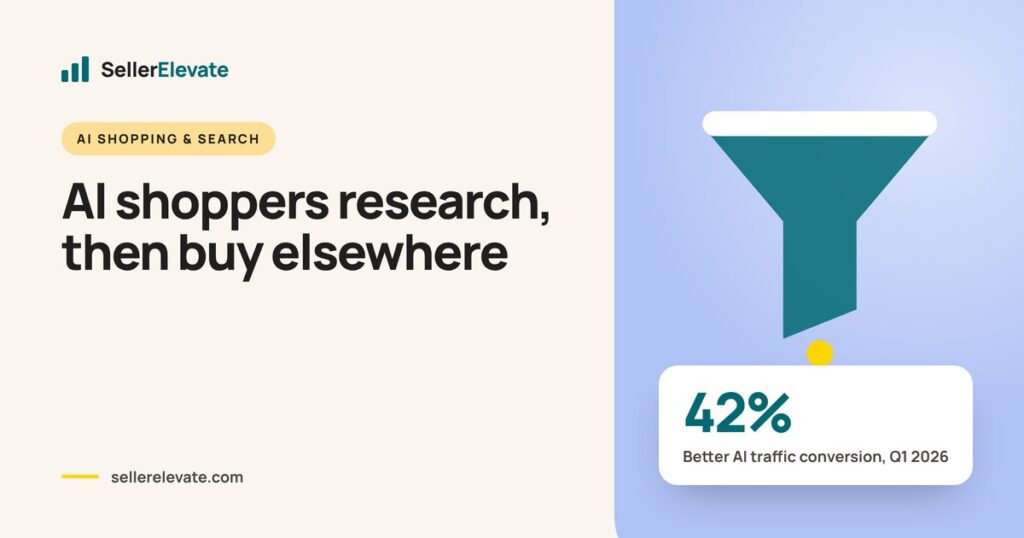
Yes. Adobe found AI-referred traffic to US retail sites converted 42% better than non-AI traffic in Q1 2026, up from 38% worse a year earlier. But few people buy inside the AI tool: one survey found only 2.18% had completed a whole purchase there. Shoppers research with AI and buy elsewhere.
Key takeaways
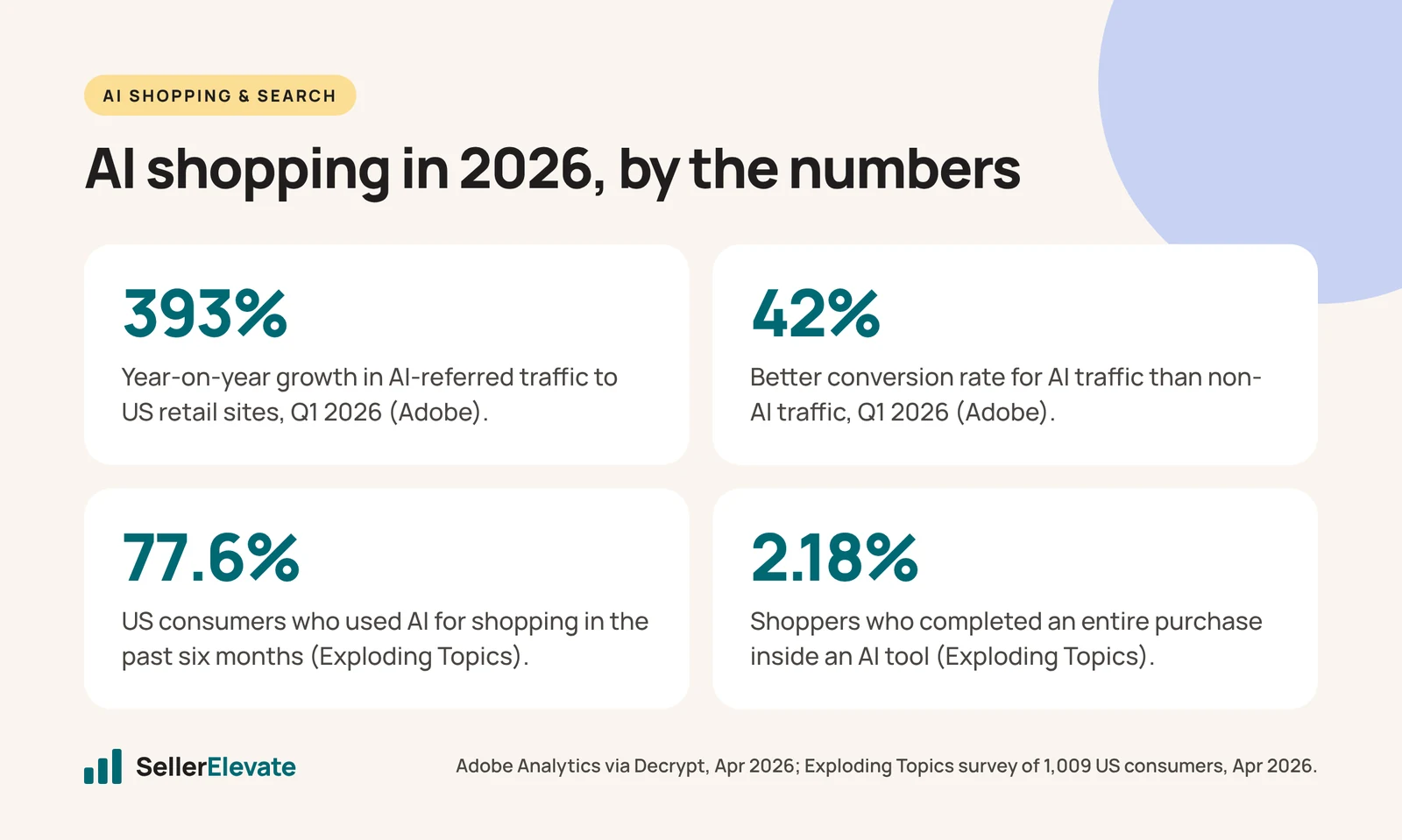
- Adobe found AI-referred traffic to US retail sites rose 393% year on year in Q1 2026 and converted 42% better than non-AI traffic.
- A year earlier, in Q1 2025, AI traffic converted 38% worse than other channels.
- An Exploding Topics survey of 1,009 US consumers found 77.6% used AI for shopping but only 2.18% completed a purchase inside the AI tool.
- Analytics undercounts AI because journeys that start in ChatGPT and end elsewhere happen about 5 times more often than direct clicks.
- The best investment for most brands is product data and product pages, not in-chat checkout integrations.
Yes, traffic from ChatGPT and other AI assistants now converts, and in early 2026 it converted better than other traffic: Adobe found AI referrals to US retail sites converted 42% better than non-AI traffic in Q1. But very few people buy inside the AI tool itself. One survey found only 2.18% of US shoppers had completed a whole purchase inside an AI assistant.
Put those two facts together and you get the pattern that matters for 2026: people research with AI and buy somewhere else. Here is the data behind that, and where we think brands should put their time and money.
Does traffic from ChatGPT convert?
The best large-scale data comes from Adobe Analytics, which tracks over 1 trillion visits to US retail sites. Its Q1 2026 figures, reported by Decrypt on April 19, 2026:
| Metric | Q1 2026 |
|---|---|
| AI-referred traffic to US retail sites, year on year | Up 393% |
| Conversion rate vs non-AI traffic | 42% better |
| Revenue per visit vs non-AI traffic (March 2026) | 37% higher |
| Time on page | 48% higher |
| Pages per visit | 13% more |
The change from a year earlier is the striking part. In Q1 2025, Adobe found AI traffic converted 38% worse than other channels. In twelve months it went from a weak channel to one of the better ones.
Shopify’s numbers point the same way. At its Q2 results on August 5, 2026, Shopify said AI-driven traffic and orders had both tripled year on year, according to Stellagent. It also said about half of AI-referred sessions land directly on product pages, and that new buyers arrive through AI channels at nearly twice the rate of other channels.
Why would AI visitors convert better? The likely explanation is that they have already done their research. Someone who asks ChatGPT to compare three blenders under $150, reads the answer, and then clicks through to one of them is much further along than someone clicking a broad search ad. They arrive with fewer questions.
Two caveats before you redirect your budget. First, growth rates of 393% start from a small base. Adobe and Shopify report growth, not what share of total retail traffic AI now drives, and Shopify said traditional search still accounts for roughly one third of storefront sessions. Second, Adobe’s figures are an average across many retailers and categories. Your own numbers may look different, which is why we suggest measuring them below.
Do customers actually buy through AI agents?
Mostly, no. An Exploding Topics survey of 1,009 US consumers, published April 27, 2026 and reported by TechWyse, found:
- 77.6% had used AI for shopping in the past six months.
- 68.5% used it for product research.
- Only 2.18% had completed an entire purchase inside the AI tool.
- 44.03% used AI as a starting point and then checked out somewhere else.
- 31.21% would let an AI agent spend $0 on their behalf without approval. Only 11.71% were comfortable with more than $100 per transaction.
Those figures come from one survey of about a thousand people, so treat the decimals loosely. The direction is clear, though, and the market has already reacted to it. On March 24, 2026, OpenAI said its first version of Instant Checkout “did not offer the level of flexibility” it wanted and moved ChatGPT shopping to discovery, with purchases finished on merchants’ own sites (TechInformed). Walmart had reported that ChatGPT checkout converted at about one third of its own website’s rate, according to Stellagent.
So the honest summary of 2026 is this: AI is now a major research tool for shoppers, a fast-growing and well-converting source of site visits, and so far a poor place to complete the sale.
Why does your analytics undercount AI?
If you look at referral traffic from chatgpt.com in your analytics and think “that’s tiny,” you are probably right about the clicks and wrong about the influence.
Similarweb found that shopping journeys which start in ChatGPT and end in a purchase later, through Google, a retailer’s own search, or a marketplace, happen about 5 times more often than journeys with a direct ChatGPT-to-retailer click. Someone asks ChatGPT which protein powder has the cleanest ingredient list, gets your brand name, and then searches for you on Amazon. Your analytics records that as an Amazon organic sale. ChatGPT gets no credit.
For Amazon sellers this is the normal case. Amazon blocks OpenAI’s crawlers, so ChatGPT rarely links to Amazon directly (we explain why in why ChatGPT rarely sends traffic to Amazon). The influence shows up as branded search on Amazon instead.
Where should brands actually invest?
Based on the data, here is how we would rank the options for a typical brand in Q4 2026.
| Option | What it costs | Why |
|---|---|---|
| Fix product data on your own site and feeds | Staff time | Gets you into AI results at all. Half of AI visits land on product pages, so those pages must sell |
| Keep Amazon listings strong | Staff time, existing ad spend | Many AI-researched purchases finish on Amazon via branded search |
| Google Shopping feed and AI Mode | Existing Google Ads budget | Shopping ads in AI Mode run from campaigns you may already have |
| ChatGPT ads test | New budget | Promising, but early, with thin public benchmarks |
| In-chat checkout integrations | Setup time | Only about 2% of shoppers buy this way today |
The first two rows carry most of the value, and neither is new. AI assistants reward the same thing a good listing has always needed: clear, accurate, specific product information that answers a shopper’s real questions. A product page that converts a visitor from ChatGPT will also convert a visitor from Google, Meta or an email. This is the same lesson we keep coming back to in PPC is an amplifier, not a fix: improve what happens after the click before you buy more clicks.
The guides for each channel are here:
- How to get your products recommended by ChatGPT
- Selling in Google AI Mode
- Shopify Agentic Storefronts
- ChatGPT ads for ecommerce brands
How do you measure AI's effect on your own sales?
You won’t get a perfect number. You can get a reasonable one with a simple routine.
- Separate AI referrals in your analytics. Create a channel group for chatgpt.com, gemini.google.com, copilot.microsoft.com and perplexity.ai. On Shopify, also check the AI channel attribution on orders.
- Compare conversion rate and order value for that group against your store average every month. That tells you whether Adobe’s pattern holds for your products.
- Track branded search in Google Search Console and in Amazon Brand Analytics. Rising branded search with flat paid spend is often the clearest sign of AI influence.
- Run a monthly prompt test. Ask ChatGPT, Gemini and Copilot the ten questions your customers ask most. Record whether you are named and what is said about you.
- Ask new customers. A one-question post-purchase survey (“How did you first hear about us?”) with an “AI assistant like ChatGPT” option costs nothing and catches what analytics misses.
What we'd do this week
- Set up the AI referral channel group in your analytics and pull the last six months.
- Add the “AI assistant” option to your post-purchase survey.
- Check your top ten product pages on a phone, as an AI visitor would land on them: is the key information above the fold?
- Run the prompt test and save the answers as a baseline.
- Hold off on paying for in-chat checkout integrations until your own data says shoppers want them.
If you want help working out where your AI-influenced sales are really landing, Amazon or your own site, our account audit is where we would start.
All figures are as reported by the sources below as of October 2026.
If you compare AI referral traffic with paid social, check how your Meta numbers are counted first: Meta’s 2026 attribution changes moved reported ROAS for many brands.
Frequently asked questions
Why does AI traffic convert better than search traffic?
The likely reason is that AI visitors have already done their research. Someone who asks ChatGPT to compare options and then clicks through arrives with fewer open questions than someone clicking a broad search ad. Adobe also found they spend 48% more time on page and view 13% more pages per visit.
How much of my traffic comes from AI?
Probably a small share so far, even though it is growing fast. Adobe and Shopify report growth rates rather than share of total traffic, and Shopify said traditional search still accounts for roughly one third of storefront sessions. Set up an AI referral channel group in your analytics to see your own figure.
Would shoppers let an AI agent buy for them?
Most would not, yet. In the Exploding Topics survey, 31.21% would let an AI agent spend $0 on their behalf without approval, and only 11.71% were comfortable with more than $100 per transaction. That is one survey of about a thousand people, but it matches OpenAI winding down Instant Checkout in March 2026.
How do I see AI-influenced sales that land on Amazon?
Watch branded search in Amazon Brand Analytics and Google Search Console. Amazon blocks OpenAI's crawlers, so ChatGPT rarely links to Amazon directly, and its influence shows up as people searching for your brand name. A post-purchase survey with an AI assistant option also catches what analytics misses.
Sources
- Decrypt: AI traffic to US retailers jumps in Q1 (Adobe data) (April 19, 2026)
- TechWyse: AI shopping adoption vs consumer distrust (Exploding Topics survey) (April 2026)
- TechInformed: OpenAI refocuses ChatGPT shopping on discovery (March 30, 2026)
- Stellagent: Shopify Q2 2026 AI search traffic 3x (August 6, 2026)
- Similarweb: ChatGPT ecommerce (November 30, 2025)
- Stellagent: OpenAI shopping agent strategy pivot (March 23, 2026)
- Modern Retail: Amazon blocks more of OpenAI’s ChatGPT web crawlers (November 21, 2025)
Get the honest version of your numbers
A free account audit from the person who would actually run your account.