Why are my Amazon ads not working even with good targeting?
Often the ads are fine and the listing gives shoppers no reason to choose it. Advertising can only distribute a reason to buy that already exists. Check your unit session percentage against your category average: if it sits well below, more traffic will only make the problem more expensive. Fix the main image, value message and pricing first.
Key takeaways
- Advertising cannot manufacture a reason to choose your product; it can only distribute one that already exists.
- Most Amazon traffic is mobile, where roughly ten to twelve results sit above the fold and the tap decision takes about a second.
- Shoppers search in the language of the problem, so read competitors' negative reviews to find keywords you are missing.
- Compare your unit session percentage to your category, not a global average: consumables commonly run 15 to 25% while high-consideration items sit closer to 5 to 12%.
- If conversion is well below your category average, you have a listing and positioning problem, and more traffic makes it more expensive.
They have a positioning problem.
You can run the right ads, target the right keywords and scale the spend properly. If your product doesn’t stand out, and doesn’t communicate real value in under three seconds, you are paying to put another listing in front of someone who has no reason to pick it.
We have watched this play out repeatedly. Good teams. Real budgets. Competent execution. No momentum.
Can advertising make an interchangeable product stand out?
Picture a box of wheat crackers, a bottle of citrus soft drink and a tube of toothpaste on a shelf. Now try to write an ad that makes one of them the obvious choice.
You can’t, because nothing about them gives you anything to work with. They are interchangeable. The only lever left is price, and price is a lever your competitors also have.
That is the position a surprising number of Amazon listings are in without realising it. Not because the product is bad, but because nothing on the page communicates why this one rather than the eleven others on the same results screen. Advertising cannot manufacture a reason to choose you. It can only distribute one that already exists.
This matters more every year. More than 70% of sellers now advertise, up from around 40% five years ago, and CPCs are expected to rise another 10 to 15% through 2026. When everyone is buying traffic, the differentiator stops being who bids and starts being who converts.
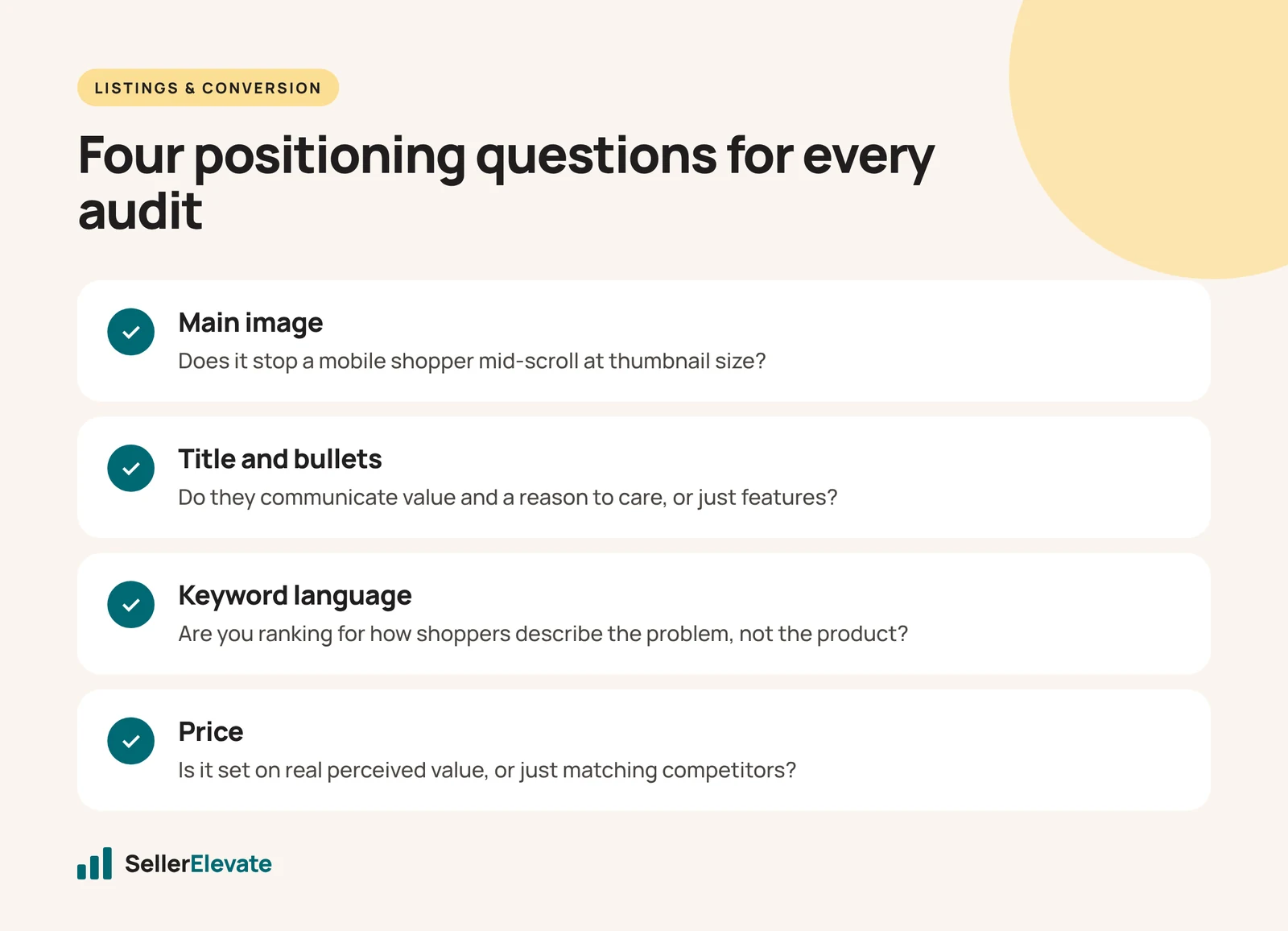
What four positioning questions should every Amazon audit ask?
Is the main image strong enough to stop a shopper mid-scroll?
Most Amazon traffic is now mobile, where roughly ten to twelve results sit above the fold and the decision to tap happens in about a second. Your main image is not a product photograph. It is the entire pitch, compressed, competing against eleven others at thumbnail size. If it looks like every other white-background shot in the category, it is doing nothing.
Do the title and bullets communicate value, or just features?
“1,500mg per serving, 60 capsules, third-party tested” is a specification sheet. It tells a shopper what is in the bottle, not what changes for them. Features belong in the listing, but they belong underneath a reason to care, not instead of one.
Are you ranking for how shoppers describe the problem, or how you describe the product?
This is the one that catches the most brands, and it is the most expensive.
Internally you describe your product in the language of the category, the formulation, the spec. Shoppers search in the language of the problem — what is wrong, what they want to stop happening, what they tried before. Those two vocabularies often barely overlap.
Which means you can be perfectly optimised, fully indexed, ranking on page one, and invisible to the people who need you, because they are searching words you never considered. Go and read the negative reviews on your three closest competitors. The complaints in there are written in the exact language your customers use, and half of them are keywords you are not targeting.
Are you priced on real perceived value, or just matching competitors?
Matching the market price is a decision to compete on everything except price, which only works if you have built something to compete on. Brands that get positioning right can usually hold a premium, and a premium fixes unit economics faster than any bid adjustment ever will.
How to tell which problem you actually have
There is a straightforward diagnostic, and it takes ten minutes.
Pull your unit session percentage from Seller Central under Reports, Business Reports, Detail Page Sales and Traffic. That is your conversion rate: units ordered divided by sessions.
Then compare it against your category rather than a global average, because the global average is meaningless. Amazon overall runs roughly 10 to 15%, which already dwarfs the 1 to 3% typical of a DTC site, since Amazon shoppers arrive with intent. But the spread by category is enormous. Low-cost consumables such as supplements, grocery and beauty commonly run 15 to 25%. High-consideration and higher-priced items sit closer to 5 to 12%. Fashion runs lower again. Items under $20 should generally clear 15%; items over $100 can perform well at 5 to 10%.
Then read it like this:
- Significantly below your category average — you have a listing and positioning problem. More traffic will make it more expensive, not better.
- At category average — there is real room, and optimisation will pay.
- Significantly above — your page is working. Now go and buy more traffic, because that is the constraint.
The same logic applies to TACoS. A brand in launch phase might sit at 25 to 40% legitimately. In growth phase, 12 to 20%. At maturity, 5 to 12% with organic carrying half to two thirds of revenue. If you are two years in and still spending like a launch, the issue is almost never the bids.
What changes when your positioning is right?
Conversion rate improves, because the page finally gives people a reason.
TACoS drops, not because you spent less, but because the same spend produces more.
And the ads stop feeling expensive. They start feeling like fuel, which is what they always were — the cost only felt unbearable because the engine was not converting what the fuel delivered.
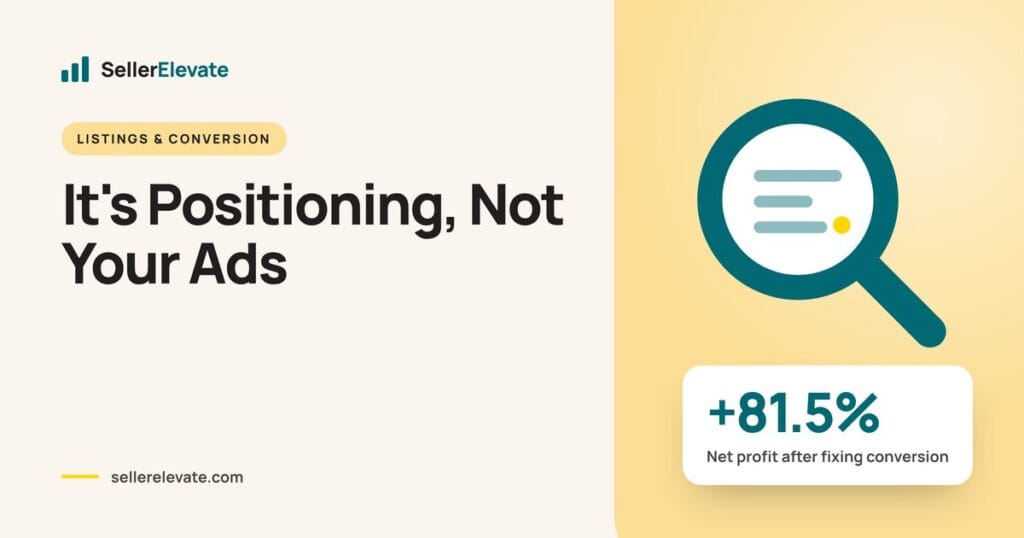
If you want to see what that looks like with real numbers, we wrote up a brand where fixing the conversion engine first meant a 25% increase in ad spend produced an 81.5% increase in net profit. Same channel. Same team. Different sequence.
The uncomfortable version
Sometimes the honest answer to “why isn’t this working” is that the product genuinely is not differentiated, and no amount of photography or copywriting will invent a difference that does not exist.
That is a harder conversation than a bid adjustment, and it is one most agencies will not have with you, because it does not lead to a retainer. But it is cheaper to hear it in month one than to fund another year of amplified sameness.
If it is true, the fix is upstream: a bundle, a formulation change, a different pack size, a claim you can substantiate that nobody else is making, a different segment of the same category. Those are product decisions, not marketing decisions, and they are the ones that actually move a stuck brand.
Where to start
Open your own listing on your phone. Not your desktop — your phone, on mobile data, the way a shopper sees it.
Look at the main image at thumbnail size next to your competitors. Read the first two bullets as though you have never heard of the product. Then pull your unit session percentage and compare it to your category.
You will usually know within ten minutes whether this is an advertising problem or something upstream of it. Most of the time it is upstream, and that is good news, because it is the part you can actually control.
If your sales are stuck and every conversation so far has been about bids, that is the signal. We look at positioning before advertising in every audit, and we will tell you if the answer is that the product needs to change.
Frequently asked questions
How do I know if I have an advertising problem or a listing problem on Amazon?
Pull your unit session percentage from Seller Central under Reports, Business Reports, Detail Page Sales and Traffic, then compare it to your category average. Significantly below average means a listing and positioning problem. At average, optimization will pay. Significantly above means the page works and traffic is the constraint, so buy more.
What is a good conversion rate on Amazon?
It depends on category. Amazon overall runs roughly 10 to 15%. Low-cost consumables such as supplements, grocery and beauty commonly run 15 to 25%, while high-consideration and higher-priced items sit closer to 5 to 12%. Items under $20 should generally clear 15%, and items over $100 can perform well at 5 to 10%.
What TACoS should an Amazon brand expect at each stage?
A brand in launch phase might legitimately sit at 25 to 40% TACoS. In growth phase, 12 to 20%. At maturity, 5 to 12%, with organic carrying half to two thirds of revenue. If you are two years in and still spending like a launch, the issue is almost never the bids.
What if my product simply isn't differentiated?
Then no amount of photography or copywriting will invent a difference. The fix is upstream: a bundle, a formulation change, a different pack size, a claim you can substantiate that nobody else makes, or a different segment of the same category. Those are product decisions, and they are the ones that move a stuck brand.
Get the honest version of your numbers
A free account audit from the person who would actually run your account.