Should you fully automate Amazon PPC?
No. Automate the repetitive work, such as search term harvesting, negation at scale, bid adjustments within guardrails, budget pacing and dayparting, but keep strategy with a human. Tools optimize past data, so they miss shifting keyword intent, unsupervised broad match drift and new ad types with no history, and their mistakes compound silently.
Key takeaways
- The account in this post spent $358,712.64 on one product at a 24.99% ACoS, with TACoS under 10% and organic carrying about 60% of revenue.
- A healthy mature product typically runs a TACoS of 5 to 12% with organic covering half to two thirds of revenue.
- Automation tools lower bids on decaying keywords but cannot see that demand has migrated to a term you are not yet targeting.
- Cap automation with bid ceilings tied to break-even CPC, maximum daily budgets and a limit on how fast anything scales without approval.
- Pull sixty to ninety days of search term data, not seven, and review the account weekly even when automation is working.
If you are considering full automation for your Amazon advertising, this is worth five minutes.
We have run over $350,000 of ad spend on a single SKU. At one point we handed that account to a well-known automation tool and let it run. It very nearly cost us the business.
We are not against software. We still use it every day. But there is a difference between automating repetitive work and handing over the strategy, and the gap between those two things is where accounts get destroyed.
The account
| Ad spend | $358,712.64 |
| Ad sales | $1,435,336.15 |
| ROAS | 4.00 |
| ACoS | 24.99% |
| Impressions | 91,762,807 |
Ninety-one million impressions on one product. A 24.99% ACoS on the advertising, and a TACoS under 10% across the business.
That second number is the one that matters, and it is worth unpacking because most sellers never connect the two. If ad spend of $358,712 represents under 10% of total sales, total sales are north of $3.5 million — which means advertising is producing roughly 40% of revenue and organic is carrying the other 60%.
That is what a healthy mature account looks like. The benchmark for a mature product is a TACoS of 5 to 12% with organic covering half to two thirds of revenue. This one sits inside it.
You do not get there by letting a tool bid for you.
What is Amazon PPC automation good at?
Let us be fair to the software, because the anti-automation position is as lazy as the full-automation one.
Tools are excellent at the work that is repetitive, rule-based and high-volume. Harvesting search terms across hundreds of campaigns. Applying negative keywords at scale. Adjusting bids toward a target on keywords with enough data to be statistically meaningful. Pausing things that have clearly stopped working. Dayparting. Flagging anomalies before a human would notice them.
That is real work, it takes hours, and a tool does it faster and more consistently than a person. We automate all of it.
Where does Amazon PPC automation fail?
Keyword intent shifts, and tools optimise the past.
“Reliable pajama” performs this week. Next week the volume moves to “pajama for women” and the first term quietly decays. An automation tool sees a keyword whose performance is declining and lowers the bid — a correct response to the data it has. What it cannot see is that demand has migrated to a term you are not yet targeting, so while it carefully optimises a dying keyword, a competitor is taking the new one.
Catching that requires somebody looking at the category rather than the account.
Broad match needs supervision it does not get.
Broad and auto campaigns are where discovery happens and where money disappears, often in the same week. Amazon’s matching logic changes, a new query pattern appears, and suddenly a meaningful share of spend is going to searches that will never convert. A rules engine judges each keyword against its target and finds nothing wrong, because the problem is not any individual keyword — it is the shape of the traffic.
Pull the search term report regularly and read it. Not the summary. The actual terms.
New ad types and features need testing, and tools only optimise what already exists.
Every new placement, match type, format and targeting option arrives without historical data. An automation tool has nothing to optimise against, so by default it either ignores them or treats them as underperforming and shuts them down. The window where a new feature is cheap because few people are using it is precisely the window automation will spend for you.
And the failure mode is silent.
This is the part that nearly cost us. A human making a bad decision usually notices something feels wrong. A tool executing a bad rule at scale, every hour, across every campaign, does it consistently and confidently, and the damage compounds before anything looks alarming enough to investigate.
What should you automate and what should a human manage?
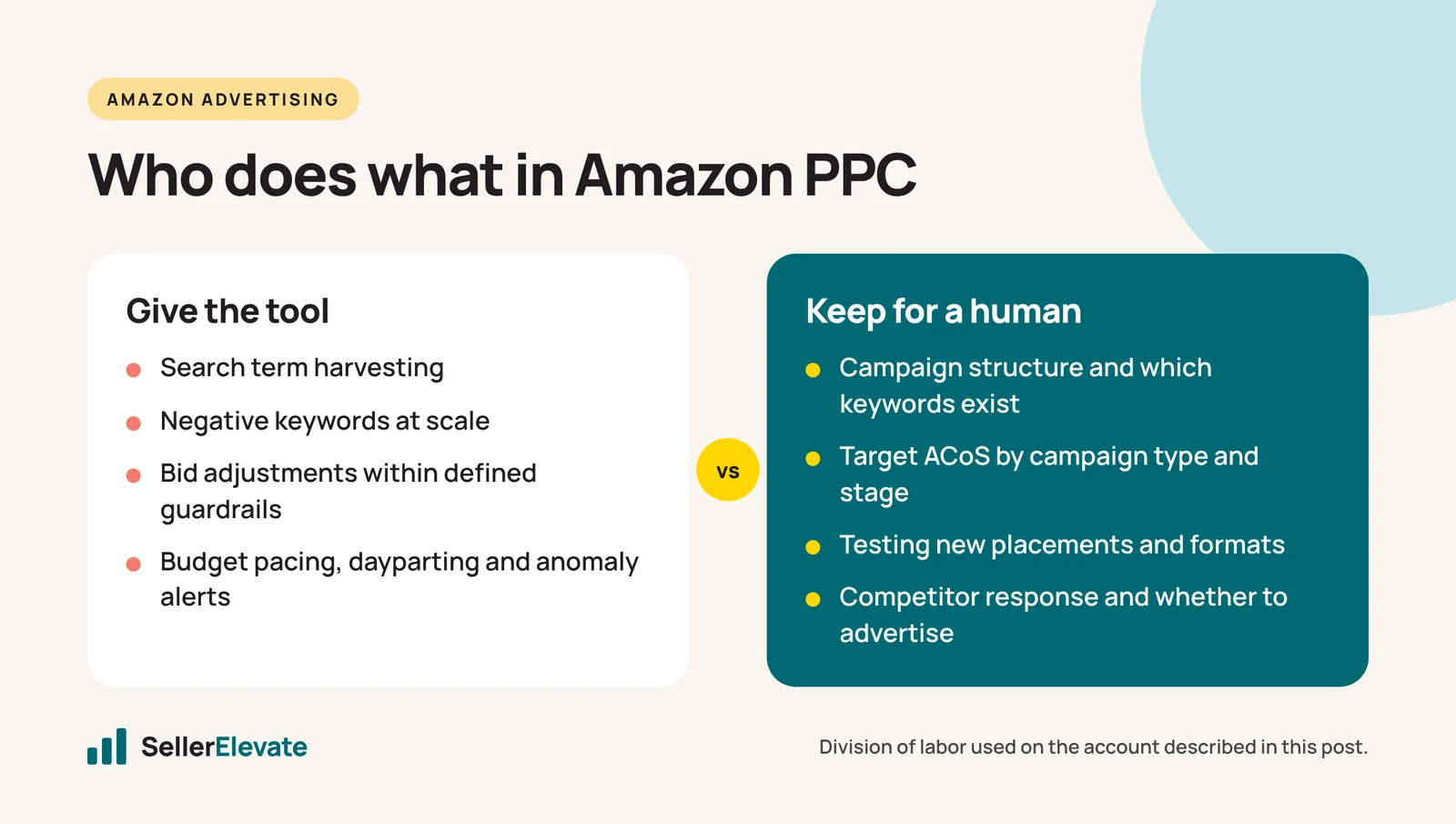
Give the tool: search term harvesting, negation at scale, bid adjustments within defined guardrails, budget pacing, dayparting, anomaly alerts.
Keep for a human: campaign structure, which keywords deserve to exist at all, target ACoS by campaign type and lifecycle stage, testing new placements and formats, competitor response, and every decision about whether a product should be advertised in the first place.
Set hard guardrails around the automation. Maximum bid ceilings tied to break-even CPC, not to a target ACoS the tool is chasing. Maximum daily budgets per campaign. A rule that nothing scales more than a set percentage in a day without a human approving it. Most automation disasters are not wrong decisions — they are correct decisions applied too fast, too widely, with no ceiling.
And review weekly regardless. If your automation is working, a weekly review is quick. If it is not, a weekly review is the only thing standing between an experiment and a write-off.
What we actually run
The account above is managed manually, with software handling the repetitive work underneath. Someone reads the search term report every week. Someone decides what the target ACoS should be on each campaign type. Someone looks at what competitors launched this month.
The tool does the parts that are boring and mechanical. It does not decide anything.
That is not a romantic argument about human judgement. It is just what the numbers demanded: a 24.99% ACoS on the ads while organic carries 60% of revenue does not happen by accident, and it does not happen from a rules engine optimising toward a target it was handed on day one.
The honest version
Automation will keep getting better, and some of what we keep for humans today will be safely delegated in a few years. The part that will hold longest is judgement about things with no data yet — new features, shifting intent, competitor moves, and whether a product should be advertised at all.
Until then: automate the repetition, supervise the strategy, and never hand a tool an unbounded budget and a target it will pursue to the exclusion of everything else.
One small correction to how this usually gets discussed: the report you want for this work is the Search Term Report, and Search Query Performance in Brand Analytics if you have Brand Registry. Pull sixty to ninety days, not seven, because a week of data will tell you whatever you want to hear.
Frequently asked questions
What should Amazon PPC automation tools handle?
Give the tool the repetitive, rule-based, high-volume work: search term harvesting, applying negative keywords at scale, bid adjustments within defined guardrails on keywords with enough data, budget pacing, dayparting and anomaly alerts. Keep campaign structure, keyword selection, target ACoS by campaign type and lifecycle stage, testing new formats and competitor response for a human.
What is a good TACoS for a mature Amazon product?
The benchmark for a mature product is a TACoS of 5 to 12%, with organic sales covering half to two thirds of revenue. The account in this post sits inside it: a 24.99% ACoS on advertising and a TACoS under 10% across the business, which means organic carries roughly 60% of revenue.
Why do PPC automation tools fail?
They optimize the past. A tool lowers bids on a declining keyword without seeing that demand moved to a new term. It judges broad match keywords one at a time and misses problems in the overall shape of traffic. New ad types have no history, so tools ignore or shut them down. And bad rules execute silently at scale.
What guardrails should you put on Amazon PPC automation?
Set maximum bid ceilings tied to break-even CPC rather than to a target ACoS the tool is chasing, maximum daily budgets per campaign, and a rule that nothing scales more than a set percentage in a day without human approval. Then review weekly regardless. Most automation disasters are correct decisions applied too fast, too widely, with no ceiling.
Get the honest version of your numbers
A free account audit from the person who would actually run your account.