Is TikTok Shop cheaper than Amazon for sellers?
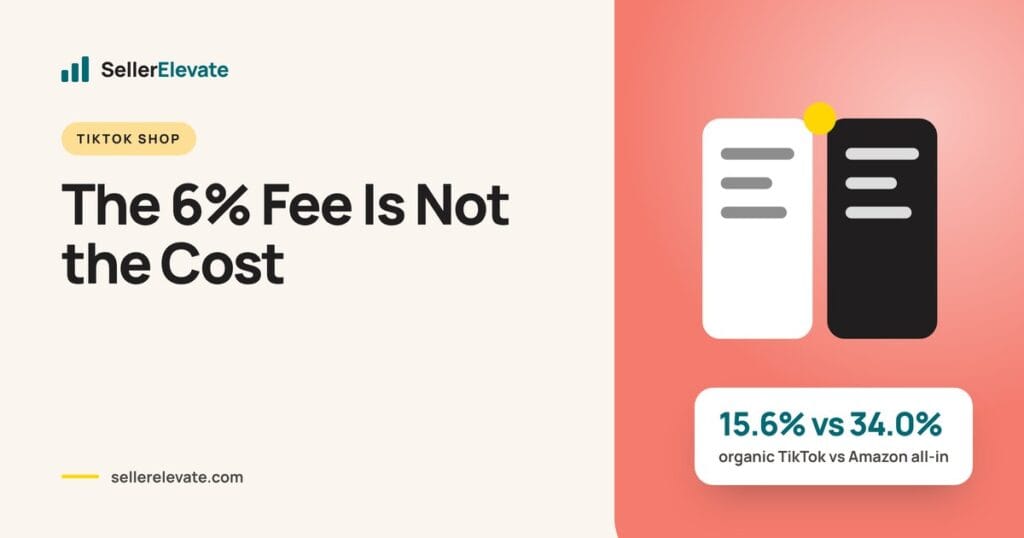
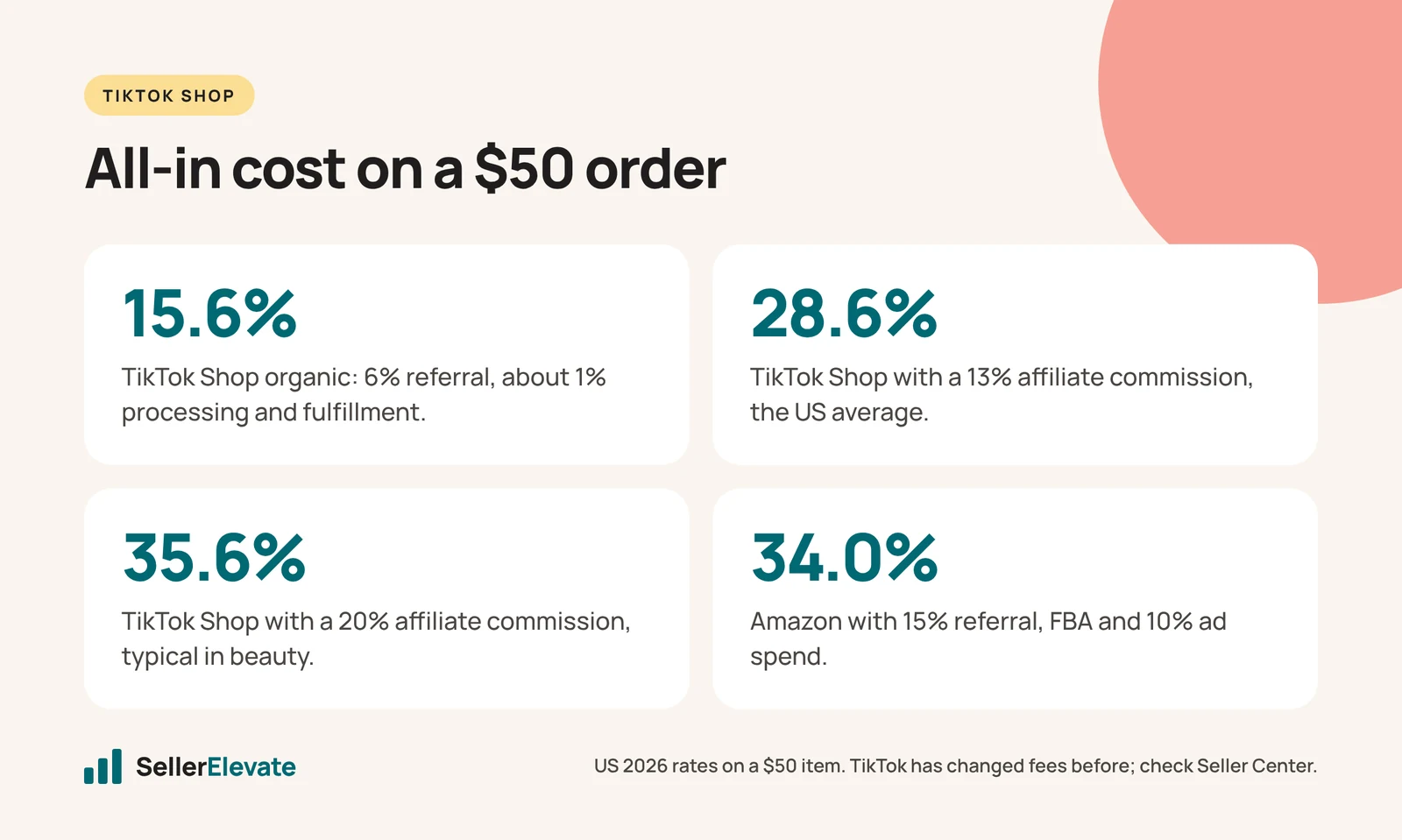
Only for organic sales. On a $50 item, organic TikTok Shop sales cost about 15.6% all-in against 34.0% on Amazon. Add a 13% affiliate commission and TikTok reaches 28.6%; at 20% it hits 35.6%. Since affiliate content drove about 80% of our shop GMV, where your sales come from decides the real cost.
Key takeaways
- TikTok Shop in the US charges a flat 6% referral fee, while Amazon charges 8 to 15% depending on category.
- On one of our settlement reports, the seller discount cost 1.7 times more than the referral fee, at 10.2% of gross sales versus 6.0%.
- On a $50 item, organic TikTok Shop sales cost about 15.6% all-in, compared with 34.0% on Amazon with FBA and 10% ads.
- With affiliate commission at 13% the TikTok Shop total reaches 28.6%, and at 20% it reaches 35.6%, above the Amazon figure.
- Price for the standard referral rate from day one, because the reduced new-seller rate expires after the first 30 to 90 days.
Amazon takes a referral fee of 8 to 15% depending on your category, and 15% covers most of them. TikTok Shop in the US takes a flat 6%, with select jewellery categories at 5%.
That gap is real. It is also, on its own, close to useless as a basis for deciding anything.
Here is why, taken straight off one of our own TikTok Shop settlement reports.
Is the referral fee the biggest TikTok Shop cost?
On a period with $3,841.86 in gross sales, this is what came out before a single unit was paid for or shipped:
| Deduction | Amount | % of gross |
|---|---|---|
| Seller discount | −$391.82 | 10.2% |
| Gross sales refund | −$93.95 | 2.4% |
| Referral fee | −$229.07 | 6.0% |
The seller discount cost 1.7 times more than the referral fee did.
That is the thing nobody puts in the fee comparison graphic. TikTok Shop is a promotion-led platform. Deals, vouchers and flash discounts are how products get surfaced, how creators get incentivised to pick you up, and how conversion holds on an impulse-driven feed. Budget for a 6% platform fee and ignore the 10% you will hand over in discounting, and your margin model is wrong before you start.
There is a further trap in how the fee is calculated. The US formula is 6% of customer payment plus platform discount, minus tax. When TikTok funds a promotional voucher, that subsidy is added back into the fee base. You pay commission on the full pre-discount price, including the part TikTok covered.
Is TikTok Shop cheaper than Amazon on a $50 order?
Fees only make sense stacked. Here is the same $50 item across both platforms, using 2026 US rates:
| Fees | Effective rate | |
|---|---|---|
| TikTok Shop, organic (no affiliate) | 6% referral + ~1% processing + ~$4.28 FBT | 15.6% |
| TikTok Shop, affiliate at 13% (US average) | above + creator commission | 28.6% |
| TikTok Shop, affiliate at 20% (typical beauty) | above + creator commission | 35.6% |
| Amazon, 15% referral + FBA + 10% ads | 34.0% |
Read that middle column twice.
Organic TikTok Shop sales are genuinely cheap — 15.6% all-in against Amazon’s 34%. If you can drive sales through your own content, the economics are excellent and the 6% headline is fully earned.
Affiliate-driven sales are not cheap. At the US average creator commission of around 13%, you are at 28.6%. In beauty, where commissions typically run 15 to 30%, you pass Amazon.
And here is the uncomfortable part. In our own TikTok Shop data, affiliate content drove about 80% of shop GMV. The organic column is the cheap one, and it is not where most of the volume comes from. Practitioner analyses put the all-in cost of selling on TikTok Shop between 35 and 55% of revenue once fees, commissions, fulfilment, discounts and returns are counted, with brands retaining roughly two thirds of reported GMV.
So the honest summary is not “TikTok is cheaper than Amazon.” It is: TikTok Shop’s costs are shaped differently, and which shape suits you depends entirely on where your sales come from.
Two more things that catch sellers out
The new-seller rate is a trap if you price around it. US sellers typically get a reduced referral fee of roughly 2 to 3% for the first 30 to 90 days. Sellers who set pricing during that window take a margin hit the day it expires. Price for the standard rate from day one and treat the promotional period as a bonus, not a baseline.
Shipping got harder to optimise. As of 31 March 2026, TikTok mandates its own logistics service for US sellers. If your model depended on negotiated carrier rates, that lever is gone.
Return rates also tend to run higher than on search-driven marketplaces, which follows naturally from a channel built on impulse purchases at low consideration.
So why bother with TikTok Shop at all?
Because the reason to be there was never the referral fee.
It is the loop. Content creates demand, demand creates sales, and the content that produced those sales becomes your advertising. You can take the exact UGC video people are already watching and put paid spend behind it through Spark Ads, directly from your shop. When something pops, you scale the thing that already worked rather than briefing a studio to guess at it.
On Amazon that connection is much weaker. Amazon captures demand that already exists — someone types “collagen powder” and you compete for the click. It is superb at converting intent and comparatively poor at creating it. TikTok Shop is the reverse: it manufactures intent in a feed, and it hands you the creative that did it.
That is a genuinely different capability, and it is worth paying for. It is just not free, and the fee table is the wrong place to look for its cost.
How do you decide between TikTok Shop and Amazon?
Work out your effective take rate rather than comparing headline percentages. Add referral fee, payment processing, expected affiliate commission, discounting, fulfilment and allocated ad spend into a single number. Subtract landed cost. What is left is your real margin on that channel, and it is the only figure worth comparing.
Run it twice: once assuming organic sales, once assuming affiliate-driven sales. If the affiliate scenario does not work, TikTok Shop is only viable for you as an owned-content channel, which is a much harder business to build and worth knowing before you seed a single unit.
None of this is an argument against the platform. We run it, it works, and the cross-channel effect on Amazon and retail is real. It is an argument against choosing a sales channel from a number on a graphic.
Fee rates cited are US 2026 figures and TikTok has changed them more than once. Check your own Seller Center before you build a model on them. If you want help working out whether your margins survive this channel, that is a conversation worth having before launch rather than after.
Frequently asked questions
What is the TikTok Shop referral fee in the US?
TikTok Shop in the US takes a flat 6% referral fee, with select jewelry categories at 5%. The fee is calculated on customer payment plus platform discount, minus tax. TikTok has changed its rates more than once, so check Seller Center for the current rule before you build a margin model on it.
Is TikTok Shop cheaper than Amazon?
For organic sales, yes: on a $50 item we estimate about 15.6% all-in on TikTok Shop against 34.0% on Amazon. For affiliate-driven sales, not necessarily. At a 13% commission TikTok Shop reaches 28.6%, and at 20%, typical in beauty, it reaches 35.6%. Which platform is cheaper depends on where your sales come from.
What hidden costs do TikTok Shop sellers miss?
Discounting is the big one. On one of our settlement reports, the seller discount was 10.2% of gross sales, 1.7 times the 6.0% referral fee. TikTok Shop is promotion-led, so deals and vouchers are part of how products get surfaced. Return rates also tend to run higher than on search-driven marketplaces.
How should I compare TikTok Shop and Amazon margins?
Calculate an effective take rate rather than comparing headline percentages. Add referral fee, payment processing, expected affiliate commission, discounting, fulfillment and allocated ad spend into one number, then subtract landed cost. Run it twice, once assuming organic sales and once assuming affiliate-driven sales. If the affiliate scenario fails, TikTok Shop only works for you as an owned-content channel.
Get the honest version of your numbers
A free account audit from the person who would actually run your account.