
How does Amazon reimburse FBA sellers for lost or damaged inventory now?
Amazon reimburses inventory lost or damaged in its warehouses at manufacturing cost, meaning what you paid to source or produce it, excluding shipping, duties and other costs. Items lost after a customer orders are still paid at sale price less fees. Most claims must be filed within roughly 60 days, so reconcile monthly.
Key takeaways
- Since March 2025, FBA inventory lost or damaged before a customer orders is reimbursed at manufacturing cost, not the price it would have sold for.
- Reported reimbursement recoveries across the market fell by roughly 50 to 75% after the change.
- If your per-unit cost field in Seller Central is missing or set to zero, Amazon substitutes its own estimate, which is typically lower than what you paid.
- Most claims must now be filed within roughly 60 days, down from an 18-month lookback, so monthly reconciliation is the minimum viable rhythm.
- Items lost or damaged after an order is placed are still reimbursed at the sale price less applicable fees.
In March 2025, Amazon changed how it reimburses FBA sellers for inventory lost or damaged in its warehouses. For most of FBA’s history you were paid roughly what the item would have sold for. Since that change, you are paid what it cost you to buy it.
The announcement generated a wave of urgency at the time. Eighteen months later the deadline is long gone, the policy is simply how things work, and the interesting question is no longer “what is changing” but “what did it cost, and what should you be doing differently now.”
What does Amazon's FBA reimbursement policy say?
Amazon reimburses lost or damaged inventory at product manufacturing cost, defined in its own words as what you paid to source the product from a manufacturer, wholesaler or reseller, or to produce it yourself. It explicitly excludes shipping, handling, customs duties and other costs.
So on a product that sells for $50 and costs $15 to manufacture, you now recover something near $15 rather than something close to $50. The freight you paid to get it into the country, the duty, the prep, the advertising spent building its rank — none of that is recoverable.
One nuance that is often missed: this applies to inventory lost or damaged before a customer orders it. Items lost or damaged after an order is placed are still reimbursed at the sale price less applicable fees. If you have been assuming everything is now cost-based, some of your claims are worth more than you think.
How much did the reimbursement change cost sellers?
Reported recoveries across the market fell by roughly 50 to 75%.
That is the number worth sitting with. If FBA reimbursements were quietly contributing five figures a year to your bottom line — and for a lot of brands they were — somewhere between half and three quarters of that has gone, and it went without an invoice or a line item to notice it in.
For a high-margin product the drop is at the top of that range. A $60 supplement costing $8 to produce used to return something near $60 when a unit vanished. It now returns $8.
The part that matters more than the valuation
Here is what most of the coverage missed at the time, and it is still the most actionable thing in the policy.
Amazon gives you two options for determining manufacturing cost: it estimates the cost for you, or you supply your own figure.
If your per-unit cost field in Seller Central is missing or set to zero, Amazon substitutes its own internal estimate — and that estimate is typically lower than what you actually paid your supplier. It is built from third-party data: other sellers, wholesale pricing, Amazon’s own sourcing information.
So the policy did not only change the basis of reimbursement. It changed who decides what your product cost, and the default answer is not you.
This is the cheapest fix available to any FBA seller and it takes an afternoon. Go into your cost fields, enter accurate invoice-backed per-unit sourcing costs for every SKU, and keep them current when supplier pricing moves. A stale low figure entered two years ago underpays you on every claim you file from now on.
How long do you have to file an FBA reimbursement claim?
The claim window.
Most FBA reimbursement claims must now be filed within roughly 60 days of the discrepancy surfacing. It used to be an 18-month lookback.
Think about what that does to how you operate. An annual reconciliation, or even a quarterly one, now forfeits money by design — by the time you run it, most of the eligible claims have expired. Monthly is the minimum viable rhythm, and faster is better.
Amazon’s automated reimbursement system covers some of this, and it creates a comfortable assumption that everything is handled. It isn’t. Automation reliably catches the simple, unambiguous cases. The complex ones — partial shipment discrepancies, damaged-in-warehouse cases needing documentation, removal orders that never arrived, fee misclassifications — are exactly where the larger sums sit, and those still require someone to find them and file them.
Documentation is now part of the claim, not an afterthought
Amazon also tightened what it wants to see. Detailed invoices, proof of purchase, shipment tracking. Incomplete or inconsistent documentation gets claims rejected, and with a 60-day window there is not much room to go back and forth.
The practical consequence is that the first filing has to be complete. A claim that bounces once and takes three weeks to resubmit may have no window left.
While we are on cash flow
Worth knowing if you have not noticed it in your disbursements: since March 2026, Amazon holds the proceeds of each sale until seven days after delivery. Every FBA seller’s cash conversion cycle got a little longer. Combined with tighter reimbursement recovery, brands running lean on working capital have had a harder eighteen months than the headline fee changes alone suggest.
What we would actually do
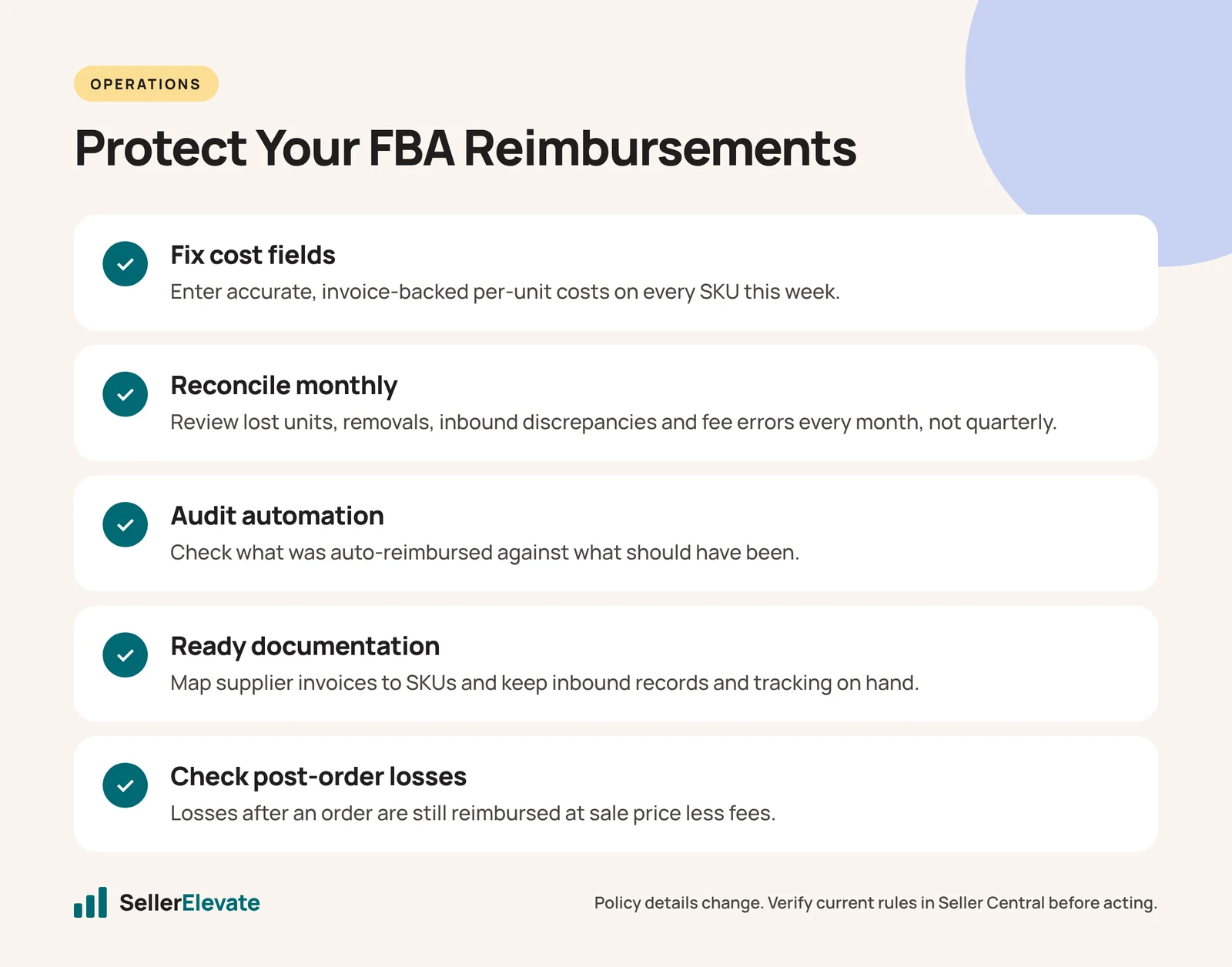
Fix the cost fields this week. Accurate, invoice-backed per-unit costs on every SKU. It is the highest-return hour of admin available to you, and it is entirely within your control.
Move to a monthly reconciliation rhythm. Inventory adjustments, lost and damaged units, removal orders, inbound discrepancies, fee errors. Monthly, not quarterly, because the window closes at sixty days.
Do not assume automation has it covered. Check what was auto-reimbursed against what should have been. The gap is the point.
Keep documentation ready before you need it. Supplier invoices mapped to SKUs, inbound shipment records, tracking. Assembling this after a discrepancy appears is how windows get missed.
And re-check your assumptions on post-order losses. Those are still reimbursed at sale price less fees. It is a meaningful distinction and an easy one to give away.
An honest note on the framing
It is tempting to read this as Amazon protecting itself at sellers’ expense, and there is something to that — the risk of warehouse losses shifted substantially onto third-party sellers, with no corresponding change in what they pay for fulfilment.
But the practical posture that actually earns money is not outrage. It is treating reimbursement as a monthly operational discipline rather than an occasional windfall. The sellers who adapted their process have kept recovering meaningfully. The ones who did not have watched recoveries shrink without ever quite noticing why.
Reimbursement reconciliation is part of what we look at in an account audit, because it is one of the few places on Amazon where money you are already owed is sitting unclaimed. Policy details change — verify current rules in Seller Central before acting on any of this.
Frequently asked questions
What is Amazon's FBA reimbursement policy for lost inventory?
Amazon reimburses inventory lost or damaged before a customer orders at product manufacturing cost: what you paid to source it from a manufacturer, wholesaler or reseller, or to produce it yourself. Shipping, handling, customs duties and other costs are excluded. A $60 supplement costing $8 to produce now returns $8. Check Seller Central for the current rule.
What happens if I leave the unit cost blank in Seller Central?
Amazon substitutes its own internal estimate, built from third-party data such as other sellers, wholesale pricing and its own sourcing information, and that estimate is typically lower than what you actually paid. Enter accurate, invoice-backed per-unit sourcing costs for every SKU and update them when supplier pricing moves, because a stale low figure underpays every future claim.
How long do I have to file an FBA reimbursement claim?
Most FBA reimbursement claims must now be filed within roughly 60 days of the discrepancy surfacing, compared with an 18-month lookback before. Annual or quarterly reconciliation now forfeits money by design. Reconcile at least monthly and make the first filing complete, because a rejected claim may have no window left to resubmit. Verify current rules in Seller Central.
Does Amazon automatically reimburse everything it owes me?
No. Amazon's automated system reliably catches simple, unambiguous cases, but complex ones such as partial shipment discrepancies, damaged-in-warehouse cases needing documentation, removal orders that never arrived and fee misclassifications still need someone to find and file them. Compare what was auto-reimbursed against what should have been, because that gap is where the larger sums sit.
Get the honest version of your numbers
A free account audit from the person who would actually run your account.