How do I quickly audit my Amazon listing?
Open your public listing on a phone and check six things: who is in the Sold by field, title length, number of images, whether A+ content exists, who owns the sponsored slot at the top of the page, and how review counts compare across your catalogue. It takes about ten minutes and needs no tools.
Key takeaways
- If the seller name in the buy box is not yours, somebody else controls your price, title, images and content.
- Amazon allows up to 200 characters in most titles, so a title under fifteen words is usually leaving search volume unclaimed.
- Amazon supports seven or more images in most categories; each one should answer one shopper question.
- Large review-count gaps within one brand, such as 3,931 ratings against 176, usually mean some products are managed and others are not.
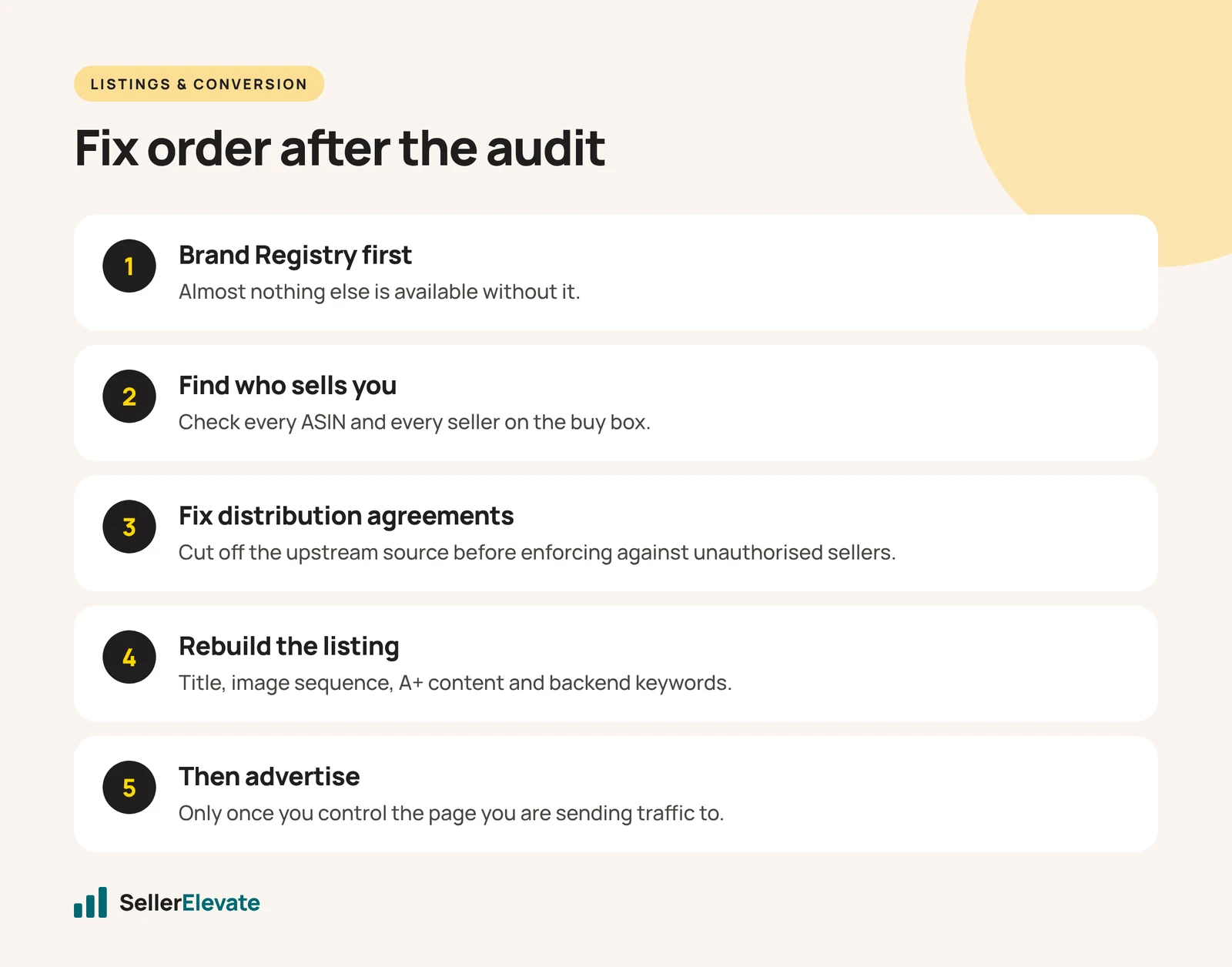
- Fix in order: Brand Registry, find who sells you, fix distribution agreements, rebuild the listing, and only then advertise.
Open one of your own Amazon listings. Not in Seller Central — the public page, on a
phone, from a shopper’s account.
Six things on that page will tell you whether you control your brand on Amazon or
somebody else does. None of them requires a tool, a login or a report.
We run this on every brand before we quote them, and it takes about ten minutes.
1. Who is in the "Sold by" field?
Look at the right-hand buy box. Under the delivery date it says who the product ships
from and who it is sold by.
If the seller name is not yours, somebody else controls that page.
We recently looked at a listing for a well-known pet brand where the buy box was held by
a reseller nobody at the brand had a relationship with. The product was genuine. The
price was set by the reseller. The title, the images and the content were whatever that
reseller decided they should be. Every review, good and bad, attached to the brand’s
name rather than the seller’s.
That is not an unusual situation. It is the default outcome for any brand that sells
through wholesale without controlling what happens downstream.
2. How long is your title?
Amazon allows up to 200 characters in most categories, and roughly the first 80 to 200
are what gets indexed.
The listing above used four words. Brand name, two descriptors, product type. Nothing
about what it solves, who it is for, or any of the terms a shopper would actually search
when they do not already know the brand name.
A short title is not clean design. It is unused indexing space, and it means the listing
can only be found by people who already know exactly what to type.
Count the words in your own title. If it is under fifteen, you are leaving search volume
on the table that costs nothing to claim.
3. How many images are there?
Look at the thumbnail strip under the main image.
Amazon supports seven or more images in most categories, plus video for brand-registered
sellers. The listing above had four, and none of them did the work that images are
supposed to do: no comparison chart, no scale reference, no lifestyle context, no
objection handling.
Each image should answer one question a shopper has at that point in the scroll. If you
have four, you are answering four questions and hoping the rest do not matter.
4. Is there A+ content?
Scroll past the bullets. If you see a plain block of text where the enhanced content
should be, you are either not brand-registered or you are registered and have not used
it.
A+ content is free to use once you hold Brand Registry, and it is where the comparison
chart, the brand story and the technical detail live. A listing without it looks like a
commodity entry regardless of what the product costs.
5. Who owns the sponsored slot at the top of your own page?
This one is the tell that most brands never look at.
At the very top of a detail page, above the product, sits a sponsored placement. On the
listing we looked at, that slot was occupied by a different product entirely — one with
3,931 ratings, discounted, running ads, clearly being actively managed.
The listing underneath had 176 ratings and no advertising behind it.
Same brand. Radically different levels of attention. One product being managed by
someone with a stake in the outcome, and one left to a reseller.
When a competitor — or worse, a neglected version of your own catalogue — owns the top of
your detail page, you are paying for traffic and handing a share of it away at the door.
6. How does your rating count compare across your own catalogue?
Pull up three or four of your ASINs side by side and compare review counts.
Large gaps within one brand usually do not mean some products are better. They mean some
products are being managed and others are not. The neglected ones are frequently the ones
a reseller controls, because a reseller has no reason to invest in a review base they do
not own.
What the six add up to
Individually each of these is a small thing. Together they describe who is actually
running your brand on Amazon.
A page with someone else’s name in the buy box, a four-word title, four images, no A+
content, no advertising and a fraction of your catalogue’s usual review count is not an
underperforming listing. It is a listing nobody is responsible for.
Which is the honest problem with selling through wholesale on Amazon and leaving it
there. Wholesalers and resellers are not doing anything wrong — they are running their
business, which is moving units at a margin. Building your brand equity is not their job,
it is not what they are paid for, and expecting it is a category error.
But the reviews still attach to your name. The price still sets the reference point a
retail buyer sees. The listing is still what a shopper finds when they search you.
How do you fix an Amazon listing you do not control?
If the audit turns up several of these, the fix is a sequence rather than a single
action, and the order matters:
Brand Registry first, because almost nothing else is available without it.
Then find out who is actually selling you — every ASIN, every seller on the buy box.
Brands are routinely surprised by both the number and by which of their own authorised
partners are involved.
Then fix the distribution agreements, before enforcing anything. Most unauthorised
sellers are supplied by an authorised wholesaler somewhere upstream, so enforcement against
the symptom fails while the source continues. This is a contract problem before it is an
Amazon problem.
Then rebuild the listing — title, image sequence, A+ content, backend keywords.
Then, and only then, advertise. Advertising into a page you do not control is the most
expensive way to discover that you do not control it.
The ten-minute version above is the free one. Our account audit is the longer version —
profit by ASIN, wasted spend, keyword coverage and seller control, written up and ranked.
Yours to keep whether or not you work with us.
When the audit flags weak copy or images, work through our four Amazon listing optimization strategies.
Frequently asked questions
How do I know if a reseller controls my Amazon listing?
Look at the buy box on the public page. Under the delivery date it shows who the product ships from and who it is sold by. If the seller name is not yours, somebody else controls that page, including the price, title, images and content, while every review still attaches to your brand name.
How long should an Amazon product title be?
Amazon allows up to 200 characters in most categories. A short title is not clean design; it is unused indexing space that means only people who already know your brand can find the listing. Count the words in your own title: if it is under fifteen, you are leaving search volume on the table that costs nothing to claim.
How many images should an Amazon listing have?
Amazon supports seven or more images in most categories, plus video for brand-registered sellers. Each image should answer one question a shopper has at that point in the scroll, such as a comparison chart, a scale reference, lifestyle context or objection handling. With only four images, you are answering four questions and hoping the rest do not matter.
What should I fix first if my Amazon listing fails the audit?
Work in sequence. Get Brand Registry first, because almost nothing else is available without it. Then find out who is selling every ASIN, fix the distribution agreements before enforcing anything, rebuild the title, images, A+ content and backend keywords, and only then advertise. Advertising into a page you do not control is the most expensive way to learn you do not control it.
Get the honest version of your numbers
A free account audit from the person who would actually run your account.