Should you raise Amazon PPC bids when you lower your price?
Only if your gross margin is above a threshold set by your elasticity. Break-even CPC equals margin times conversion rate, and a price cut raises conversion but cuts margin faster. If a 5% cut lifts conversions 10%, the break-even point is 55% gross margin. Below that, you should bid less, not more.
Key takeaways
- Break-even CPC is contribution margin per unit multiplied by conversion rate, and a price cut moves those two in opposite directions.
- On a $30 product at 33% gross margin, a 5% price cut drops margin by 15%, three times the size of the price cut.
- When a 5% cut produces 10% more conversions, 55% gross margin is the point where raising bids starts to make sense.
- Deeper price cuts need higher margins to justify higher bids, not lower ones.
- Recalculate break-even CPC at each price point and use it as a bid ceiling rather than applying a blanket percentage adjustment.
Here is an advanced idea that circulates among experienced Amazon operators: tie your bids to your price.
The logic runs like this. Measure your price elasticity — if a 5% price cut produces 10% more conversions, demand is elastic. Since a lower price converts better, raise your bids during price cuts to buy more of the traffic that is now converting well, and lower them when prices rise to stop paying for clicks that will not convert.
It sounds right. It is right in some cases and expensively wrong in others, and the line between them is a single number most sellers can calculate in about a minute.
What number decides whether to raise bids?
Break-even CPC is contribution margin per unit multiplied by conversion rate.
Break-even CPC = margin × conversion rate
Now notice what a price cut does to that equation. It raises conversion rate, which pushes break-even CPC up. It also cuts margin, which pushes break-even CPC down.
The two move in opposite directions, so whether you should bid more or less depends entirely on which effect is larger. The elasticity alone does not tell you.
Why is a 5% price cut not a 5% margin cut?
This is the part that trips people up, and it is the whole reason the naive version of the rule fails.
A price cut comes entirely out of margin. So a 5% reduction in price is a much larger percentage reduction in margin, and how much larger depends on how thin your margin already is.
Take a $30 product at 33% gross margin. Margin is $9.90. Cut the price 5% to $28.50 and margin falls to $8.40 — a 15% drop, three times the size of the price cut.
Against that, a 10% conversion lift. Ten percent up against fifteen percent down. Break-even CPC falls, and raising bids would mean overpaying.
The threshold
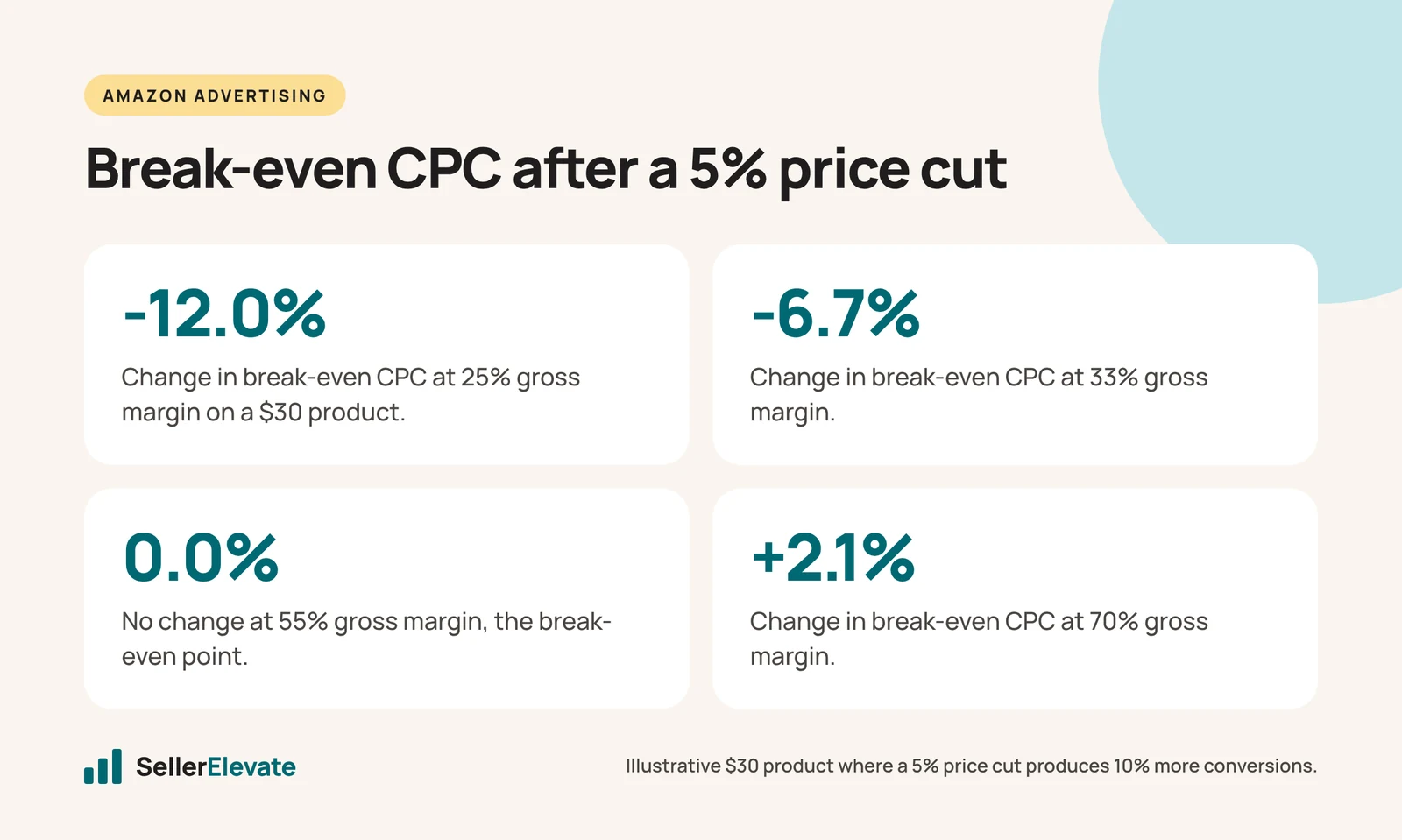
Running the full comparison at the elasticity in this example — a 5% cut producing 10% more conversions — here is what happens to break-even CPC at different gross margins on a $30 product:
| Gross margin | Break-even CPC before | After the price cut | Change |
|---|---|---|---|
| 25% | $0.750 | $0.660 | −12.0% |
| 33% | $0.990 | $0.924 | −6.7% |
| 40% | $1.200 | $1.155 | −3.7% |
| 50% | $1.500 | $1.485 | −1.0% |
| 55% | $1.650 | $1.650 | 0.0% |
| 60% | $1.800 | $1.815 | +0.8% |
| 70% | $2.100 | $2.145 | +2.1% |
At this elasticity, 55% gross margin is the break-even point.
Above it, cutting price genuinely does justify bidding more. Below it, cutting price means you should be bidding less, because the margin you gave away shrank your advertising headroom faster than the conversion lift expanded it.
Most private label sellers operate well below 55%. Which means for most brands, the intuitive version of this rule is backwards.
The general form
The condition is:
Raise bids on a price cut only if (1 − d/r) × (1 + e·d) > 1
where d is the price cut as a fraction, r is your gross margin ratio, and e is your elasticity magnitude.
Solving for the margin threshold at different elasticities:
| Elasticity | 5% price cut | 10% price cut |
|---|---|---|
| 1.5 | above 71.7% margin | above 76.7% |
| 2.0 | above 55.0% | above 60.0% |
| 2.5 | above 45.0% | above 50.0% |
| 3.0 | above 38.3% | above 43.3% |
Two things fall out of this table.
Deeper cuts need higher margins, not lower. The intuition that a bigger discount justifies bidding harder is exactly wrong — a bigger cut takes proportionally more margin, so it needs an even stronger conversion response to pay for itself.
Highly elastic products are the ones where the rule works. If your demand is genuinely elastic — elasticity of 3 or more, meaning a 5% cut produces 15% more conversions — the strategy holds at ordinary margins. Below elasticity of 2, it almost never does.
How do you measure price elasticity honestly?
The whole framework depends on knowing your elasticity, and this is where most attempts fall apart.
Change one thing. A price test run alongside a creative change, a coupon or a new campaign tells you nothing about price.
Run it long enough. A week of data on a low-volume ASIN is noise. You need enough orders at each price point for the difference to mean something.
Control for the confounds. Competitor price moves, stock-outs, seasonal shifts in query mix, and review velocity all move conversion independently of your price.
And account for the second-order effects. A price cut does not only change conversion. Competitive total price is one of the named Featured Offer factors, so a lower price can win you Buy Box share you did not previously hold — which shows up as a conversion improvement that is not really elasticity at all. Better conversion also feeds sales velocity, which feeds organic rank, which brings traffic you did not pay for.
Those effects are real and they favour the price cut. They just are not what you measured, and folding them into an elasticity figure will overstate it.
Elasticity is not constant. It differs by price point, by season, by competitive set. The number you measured at $30 does not necessarily hold at $24.
What we would actually implement
Calculate the threshold before building any automation. Your gross margin ratio and a rough elasticity estimate tell you immediately whether this strategy is even directionally correct for your catalogue. For most brands it is not, and that is a five-minute saving on a month of work.
Segment by margin, not by campaign. If you sell across a range of margins, the rule may hold on your premium SKUs and reverse on your commodity ones. A blanket rule applied across a mixed catalogue will lose money on half of it.
Move the bid ceiling, not the bid. The clean implementation is to recalculate break-even CPC at each price point and use it as a ceiling, rather than applying a percentage adjustment in one direction. That way the rule self-corrects regardless of which way the maths falls.
And watch what happens when the price goes back up. The rule is symmetric in theory. In practice conversion often does not recover instantly, because the reviews, rank and velocity earned during the discount period persist for a while. Cutting bids immediately on a price increase can give away position you paid to build.
This is the level of detail our account audits go into on accounts where it matters. If your catalogue spans a wide margin range, the blanket bid rules most agencies apply are almost certainly losing money on one end of it.
Frequently asked questions
How do you calculate break-even CPC on Amazon?
Multiply contribution margin per unit by conversion rate. In the post's example, a $30 product at 33% gross margin makes $9.90 per unit and has a break-even CPC of $0.990. Any click that costs more than that loses money on average. Calculate it per price point, and per placement where conversion rates differ, rather than relying on one blended account figure.
Why does a small price cut hurt margin so much?
A price cut comes entirely out of margin, so the percentage hit to margin is much larger than the percentage cut to price. On a $30 product at 33% gross margin, margin is $9.90. Cut the price 5% to $28.50 and margin falls to $8.40, a 15% drop. The thinner your margin to begin with, the bigger that multiplier gets.
What gross margin do you need to raise bids during a price cut?
It depends on elasticity and the size of the cut. At elasticity 2.0, a 5% cut needs margin above 55.0% and a 10% cut needs above 60.0%. At elasticity 3.0, the thresholds fall to 38.3% and 43.3%. At elasticity 1.5, you need above 71.7% for a 5% cut. Most private label sellers operate well below 55%.
How do you measure price elasticity on Amazon accurately?
Change only the price, run the test long enough to collect meaningful order volume at each price point, and control for competitor price moves, stock-outs, seasonality and review velocity. Also separate out Buy Box gains and organic rank effects, which improve conversion but are not elasticity. Remember elasticity changes by price point, season and competitive set.
Get the honest version of your numbers
A free account audit from the person who would actually run your account.