Which Brand Analytics report should you use to find competitors to target on Amazon?
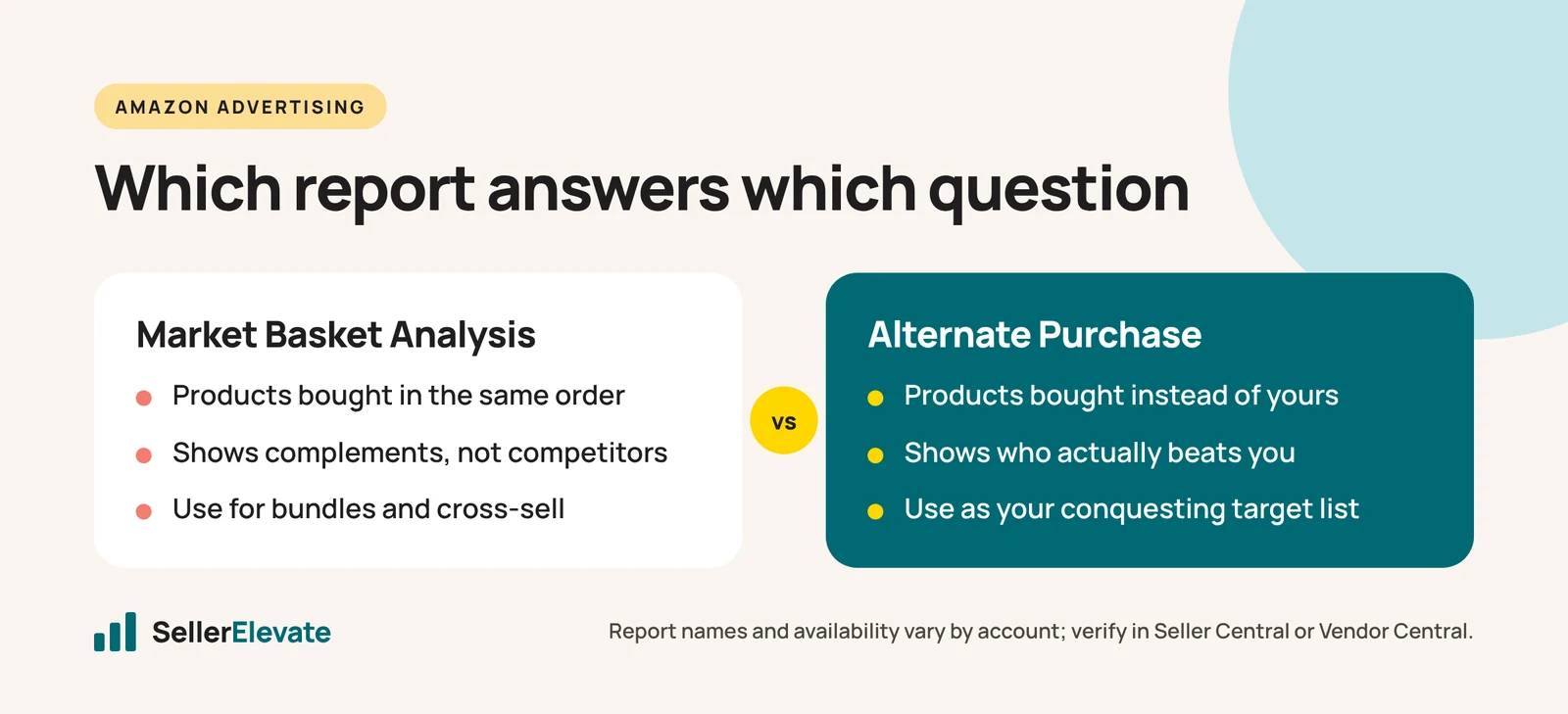
Use the Alternate Purchase report. It shows the top five products customers bought instead of yours after viewing yours, so it lists who is actually beating you. Market Basket Analysis shows products bought in the same order, which are complements, and targeting them means paying to interrupt your own customer.
Key takeaways
- Market Basket Analysis shows complements bought alongside your product, so it suits bundles and cross-sell, not conquesting.
- Item Comparison shows the top five products viewed within 24 hours of yours, which is your consideration set.
- Alternate Purchase shows the top five products bought instead of yours, making it the right starting list for competitor targeting.
- None of these reports shows share movement, so snapshot them monthly and use Search Query Performance for real share trends.
- Out-of-stock, price rises and deteriorating reviews are worth a budget shift; deliberate ad cuts and third-party outranking usually are not.
Static ASIN targeting is lazy. You pick the five biggest products in your category, point Sponsored Products at them, and leave it running for a year while the category rearranges itself around you.
The better version is to target competitors who are currently weakening — losing share, losing conversion, out of stock — because that is where displaceable demand actually sits.
The instinct is right. But the report most people reach for to do it is the wrong one, and using it will send your conquesting budget at products that were never your competitors.
Which Brand Analytics report shows your real competitors?
Brand Analytics is often discussed as one thing. It is six reports answering six different questions, and three of them touch competition.
Market Basket Analysis shows the top products customers bought in the same order as yours. A shopper buys your protein powder and a shaker bottle together. That is a complement, not a competitor.
This is the report most commonly misused for conquesting, and it is the wrong tool for it. If you build ASIN targeting from Market Basket data, you are bidding on products people buy alongside yours — which means competing for a shopper who was already going to buy from you. You will pay to interrupt your own customer.
Market Basket Analysis is genuinely valuable. It is a bundling and cross-sell report. Use it to design bundles, build variations, and target adjacencies where you sell the complement too. Just not for conquesting.
Item Comparison shows the top five products customers viewed within 24 hours of viewing yours, with the percentage of times each appeared. This is your consideration set — who you are being weighed against.
Alternate Purchase shows the top five products customers bought instead of yours after viewing yours, with the percentage for each.
That last one is the conquesting report. It is the only one that tells you who actually beat you, on a shopper who had already found you. If you are going to spend money displacing a competitor, start with the list of competitors who are currently displacing you.
On "market share movement"
None of these reports gives you share movement as a metric. There is no column labelled “trend.”
What you can do is snapshot. Pull Item Comparison and Alternate Purchase monthly, save them, and compare. A competitor whose comparison percentage is climbing is taking a larger share of your consideration set. One whose alternate-purchase percentage is climbing is winning more of the shoppers who saw you first — a more urgent problem.
For actual share data, Search Query Performance is the report you want. It gives impressions, clicks, cart adds and purchases by search query, along with your share of each. Track your purchase share on your top twenty queries month over month and you have a real share trend, at the level where advertising decisions get made.
The work is in the saving and comparing. Amazon does not do it for you, and neither does most agency reporting.
Why does it matter why a competitor is weakening?
Here is where the tactic needs more judgement than it usually gets. A competitor losing share is an opportunity. Why they are losing it determines whether the opportunity lasts a week or a year, and how hard to push.
They went out of stock. The best conquesting target there is, and the most time-limited. Their demand has to go somewhere immediately, and the shopper is deciding today. Bid aggressively and expect the window to close the moment they restock — but the rank and reviews you pick up during it persist.
They raised price. A durable opportunity, provided you can hold your own price. Worth a sustained position rather than a burst.
Their review profile deteriorated. The most durable of all, because reviews are slow to repair. A competitor drifting from 4.5 to 4.1 stars will keep leaking shoppers for months.
They cut advertising deliberately. Usually a margin decision, not weakness. They will be back, and you may simply be buying the traffic they stopped subsidising — at a price they decided was too high.
They are being outranked by someone else. Their share is moving to a third party, not to you. Targeting them puts you in a fight you did not start and may not win.
Only the first three are genuinely worth a budget shift, and they call for different tactics.
The honest caveat about conquesting
Competitor ASIN targeting converts worse than category or keyword targeting in most accounts, and the reason is structural.
When you appear on a competitor’s detail page, you are interrupting somebody who has already decided what they want. You are asking them to reconsider, and most will not. Your conversion rate on that placement is usually a fraction of what you see on a search result where intent is still open.
Which means conquesting needs a break-even calculation of its own. Use the same formula — margin multiplied by conversion rate — but with the conversion rate you actually achieve on ASIN placements, not your account average. Run it as its own campaign so that number is visible rather than blended away.
There is also a retaliation dynamic worth thinking about. Conquesting a competitor who has not been bidding on you frequently teaches them to bid on you. Against a larger competitor with more budget, starting that exchange can be a poor trade.
What we would actually run
Pull Alternate Purchase first. That is your target list, ranked by who is beating you. Not the biggest products in the category — the ones winning shoppers who already found you.
Cross-reference with Item Comparison to see who you are being weighed against but not losing to. Those are competitors where the gap is small, and a listing improvement may serve you better than an ad spend.
Snapshot monthly and compare. Movement is the signal, and it only exists if you kept last month’s file.
Establish why before you spend. Check the competitor’s stock status, price history and recent reviews. Five minutes of checking prevents a month of chasing a competitor who simply paused their ads.
Run conquesting as its own campaign with its own break-even target, and judge it on that rather than on blended account ACoS.
And use Market Basket Analysis for what it is for — bundles, variations and cross-sell. It is one of the most underused reports on the platform, just not for this job.
One practical note: Amazon changes report labels periodically, and availability differs between Seller Central and Vendor Central. Verify what your account actually shows before building a workflow around a report name from an article — including this one.
Frequently asked questions
Can I use Market Basket Analysis for ASIN targeting?
Not for conquesting. Market Basket Analysis shows products customers bought in the same order as yours, which are complements, not competitors. Targeting them means bidding for a shopper who was already going to buy from you. Use the report for bundles, variations and cross-sell, or to target adjacencies where you also sell the complement.
How do I track competitor market share in Brand Analytics?
No report gives share movement as a metric, so you have to snapshot. Pull Item Comparison and Alternate Purchase monthly, save them and compare percentages. For real share data, use Search Query Performance, which shows impressions, clicks, cart adds and purchases by query with your share of each. Track purchase share on your top twenty queries month over month.
Does competitor ASIN targeting convert well?
Usually worse than category or keyword targeting. On a competitor's detail page you are interrupting someone who has already decided what they want, so conversion is often a fraction of what you see on search. Run conquesting as its own campaign and calculate break-even using the conversion rate you actually achieve on ASIN placements, not your account average.
Which weakening competitors are worth targeting?
Three situations justify a budget shift. A competitor that went out of stock is the best and most time-limited target. One that raised price is a durable opportunity if you can hold your own price. One whose reviews deteriorated is the most durable, because reviews are slow to repair. A competitor that simply cut advertising will usually be back.
Get the honest version of your numbers
A free account audit from the person who would actually run your account.