Is there one right Amazon PPC strategy?
No. Each common PPC argument is settled by a variable specific to your account: whether competitors bid on your brand, how much conversion data you have, your gross margin, your Brand Registry status, catalogue maturity and data volume. A rule that made money in a $9 consumable can lose money in a $200 considered purchase.
Key takeaways
- Branded campaigns are mostly non-incremental if nobody bids on your name, but cheap defense if competitors do.
- Broad match is for discovery on new products; exact match is for harvesting once you know which queries convert.
- Calculate break-even CPC separately for top of search, rest of search and product pages instead of using one multiplier.
- Sponsored Products, Brands and Display solve different funnel problems, and only Sponsored Products is available without Brand Registry.
- Below roughly fifty conversions a week, automated bidding is optimizing against noise.
Spend any time in Amazon advertising circles and you will hear the same disputes, stated with total confidence, by people who have all genuinely made money.
Branded terms dilute your KPIs.
Exact match dominates.
No — broad match wins.
Negative-exact everything out of your broad and phrase campaigns.
Top of search is the only placement that matters.
Sponsored Products. No, Sponsored Brands. Actually Sponsored Display.
I just set targets and let the AI run it.
None of them is universally right. Every product, price point and category is its own world, and a rule that made someone money in a $9 consumable will lose money in a $200 considered purchase.
But “it depends” is a useless answer unless you say what it depends on. So here is the variable that actually decides each argument.
1. Do branded terms dilute your KPIs?
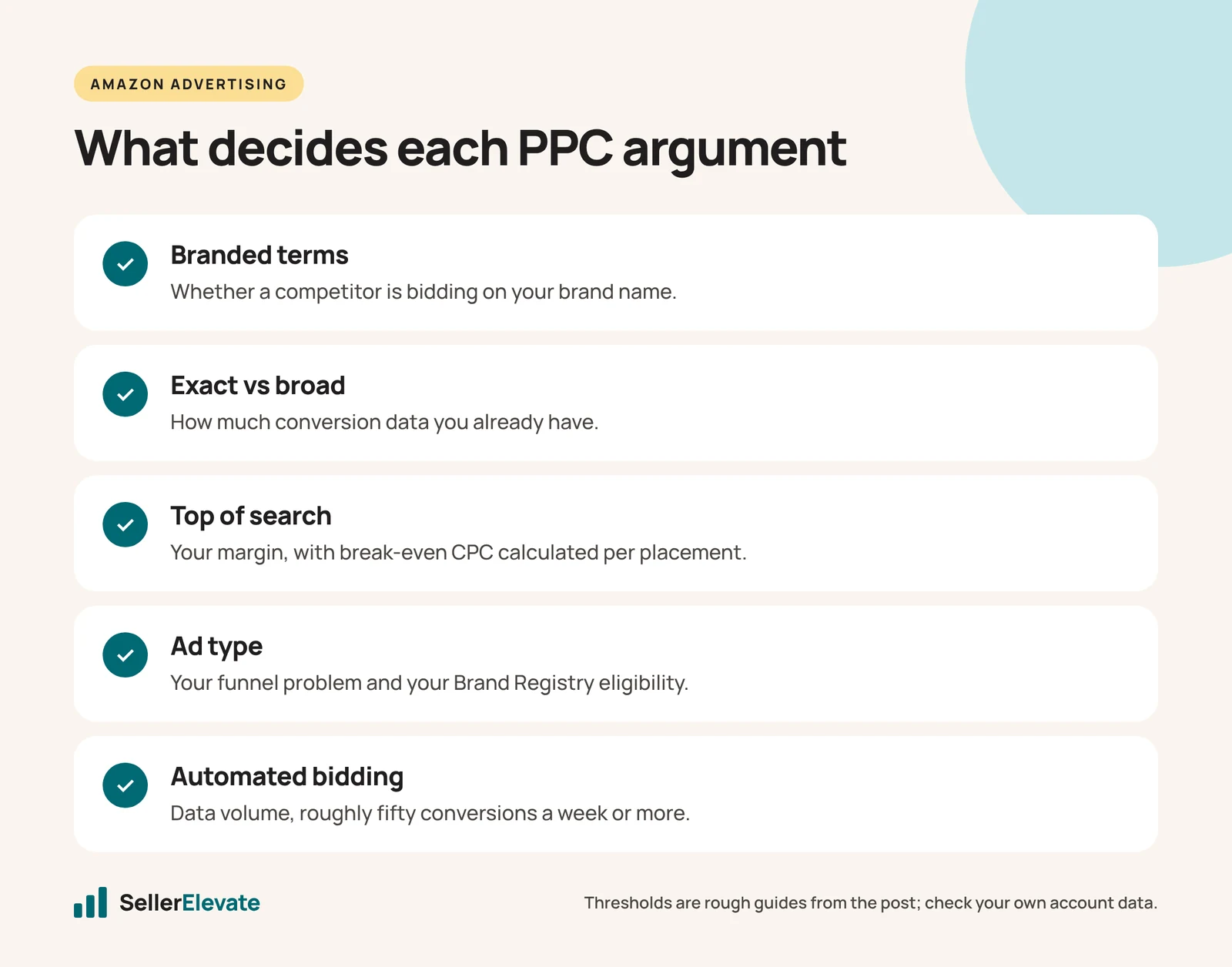
It depends on whether anyone else is bidding on your brand.
If your branded search results are uncontested, you are mostly buying clicks from people who were going to find you anyway. The sale gets attributed to advertising, your ACoS looks great, and almost none of it is incremental. That is the dilution the argument is pointing at, and it is real.
If a competitor is bidding on your name, the calculation inverts completely. Now the choice is not “pay for a sale you’d have got free” — it is “pay a small amount, or let a competitor intercept a shopper who was specifically looking for you.” Branded defence in that situation is among the cheapest money you will spend.
How to settle it for your account: search your own brand name, logged out, on mobile. If competitors occupy the sponsored slots, defend. If they do not, run a holdout — pause branded for two weeks and watch whether total branded revenue moves. If it does not, you were paying rent on your own name.
2 and 3. "Exact match dominates" versus "broad match wins"
It depends on how much conversion data you already have.
Broad is a discovery instrument. It finds queries you did not think of, at the cost of paying for a lot that will never convert. Exact is a harvesting instrument. It is efficient precisely because someone already did the discovery.
A new product has no data, so broad is the only way to find out what converts. A mature catalogue in a well-mapped category already knows its queries, so most of the budget belongs in exact and the broad campaigns exist as a small, tightly-negated tap left running to catch new language.
Both camps are describing the account they happen to run.
4. "Exclude exact from broad and phrase"
It depends on whether you value clean attribution or maximum reach.
Negative-exacting your converting terms out of broad and phrase campaigns stops your own campaigns competing for the same query. Each campaign then reports on a distinct slice of traffic, which makes the data readable and the decisions defensible.
The cost is that if your exact campaign runs out of budget, that query goes uncovered for the rest of the day rather than being picked up by a broad campaign with headroom left.
So it is a structure decision, not a performance one. Tight isolation if you want to be able to read your account and act on it, which is our default. Looser if you are budget-constrained and would rather capture the query anywhere than lose it.
5. Is top of search really king?
It depends on your margin.
Top of search genuinely converts best. It also costs the most. Whether that trade works is decided by break-even CPC — contribution margin per unit multiplied by conversion rate — calculated at that placement, not blended across the account.
A high-margin product can bid into top of search and still make money at a CPC that would bankrupt a thin-margin competitor. That competitor is not wrong to avoid it, and the person telling them top of search is king is generalising from a P&L they do not share.
Pull your placement report and calculate break-even separately for top of search, rest of search and product pages. They will be different numbers. Applying one multiplier across all three is how accounts overpay for the weak placement and underbid the strong one simultaneously.
6. "Sponsored Products vs Brands vs Display"
It depends on what stage of the funnel your problem is in — and what you are eligible for.
Sponsored Products captures existing intent. If your problem is that people searching your category are not finding you, this is where the money goes. It is also the only one of the three available without Brand Registry.
Sponsored Brands works when you have a range rather than a product, and when the job is establishing that you are a brand rather than a listing. It does more for a catalogue than for a single SKU.
Sponsored Display is the retargeting and defence instrument — re-reaching people who viewed but did not buy, and holding your own detail pages against competitors.
They are not competitors for the same budget. They solve different problems, and arguing about which is best is like arguing whether a hammer beats a screwdriver.
7. "I set my targets and let the AI run it"
It depends on data volume, and increasingly on which platform you are on.
Automated bidding needs enough conversions to learn from. Below roughly fifty conversions a week, you are asking a machine learning system to optimise against noise, and it will oblige. Above that, it will out-execute a human on the repetitive work — bid adjustment, pacing, negation at scale.
What it cannot do is notice that demand has migrated to a query you are not targeting, or that a new placement type is temporarily cheap, or that your listing is the reason conversion dropped. It optimises the past.
Worth noting the platforms are diverging on this. On Amazon you still get the choice. On TikTok Shop you do not — GMV Max has been the only format for new Sales-objective campaigns since July 2025.
The actual lesson
Every one of these arguments is someone generalising correctly from their own account and incorrectly to yours.
The variables that decide them are not exotic. They are your gross margin, your conversion rate, your data volume, your Brand Registry status, your catalogue maturity and whether a competitor is bidding on your name. Six things, all of which you can establish in an afternoon.
Which is why we are wary of anyone selling a universal Amazon PPC playbook, including the ones that are genuinely good. A playbook describes what worked in a particular set of conditions. The skill is knowing which conditions you are actually in.
If you cannot answer the six questions above for your own account, that is the gap — not the tactics.
Our free account audit answers those six for your catalogue specifically, and tells you which of the arguments above are even relevant to you. Most brands find that three of the seven do not apply at all.
Frequently asked questions
Should I bid on my own brand name on Amazon?
It depends on whether anyone else is bidding on it. Search your brand logged out on mobile. If competitors occupy the sponsored slots, defend, because branded defense is cheap. If not, run a holdout: pause branded campaigns for two weeks and watch total branded revenue. If it does not move, you were paying for sales you would have got anyway.
Is exact match or broad match better on Amazon?
It depends on how much conversion data you have. Broad match is a discovery tool that finds queries you did not think of, at the cost of wasted clicks, so new products need it. Exact match harvests queries already proven to convert. A mature catalogue should keep most budget in exact, with a small, tightly negated broad campaign catching new search language.
Is top of search worth the higher CPC?
It depends on your margin. Top of search converts best but costs the most. Pull your placement report and calculate break-even CPC, margin multiplied by conversion rate, separately for top of search, rest of search and product pages. A high-margin product can profit at a CPC that would sink a thin-margin competitor, so copying someone else's placement strategy is risky.
Can I let Amazon's automated bidding run my campaigns?
Only with enough data. Below roughly fifty conversions a week, the system is optimizing against noise. Above that, it handles repetitive work like bid adjustment, pacing and negation at scale better than a human. It cannot notice demand moving to a new query or that your listing caused a conversion drop, so strategy still needs a person.
Get the honest version of your numbers
A free account audit from the person who would actually run your account.