Can Amazon sellers get tariff refunds after the Supreme Court ruling?
Yes, if you were the importer of record on entries that paid IEEPA duties. Refunds are claimed through CBP's CAPE process in the ACE Portal and are not automatic. Tariffs did not disappear: since July 24, 2026, Section 301 duties of 10% or 12.5% apply to goods from 60 economies. Confirm details with a customs broker.
Key takeaways
- The Supreme Court ruled 6-3 on February 20, 2026 that IEEPA does not give the president clear authority to impose tariffs.
- IEEPA refunds go to the importer of record through CBP's CAPE process, which opened Phase 1 on April 20, 2026, Phase 2 on June 29 and Phase 3 on October 6.
- The 10% Section 122 surcharge expired on July 24, 2026 and was replaced the same day by Section 301 duties of 10% or 12.5% on 60 economies.
- USTR extended 178 China Section 301 exclusions until November 10, 2026, so check whether any of your SKUs depend on one before Q4 reorders.
- Treat any refund as a one-off cash event and re-price SKUs on current landed cost, not on expected refunds.
Yes, many Amazon sellers who paid IEEPA tariffs can get that money back, but only the importer of record can claim it, through CBP’s CAPE process in the ACE Portal. And no, the ruling did not take tariffs off your imports: since July 24, 2026, new Section 301 duties of 10% or 12.5% apply to goods from 60 economies, on top of whatever else your products already carried.
That is the short version. The rest of this post covers what changed, who can actually claim a refund, what is still unsettled in October, and how we would re-price imported SKUs before Q4 locks in. We are not customs lawyers, and nothing here is legal or customs advice. For your specific entries, talk to a licensed customs broker and check CBP’s official guidance.
What did the Supreme Court actually decide?
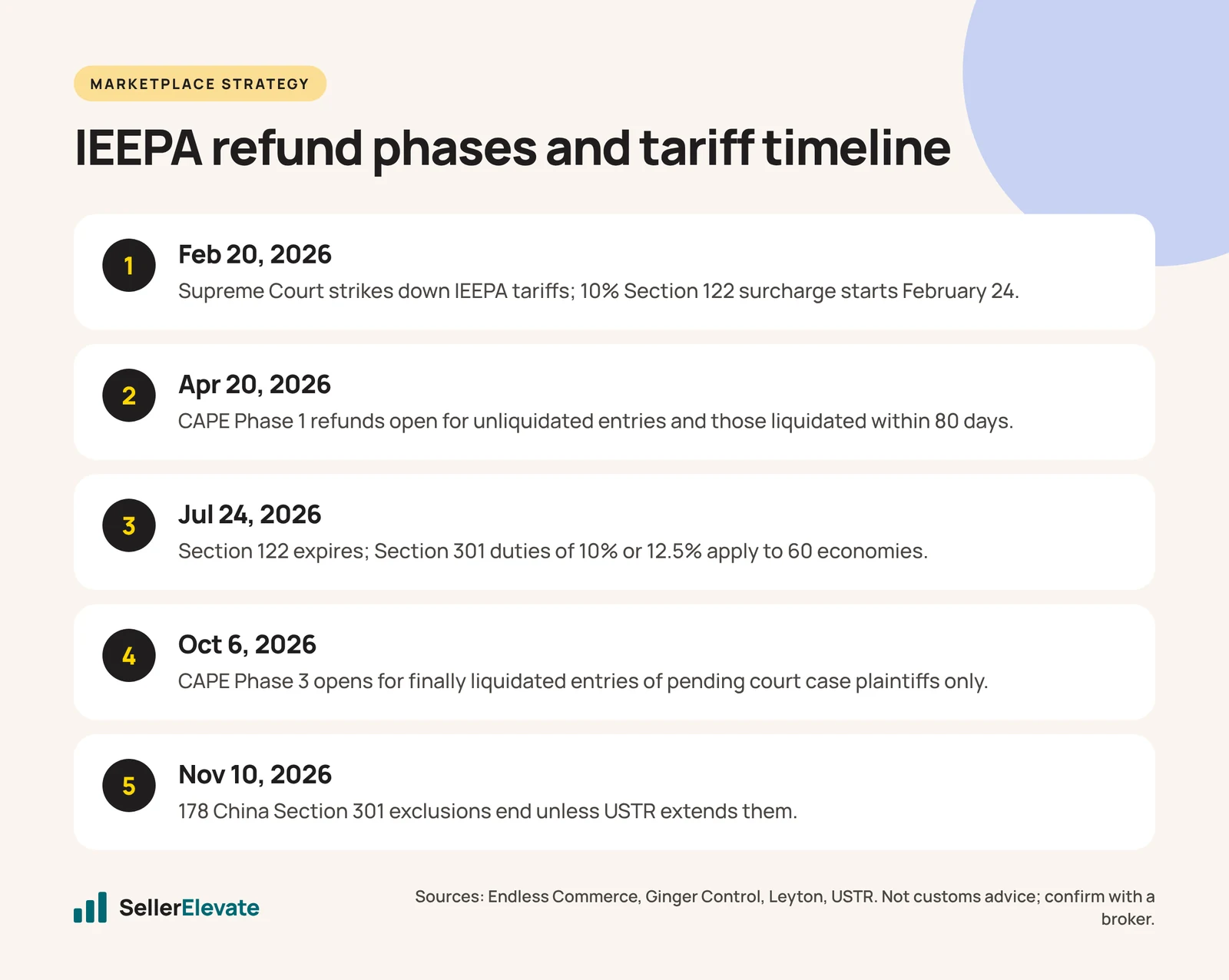
On February 20, 2026, the Supreme Court ruled 6-3 that the International Emergency Economic Powers Act (IEEPA) does not give the president clear authority to impose tariffs. According to Endless Commerce’s summary of the ruling, that knocked out the IEEPA reciprocal tariffs, the “fentanyl” tariffs on China, Canada and Mexico, and several country-specific IEEPA duties.
The administration replaced them almost immediately. A 10% global surcharge under Section 122 of the Trade Act of 1974 took effect on February 24, 2026. Section 122 allows a surcharge of up to 15% for up to 150 days, and the increase to 15% that officials signaled never took effect, per Ginger Control’s Section 122 explainer (updated September 18, 2026). Products covered by Section 232 (steel, aluminum, autos, copper, lumber, semiconductors) were outside the Section 122 surcharge.
Section 122 expired at 12:01 a.m. EDT on July 24, 2026. The same day, new Section 301 duties took over:
- Rate: 10% or 12.5%, depending on the country.
- Scope: 60 economies, with the European Union counted as one.
- In-transit goods: shipments already on the water before July 24 were exempt if entered before July 28.
- No clock: unlike Section 122, Section 301 has no rate cap and no 150-day limit.
So the honest answer to “what tariffs apply to my imports now?” is: the old layers (normal duty rates, the existing China Section 301 duties, any Section 232 duties) plus the new Section 301 duty for the 60 economies. Your broker can tell you the exact stack for each HTS code.
Can Amazon sellers get tariff refunds?
If you were the importer of record on entries that paid IEEPA duties, probably yes. If your supplier shipped DDP or your freight forwarder acted as importer of record, the refund runs through their account, not yours, so that conversation starts with them.
CBP is paying refunds through a system called CAPE (Consolidated Administration and Processing of Entries), in phases:
| Phase | Opened | What it covers |
|---|---|---|
| Phase 1 | April 20, 2026 | Unliquidated entries, or entries liquidated within the prior 80 days |
| Phase 2 | June 29, 2026 | Entries flagged for reconciliation (types 01, 02, 06) with no type 09 reconciliation entry filed yet |
| Phase 3 | October 6, 2026 | Finally liquidated entries, but only for plaintiffs in a pending Court of International Trade case and within a court reliquidation order |
Sources: Endless Commerce (Phase 1), Thompson Hine (Phase 2), Leyton (Phase 3).
A few details trip sellers up:
- Refunds are not automatic. You (or your broker) file a CAPE declaration in the ACE Portal and it has to pass CBP’s validation.
- Bank details matter. As of May 11, 2026, Endless Commerce counted 1,880 refunds blocked by missing ACH details. Check that your ACE account has refund banking set up.
- Liquidation timing matters. Endless Commerce advises filing protests on entries nearing the 180-day protest deadline to preserve your rights. This is exactly the kind of call to make with a broker, not alone.
- Phase 3 is narrow. If your entries are already finally liquidated and you are not a plaintiff in a pending case, Phase 3 likely does not help you today. Leyton also notes that importers who submitted their importer-of-record information after July 30, 2026 must wait for further CBP instructions.
Endless Commerce estimated total IEEPA refunds at about $35.46 billion across 8.3 million entries. That figure is an estimate, not a promise about your share.
What is still unsettled in October 2026?
Two things could change your numbers before the end of the year.
The Section 301 court challenge. A coalition of small businesses and 25 Democratic-led states is challenging the new Section 301 duties at the Court of International Trade. A three-judge panel heard arguments on September 30, 2026, according to Quartz. There was no ruling as of early October. If the duties are struck down, there may be another refund question; if they survive, they stay with no expiry date. Plan for them staying.
The China exclusions. Separate from the new duties, the long-running China Section 301 tariffs still apply. USTR extended 178 product exclusions until November 10, 2026. Ginger Control’s list puts the end at 11:59 p.m. EDT on November 9, with tariffs returning on November 10, and says no further extension had been announced. The underlying Section 301 rate on those products is typically 25%. If any of your SKUs ride on one of those exclusions, a Q4 reorder landing after November 10 could cost materially more.
One thing is not coming back: de minimis. Sellerboard notes the exemption ended for Chinese-origin goods on May 2, 2025 and was suspended globally on August 29, 2025, so every shipment needs a formal entry, at roughly $125 to $300 per entry in broker fees.
How should you re-price imported SKUs for Q4?
Start with landed cost, not factory price. Sellerboard’s worked example (July 20, 2026) takes 1,000 units at a $6.00 factory cost in a kitchen category with a 38% effective duty rate: duties come to $2,280 and true landed cost to $9.73 per unit, a 62% increase over invoice. Sellerboard warns that sellers who log COGS as factory price alone can see margins “20-plus points too high.”
The tariff changes since February move that number in both directions at once. Your IEEPA layer is gone and may come back as a refund. Your Section 122 layer (10%) ended. A Section 301 layer (10% or 12.5%) replaced it for most origins. For many SKUs the net effect on new entries is small, but it is not zero, and the refund is a one-off cash event, not a margin improvement.
Here is how we treat it with clients:
- Rebuild landed cost per SKU using the duty stack on entries after July 24, 2026, plus freight, broker fees per entry, and prep.
- Book any refund as a separate line. Do not use expected refund money to justify a lower price. It belongs to past inventory.
- Run the price test on contribution margin after ads. Referral and fulfillment fees, peak-season fees and ad spend all sit on top of landed cost. Our post on Amazon Q4 2026 fees has the Q4 layers.
- Decide price per SKU, not across the catalog. A hero SKU with strong conversion can usually carry a small increase. A SKU fighting on price may need a cost fix instead.
A hypothetical to show the scale. For a product with an $8.00 customs value, every 2.5 points of duty adds $0.20 per unit. On a $29.99 selling price that is small. On a $12.99 product with thin margins, after fees and ads, it can be the whole profit. That is why we never apply one blanket price increase. As we argued in your price is doing more work than your ads, price changes conversion, which changes ad efficiency, which changes everything downstream.
What we'd do this week
If you import your own inventory, this is the list we would work through before mid-October:
- Confirm who your importer of record was on every entry since early 2025. If it was not you, ask that party in writing whether they are filing CAPE claims and how refunds will be passed back.
- Ask your customs broker for an entry list with liquidation status, so you know which entries fall under Phase 1, Phase 2 or Phase 3, and which are close to protest deadlines.
- Check ACE refund banking (ACH) details. It is a small task that has held up real refunds.
- Flag any SKU on a China Section 301 exclusion and decide whether to land Q4 stock before November 10, 2026 or price in the higher duty.
- Recalculate landed cost and contribution margin for your top 20 SKUs using post-July 24 entries, then decide price changes SKU by SKU.
- Watch the Court of International Trade case and the USTR site, and recheck before you place Q1 2027 purchase orders.
If you want a second pair of eyes on the margin side, our account management team does this SKU-level pricing work with clients. The customs side belongs with your broker and CBP.
Frequently asked questions
Who receives an IEEPA tariff refund if my supplier shipped DDP?
The refund runs through the importer of record's ACE account, not automatically to the Amazon seller. If your supplier shipped DDP or your freight forwarder acted as importer of record, ask that party in writing whether it is filing CAPE declarations and how any refund will be passed back to you. Your customs broker can confirm who the importer of record was on each entry.
Is the CAPE refund automatic?
No. The importer of record or its broker must file a CAPE declaration in the ACE Portal, and it has to pass CBP's file and entry-level validation before money moves. Refund banking matters too: as of May 11, 2026, Endless Commerce counted 1,880 refunds blocked by missing ACH details. Check your ACE refund banking setup.
Will the new Section 301 tariffs expire like Section 122 did?
Not on their own. Section 122 had a built-in 150-day limit, which is why it ended on July 24, 2026. Section 301 has no rate cap and no 150-day clock. A court challenge was argued at the Court of International Trade on September 30, 2026, with no ruling as of early October, so plan as if the duties stay.
Is de minimis coming back for small shipments?
Nothing in our sources suggests it is. According to Sellerboard, the de minimis exemption ended for Chinese-origin goods on May 2, 2025 and was suspended globally on August 29, 2025, so every shipment needs a formal customs entry. Sellerboard puts broker fees at roughly $125 to $300 per entry, which belongs in your landed cost.
Sources
- Endless Commerce: Supreme Court IEEPA tariff ruling and refunds (data as of May 11, 2026)
- Ginger Control: Section 122 tariffs explained (updated September 18, 2026)
- Thompson Hine: CBP launches Phase 2 of the IEEPA tariff refund process (July 29, 2026)
- Leyton: CAPE Phase 3 set to launch October 6 (September 17, 2026)
- Quartz: Section 301 forced-labor tariffs face trade court challenge (September 30, 2026)
- USTR: USTR extends exclusions from China Section 301 tariffs (November 26, 2025)
- Ginger Control: Section 301 exclusions expiring November 2026 (June 1, 2026)
- Sellerboard: How do tariffs affect your Amazon margins in 2026 (July 20, 2026)
Get the honest version of your numbers
A free account audit from the person who would actually run your account.