How do I get my products to show up in ChatGPT shopping results?
Connect a product feed, either through Shopify Catalog if you sell on Shopify or by applying for direct feed access with OpenAI. Since September 4, 2026, ChatGPT shopping results feature only brands with feeds. After that, clear and consistent product data, plus reviews and independent mentions, decide how ChatGPT describes you.
Key takeaways
- Since September 4, 2026, ChatGPT shopping results feature only brands that submit product feeds.
- OpenAI moved ChatGPT shopping from in-chat checkout to discovery on March 24, 2026, so shoppers now buy on the merchant's own site.
- ChatGPT weighs three inputs that should agree: your feed, your product pages and your wider brand footprint.
- Amazon blocks OpenAI's crawlers, so Amazon-first brands need a DTC site with a feed that ChatGPT can read.
- Journeys that start in ChatGPT and end in a purchase elsewhere happen about 5 times more often than direct clicks, so measure branded search too.
To get your products into ChatGPT’s shopping results, you need a connected product feed: either through Shopify Catalog if you sell on Shopify, or a feed you submit to OpenAI directly. After that, what ChatGPT says about your product depends on how clear your product data is and what the rest of the web says about you.
That is the short version. The longer version matters because the rules changed twice this year, and a lot of the advice still circulating was written for a system that no longer exists.
What changed in ChatGPT shopping in 2026?
Two things.
First, OpenAI walked away from in-chat checkout. On March 24, 2026, it said the first version of Instant Checkout “did not offer the level of flexibility” it wanted, and moved its focus to product discovery, with shoppers finishing the purchase on the merchant’s own site or app (TechInformed, March 30, 2026). Uptake had been thin. A Forrester analyst put Shopify adoption at about 30 merchants as of February, and Walmart said ChatGPT checkout converted at about one third of its own website, as reported by Stellagent.
Second, feeds became the entry ticket. The Agentic Commerce Protocol (ACP), originally built for checkout, is now the catalog and discovery layer. Merchants send structured feeds with titles, descriptions, images, price and availability, as a daily snapshot plus API updates. Target, Sephora, Nordstrom, Lowe’s, Best Buy, The Home Depot and Wayfair have integrated it, and Shopify merchant data flows in through Shopify Catalog. Then, in early September, Search Engine Roundtable reported that ChatGPT shopping results now feature only brands that submit product feeds (September 4, 2026).
So if you have no feed, you are not in the shopping results. It does not matter how good the product is.
How does ChatGPT decide which products to recommend?
OpenAI has not published a ranking formula. What it has said is that shopping results “are not ads and are not influenced by partnerships.” Advertising is a separate, labeled product, which we cover in our post on ChatGPT ads for ecommerce brands.
The most useful outside framework we have seen is from Similarweb, which describes three inputs that need to agree with each other:
- The feed. ID, title, description, price, availability, images and attributes.
- Your product pages. Used to check specs, imagery and who the product is for.
- Your brand footprint. Reviews, marketplace listings, editorial roundups and other trusted sources.
That matches what we see when we test prompts for clients. ChatGPT tends to name products whose facts are easy to confirm from more than one place. A product whose feed says “waterproof”, whose page says “water resistant” and whose reviews complain about leaks gives the model three conflicting answers. It will usually pick someone else.
Similarweb also found that journeys which start in ChatGPT and end in a purchase somewhere else (Google, a retailer’s search box, a marketplace) happen about 5 times more often than journeys with a direct click from ChatGPT to a retailer. Most of ChatGPT’s influence is upstream of the click. We look at what that means for measurement in does AI traffic convert.
What if most of my sales are on Amazon?
This is the awkward part for Amazon-first brands. Amazon has blocked OpenAI’s crawlers in its robots.txt, including ChatGPT-User, the agent ChatGPT uses to fetch live pages when someone asks a question, and OAI-SearchBot (Modern Retail, November 21, 2025). ChatGPT cannot reliably read current Amazon prices, stock or detail pages.
That does not make ChatGPT irrelevant for you. It means your Amazon listing cannot be the only source of truth about your product. You need something ChatGPT can read and send people to: a small DTC site with a feed, even if most buyers end up on Amazon anyway. We cover the wider picture in why ChatGPT rarely sends traffic to Amazon.
The checklist: a brand with an Amazon listing and a small DTC site
This is the order we would work in. Feed first, because nothing else counts until you are eligible.
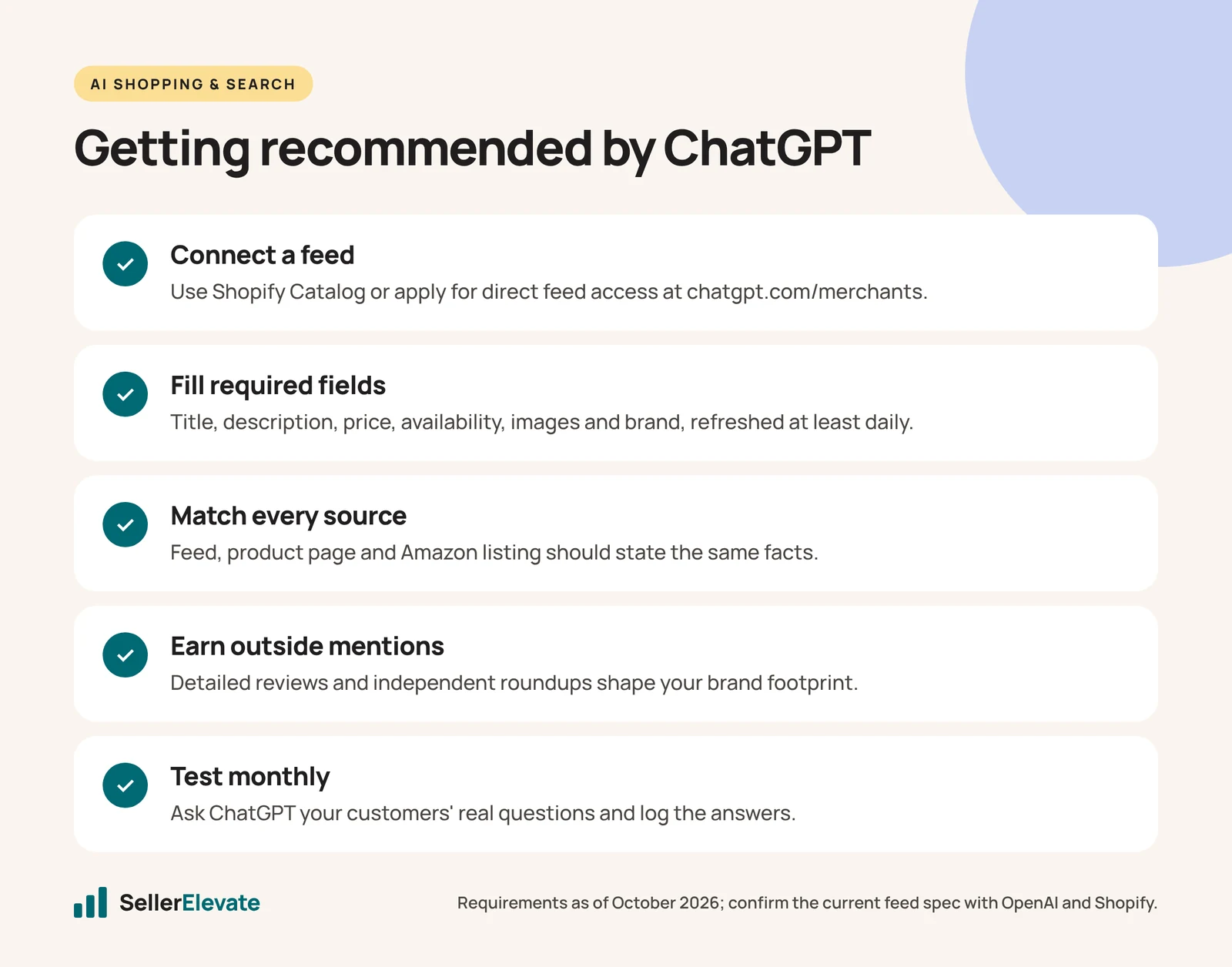
- Get a feed connected. If your DTC site runs on Shopify, Agentic Storefronts is on by default for eligible US stores and your products reach ChatGPT through Shopify Catalog. Check it under Sales channels in your admin (our Shopify Agentic Storefronts guide has the steps). If you are on another platform, you can apply for direct feed access at chatgpt.com/merchants, or use Shopify’s Agentic plan to list in Shopify Catalog without moving your store.
- Fill every required field. One vendor guide to the OpenAI feed spec, from Alhena (updated September 30, 2026), lists nine required fields: item_id, title, description, url, brand, seller_name, image_url, availability and price, with a full snapshot at least daily. Confirm the current spec with OpenAI before you build anything, since this is changing quickly.
- Write titles and descriptions that answer questions. People ask ChatGPT things like “a carry-on backpack that fits under a plane seat and holds a 16-inch laptop.” Put size, material, compatibility and use case in plain words, not just keywords. This is the same discipline we apply in listing optimization on Amazon.
- Make the feed, the page and the Amazon listing say the same thing. Same dimensions, same claims, same product name. Contradictions are the most common problem we find.
- Keep price and stock current. A product that shows as in stock at the wrong price creates a bad experience, and feeds are refreshed daily, not instantly.
- Add structured data to your product pages. Product, Offer and AggregateRating schema help any machine reader confirm the basics (Yotpo covers this well).
- Earn mentions outside your own site. Reviews with real detail, inclusion in independent roundups, and honest answers on forums all feed the “brand footprint” input. You cannot buy this quickly, and paying for fake reviews will hurt you on Amazon long before it helps you in ChatGPT.
- Test monthly. Ask ChatGPT the five or six questions your customers really ask. Record whether you appear, what it says, and which sources it cites.
How do you know if it's working?
Be realistic about what you can measure.
| Signal | Where to see it | What it tells you |
|---|---|---|
| Referral sessions from chatgpt.com | Your site analytics | Direct clicks only, the smaller share |
| Orders with ChatGPT attribution | Shopify admin order details | Direct sales, if you are on Shopify |
| Branded search volume | Google Search Console, Amazon Brand Analytics | Indirect demand, including people who research in ChatGPT and buy elsewhere |
| Prompt test results | Your own monthly log | Whether you are named, and how you are described |
If you only watch the first row you will undercount what ChatGPT is doing, for the reason Similarweb gives above. If you only watch the last row you will chase a number that does not pay the bills. Watch all four for three months before you decide anything.
What we'd do this week
For a typical client of ours, a brand doing most of its volume on Amazon with a Shopify site on the side:
- Log into Shopify and confirm the Agentic Storefronts channels are on, and that the products you care about are in the catalog.
- Export the product feed and compare it, line by line, against the Amazon listing for your top five products. Fix every mismatch.
- Rewrite the first two sentences of each product description so they state what the product is, who it is for and the one spec people ask about most.
- Write down ten real customer questions and test them in ChatGPT. Save the answers as your baseline.
- Decide whether paid placement is worth testing. For most brands we would wait until the organic basics are done, for the same reason we treat PPC as an amplifier rather than a fix: ad spend on a weak listing just buys more of the leak.
None of this replaces your Amazon work. It is a few days of product data clean-up that makes your brand easier for every AI assistant to describe accurately, including Google’s, which we cover in selling in Google AI Mode. If you would like a second pair of eyes on your listings and feed before Q4, our free audit is a good place to start.
All rules and requirements here are as of October 2026. Confirm the current feed spec and eligibility with OpenAI and Shopify before you act.
Frequently asked questions
Can I pay to appear in ChatGPT's organic product recommendations?
No. OpenAI says shopping results are not ads and are not influenced by partnerships. ChatGPT ads are a separate, labeled product bought through ChatGPT Ads Manager. Buying ads does not get you into the organic results, and you need a connected product feed for those either way.
Does ChatGPT recommend Amazon products?
It can name them, but it cannot reliably read current Amazon pages. Amazon blocks OpenAI's crawlers, including ChatGPT-User and OAI-SearchBot, in its robots.txt. That means ChatGPT often lacks current Amazon prices and stock. Amazon-first brands should give ChatGPT another accurate source, such as a DTC site with a product feed.
What fields does a ChatGPT product feed need?
One vendor guide to OpenAI's spec lists nine required fields: item_id, title, description, url, brand, seller_name, image_url, availability and price, with a full snapshot at least daily. Shopify merchants are covered through Shopify Catalog. Confirm the current spec with OpenAI before building a feed, because requirements are changing quickly.
How long does it take to show up in ChatGPT?
There is no published timeline. Feeds are refreshed daily, so eligibility can follow quickly once a feed is connected, but being in the feed does not guarantee you are shown. We suggest testing the same customer questions monthly and watching results for three months before drawing conclusions.
Sources
- TechInformed: OpenAI refocuses ChatGPT shopping on discovery (March 30, 2026)
- Stellagent: OpenAI shopping agent strategy pivot (March 23, 2026)
- Search Engine Roundtable: ChatGPT Ads Manager plugin, audience updates, product feeds (September 4, 2026)
- Similarweb: ChatGPT ecommerce (November 30, 2025)
- Modern Retail: Amazon blocks more of OpenAI’s ChatGPT web crawlers (November 21, 2025)
- Alhena: ChatGPT shopping product feed guide (updated September 30, 2026)
- Yotpo: How ChatGPT recommends products (updated July 27, 2026)
Get the honest version of your numbers
A free account audit from the person who would actually run your account.