Did Amazon overcharge me for Sponsored Products ads?
Nobody knows yet. On August 31, 2026 the FTC and 22 states sued Amazon, alleging a hidden soft reserve price pushed advertisers toward paying their own bids since 2019. Amazon denies it. You can compare your average CPC with your bids to see how close you have been paying to your maximum.
Key takeaways
- The FTC and 22 states sued Amazon on August 31, 2026, alleging a hidden soft reserve price in the Sponsored Products auction.
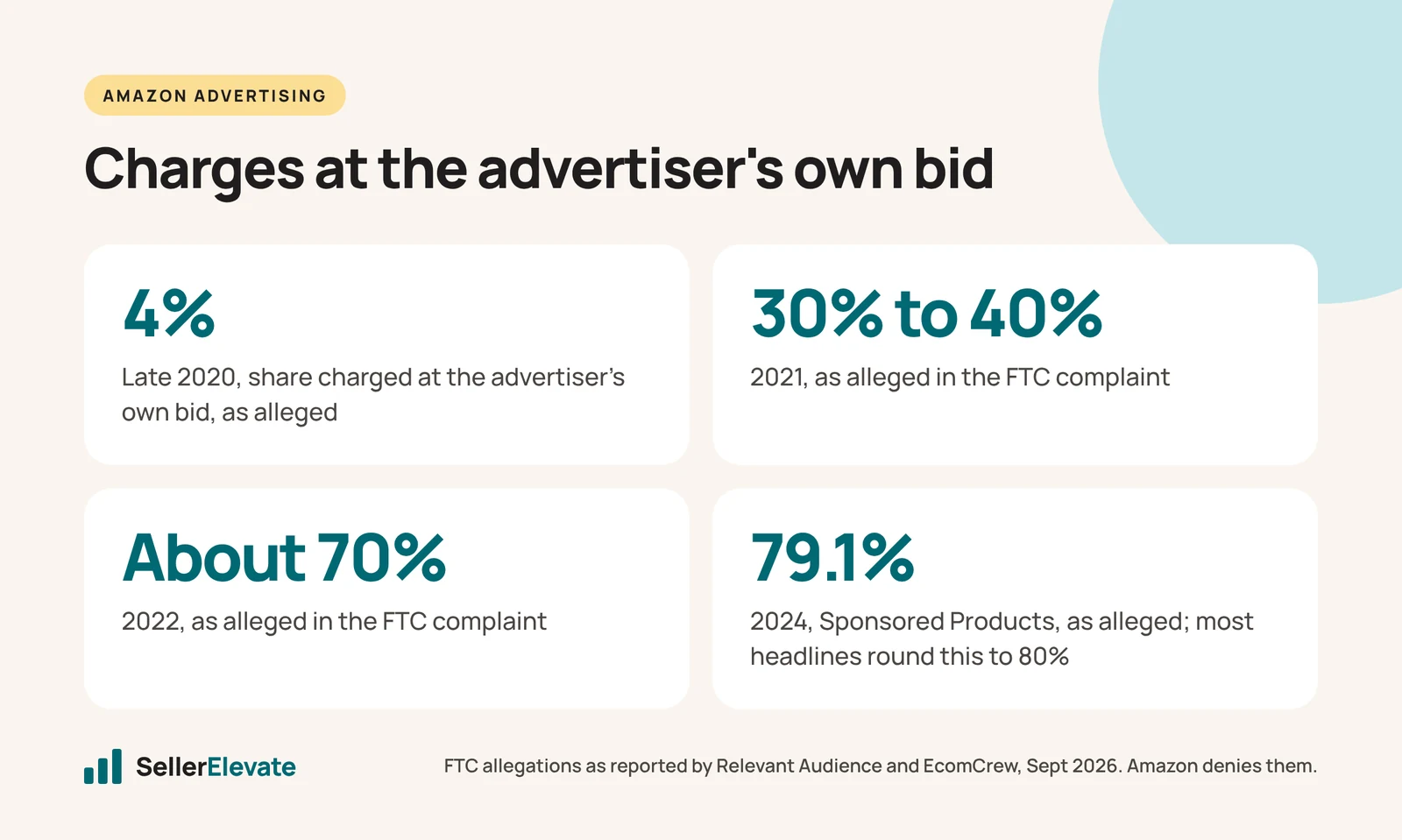
- As reported, the complaint says the share of charges at the advertiser's own bid rose from about 4% in late 2020 to 79.1% in 2024.
- Amazon denies wrongdoing and says inflation-adjusted CPC was flat from 2019 to 2024 while conversion rates rose 24%.
- You can check your exposure by dividing average CPC by bid for your top targets, especially around Prime Day and Black Friday.
- There is no claims process today, so treat your bid as your likely price and set it from margin.
You may have paid more per click than the auction rules Amazon described would suggest, but nobody knows yet, and nothing has been proven. On August 31, 2026, the FTC and 22 states sued Amazon alleging a hidden “soft reserve” price inflated Sponsored Products costs since 2019; Amazon denies it, and the case will take years.
What you can do now is look at your own data. That takes about an hour, and it is useful whatever a court eventually decides, because it tells you how close your clicks run to your maximum bids.
What does the FTC lawsuit actually allege?
The complaint was filed in federal court in Seattle by the FTC and 22 state attorneys general. Relevant Audience lists it as case 2:26-cv-03097. Everything below is an allegation from that complaint as reported by the press. None of it has been tested in court.
The core claims, as reported:
- Amazon told advertisers Sponsored Products was a second-price auction, where the winner pays roughly one cent more than the next-highest bid.
- Starting in 2019, Amazon allegedly added an undisclosed “soft reserve price,” calculated after the winner and runner-up were known. When that reserve was higher than the second price, the advertiser paid the reserve, capped only by their own bid. EcomCrew reports internal documents describing a “surchargedSecondPrice” with “a surcharge hidden in it.”
- The share of charges landing at the advertiser’s own bid allegedly rose from about 4% in late 2020, to 30% to 40% in 2021, about 70% in 2022, and 79.1% in 2024. Outlets describe this figure differently: Relevant Audience reports it as the share of clicks charged at the advertiser’s own bid, while EcomCrew describes it as the share of advertisers paying their full bid. Most headlines round it to 80%.
- According to Relevant Audience, the reserve began in Sponsored Brands in December 2018, reached Sponsored Products in mid-2019 and Display ads in 2023. It reports about 50% of Sponsored Brands charges at the advertiser’s own bid in 2024.
- Retail Dive reports the complaint alleges higher surcharges during “high-volume shopping occasions” such as Prime Day and Black Friday.
- The suit says more than one million brands and sellers were affected. Coverage of the total varies: some outlets say “tens of billions of dollars,” and exchange4media reports a $20 billion figure.
How was the auction supposed to work?
Here is a hypothetical example to make the mechanics concrete.
Say your max bid on a keyword is $2.00 and the next-highest bidder is at $1.20. Under a plain second-price auction you win and pay about $1.21. Under the alleged soft reserve, Amazon’s system estimates the slot is worth, say, $1.85, so you pay $1.85. You never pay more than your $2.00 bid, which is Amazon’s point, but you pay a lot more than $1.21.
That is why both sides can say true-sounding things at once. Amazon can say advertisers never pay more than they bid. The FTC can say advertisers paid far more than the auction they were told about would have charged.
What does Amazon say?
Amazon denies wrongdoing. Its responses, as reported:
- The FTC “fundamentally misunderstands how advertisers operate,” and the complaint “cites no evidence of consumer price increases” (Boston Globe).
- Reserve pricing sets a real-time minimum value for ads, and advertisers never pay more than they bid.
- Sponsored ads cost per click was flat when adjusted for inflation between 2019 and 2024, while conversion rates rose 24%. “Advertisers adjust bids based on real-world performance, not descriptions of auction mechanics” (Retail Dive).
- Amazon says relevance-based ranking saved advertisers more than $8 billion from 2021 to 2025, and characterizes the internal documents as brainstorming.
Our read: Amazon’s strongest argument is the one about behavior. Most sellers set bids from ACoS and conversion data, not from a theory of the auction. The FTC’s strongest argument is that sellers were told one thing and charged under another. A court will decide which matters more. We would not bet a budget on the outcome either way.
How can I check whether I paid close to my max bid?
You cannot see the auction itself. You can see how your average cost per click compares with the bid you set. A ratio close to 1.0 over a long period means you have mostly been paying your own bid.
- In the Ads console, open a Sponsored Products campaign with steady spend and download the targeting report (keywords and product targets) for the longest period available.
- For each target, divide average CPC by the bid on that target. Sort by spend.
- Look at your top 20 targets by spend. Those are where any overpayment would be concentrated.
- Repeat for Prime Day and Black Friday weeks separately, since the complaint alleges higher surcharges in those periods.
- Note any placement adjustments or dynamic bidding settings. These can raise your effective bid above the number in the bid column, so a CPC above your base bid is not, by itself, evidence of anything.
- Save the reports. If a claims process ever exists, contemporaneous records will matter.
How to read the ratio:
| Average CPC ÷ bid | What it usually means | What we would do |
|---|---|---|
| Under 0.70 | Real competition sets your price | Leave bids alone, keep monitoring |
| 0.70 to 0.90 | Prices close to your ceiling | Check whether the target earns its bid |
| Over 0.90 for months | You mostly pay what you bid | Treat your bid as your price and set it accordingly |
That last row is the practical lesson. If you are routinely charged your full bid, then your bid is not a ceiling you hope never to reach. It is the price.
Which bidding habits limit your exposure?
None of these depend on the lawsuit. They are simply how we think bids should be set when the charged price sits near the bid.
- Set bids from margin, not from hope. Work out the most you can pay per click and still hit your target ACoS at your current conversion rate. Bid that, not a round number with headroom.
- Stop “bidding high to win, expecting to pay less.” That habit made sense in a pure second-price auction. If charged prices track bids, it just raises your cost.
- Be careful with blanket placement multipliers. A large top-of-search adjustment applied to every target multiplies your exposure on weak keywords along with strong ones.
- Watch peak events closely. Lower bids on marginal targets going into Prime Day and Black Friday and review CPC daily during the event.
- Keep some manual control. Rules and automation are useful, but a set of manually bid campaigns gives you a baseline to compare against. We wrote about what happened when automation ran unchecked in our post on PPC automation limits.
If you want a second pair of eyes on bid structure, that is a normal part of our Amazon PPC management work.
Will sellers get money back?
Possibly, eventually, and not soon. Even if the FTC wins, EcomCrew notes litigation can take years and the outcome for individual advertisers is uncertain. There is no claims process today. Be wary of anyone offering to “recover” your FTC refund for a fee. If you spend heavily and want to understand your position, talk to a lawyer, not an ads agency.
This case also sits inside a bigger trend. Advertising revenue is growing faster than seller revenue on Amazon, which we break down in why your ACoS keeps rising.
What we'd do this week
- Pull 12 months of targeting reports for your three biggest Sponsored Products campaigns and calculate CPC ÷ bid for the top 20 targets.
- Flag any target over 0.90 and check whether it earns that price at your margin.
- Recalculate maximum profitable bids from current conversion rates and reset bids that sit above them.
- Review placement multipliers before Black Friday and Cyber Monday.
- Archive the reports in case they are needed later.
If the numbers look odd and you cannot tell why, a free account audit is a reasonable place to start. Everything in this post reflects reporting as of October 2026; check the case docket and Amazon’s own ads documentation for anything newer.
The case lands as Amazon pushes its ad stack beyond its own store through Amazon Retail Ad Service, which raises the same questions about auction transparency.
Frequently asked questions
Can I join the FTC lawsuit against Amazon?
No. This is a government enforcement case brought by the FTC and 22 state attorneys general, not a class action that sellers sign up for. There is no claims process today. If one is ever created, it would come later, and records of your own CPC and bids would likely help. A lawyer can advise on any private options.
What is a soft reserve price on Amazon ads?
As alleged in the complaint, it is a hidden price floor Amazon calculated after an auction's winner and runner-up were known. If it was higher than the second-highest bid, the winner paid the reserve instead, capped at their own bid. Amazon says reserve pricing reflects the real value of an ad slot.
Does the lawsuit cover Sponsored Brands and Display ads too?
Reporting suggests the alleged reserve started in Sponsored Brands in December 2018, reached Sponsored Products in mid-2019 and Display ads in 2023. Relevant Audience reports about 50% of Sponsored Brands charges were at the advertiser's own bid in 2024. These are allegations Amazon disputes.
Should I lower my Amazon bids because of the lawsuit?
Not because of the lawsuit itself. Lower bids where the numbers say a target cannot earn its price. If your average CPC divided by your bid sits above 0.90 for months, treat the bid as what you will pay and set it from margin and conversion rate rather than leaving headroom.
Sources
- Boston Globe: FTC, 22 states claim in lawsuit that Amazon secretly inflated ad prices (Aug 31, 2026)
- EcomCrew: The FTC is suing Amazon over how Sponsored Products pricing actually works (Sep 2026)
- Retail Dive: Amazon hid surcharges on ad auctions, alleges FTC complaint (Sep 2026)
- Relevant Audience: The FTC says Amazon charged advertisers their own bid 79 percent of the time (Sep 2026)
- exchange4media: Amazon sued by FTC, 22 US states over alleged $20 billion ad pricing scheme (Sep 2026)
Get the honest version of your numbers
A free account audit from the person who would actually run your account.