Did Amazon change Buy Box eligibility in 2026?
Yes. From July 2026, Amazon began removing the separate seller-performance eligibility check for the Featured Offer, with a global rollout expected by the end of 2026. Performance metrics now feed the ranking directly alongside price and delivery speed, so all offers compete from one pool. Being considered does not guarantee winning.
Key takeaways
- Amazon began removing the standalone Featured Offer eligibility gate in July 2026, with EU and UK rollout from July 20 and global completion expected by the end of 2026.
- Seller performance metrics did not disappear; they now act as inputs to a single ranking alongside price and delivery speed.
- Sellers who used to fail the gate can now compete, so a lower-priced offer with weaker metrics may win some of the time.
- Amazon has not published a country-by-country schedule or how heavily each metric now weighs.
- Diagnose a falling Featured Offer percentage by checking total price, delivery promise, metrics, stock and new competitors before cutting price.
Yes, Amazon changed how the Featured Offer (the Buy Box) is chosen in 2026: from July, it began removing the separate seller-performance eligibility check, with a global rollout expected to finish by the end of the year. If you are still losing the Buy Box, the reason has not gone away. The same metrics now feed the ranking directly, and you are competing against a larger pool of offers than before.
The wording of the announcement confused a lot of sellers. “Eligibility removed” sounds like a door opening. In practice it means the door is gone and the race starts for everyone at the same line.
What exactly did Amazon change?
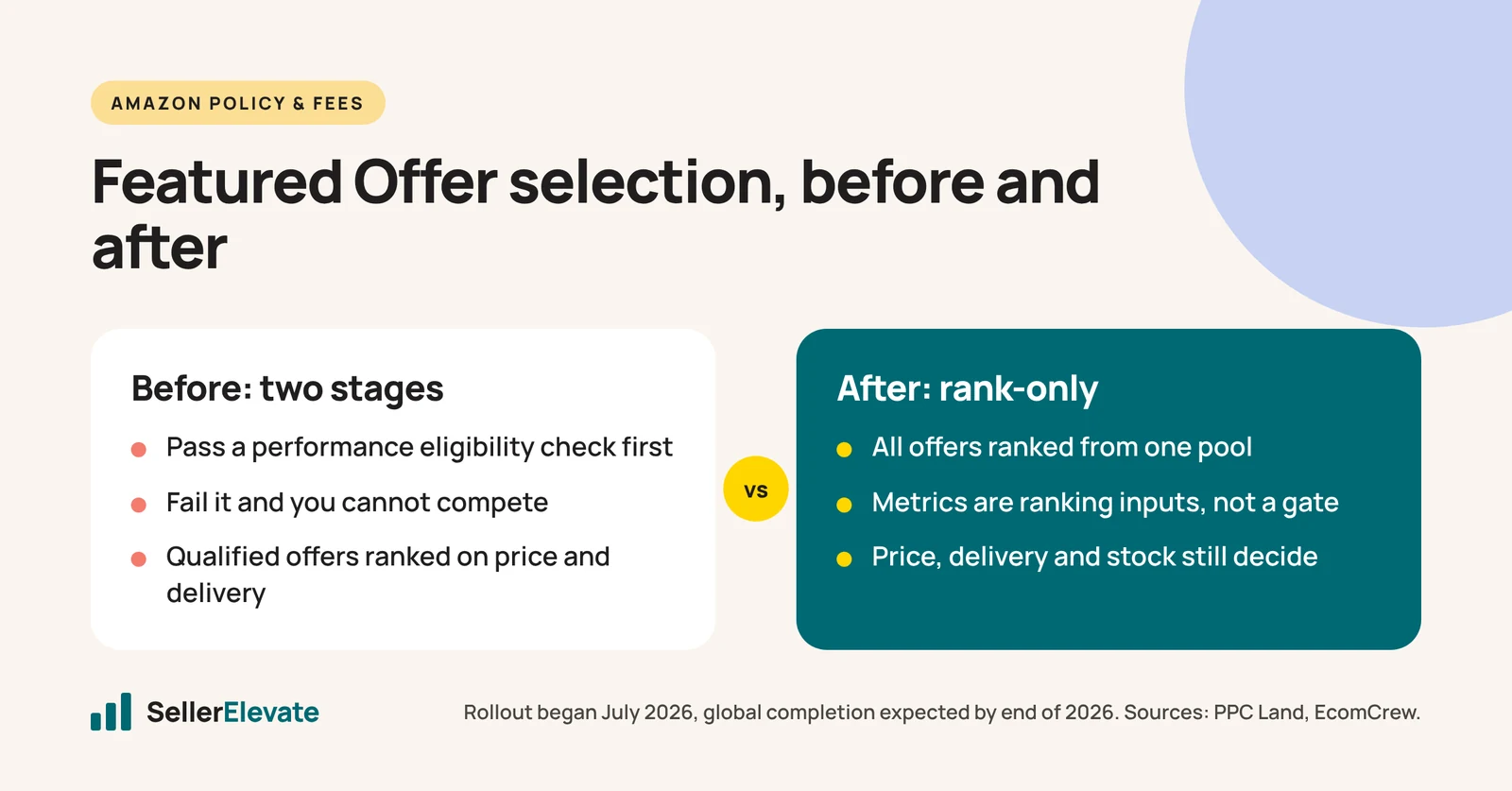
Amazon announced the change through its News_Amazon account on the Seller Forums in early July, according to PPC Land. Before and after, as reported as of October 2026:
| Before (two-stage) | After (rank-only) | |
|---|---|---|
| Step 1 | Pass a standalone performance-based eligibility check | Removed |
| Step 2 | Qualified offers ranked on price, delivery and service | All offers ranked from the full pool |
| Performance metrics | Acted as a gate: fail and you could not compete | Act as inputs to the ranking alongside price and delivery |
| Seller action needed | Meet the thresholds | None to enroll; existing offers are included automatically |
Amazon’s stated reason was that the first step was “no longer delivering additional value to customers, so we’re removing it.” It also said, plainly, that “being considered for the Featured Offer doesn’t guarantee your offer will be featured.” My Amazon Guy reports Amazon describing it as “a structural change to the Featured Offer process rather than a change to the standards.”
When does the change reach my marketplace?
Here the detail is thin. The sources agree on:
- July 2026: rollout begins.
- July 20, 2026: start date for the EU and UK, according to EcomCrew, BQool and My Amazon Guy.
- End of 2026: global rollout expected to be complete.
PPC Land notes that Amazon has not published a country-by-country schedule. So as of early October, you cannot be certain whether your US listings are already ranked under the new model. That matters less than it sounds, because the factors that win the Buy Box are the same under both systems. Plan as if the change is live.
Which metrics used to be the gate?
The sources list slightly different metrics, which is part of the confusion:
- PPC Land: chargeback rate, order defect data and Voice of the Customer complaints.
- EcomCrew: Order Defect Rate, Late Shipment Rate and cancellation rate.
- BQool: a Professional selling plan, Order Defect Rate below 1%, and low cancellation and late shipment rates.
Amazon has not published how heavily any of these now weigh in the single ranking. PPC Land lists the weighting as an open question, along with whether anything changes in how Amazon handles offers priced higher than elsewhere online. We would not trust any article that gives you a percentage weighting.
Why am I still losing the Buy Box?
Because nothing that wins the Buy Box was removed. The factors the sources list as unchanged: competitive pricing, delivery speed, free shipping and free returns, Prime eligibility, consistent stock, and seller performance.
What did change is who you are up against. Sellers whose metrics used to fail the gate are now in the ranking. A seller with a slightly worse defect rate and a meaningfully lower price could now beat you where they previously could not even compete. EcomCrew recommends auditing competitors “particularly those previously excluded,” and that is where we would look first.
Run this diagnostic for each ASIN where your Featured Offer share has dropped:
- Check your Featured Offer percentage in Business Reports, by ASIN, for the last 30 days against the 30 days before. Find when it fell.
- List every active offer on the ASIN. Note any new sellers, and their price, fulfillment method and delivery promise.
- Compare total price, not item price. Item plus shipping is what the shopper pays.
- Compare delivery promises. EcomCrew notes Amazon tightened handling time requirements through 2026. A one-day slower promise can cost the Buy Box on its own.
- Check your Account Health metrics: Order Defect Rate, Late Shipment Rate, cancellation rate and any Voice of the Customer flags on the ASIN. These are now ranking inputs, so small moves matter.
- Check stock. Low inventory or a stockout restarts the race when you come back.
- Check external prices. If your product is cheaper on another site, Amazon may treat your price as uncompetitive. How that interacts with the new model is unclear, per PPC Land.
- Check your reference price. Our post on why strikethrough prices disappeared explains how List Price rules now depend on Featured Offer sales, which ties the two problems together.
If the new competitor is an unauthorized seller of your brand, the Featured Offer change is not the root cause. The fix is distribution control, and the new Reseller role for ASIN creation gives brand owners more leverage there. We wrote about the wider pattern in someone is already selling your brand on Amazon.
A hypothetical example
To make the shift concrete, imagine two sellers on the same ASIN. These numbers are illustrative only; Amazon does not publish weights.
| Seller A (you) | Seller B (new competitor) | |
|---|---|---|
| Item price | $29.99 | $27.49 |
| Shipping | Free, FBA | Free, FBM |
| Delivery promise | 2 days | 4 days |
| Late shipment history | Clean | Patchy enough to have failed the old gate |
Under the old system, Seller B might never have entered the ranking. Under the new one, Seller B is ranked, and on some days, for some shoppers, a $2.50 lower price may outweigh a slower promise and weaker metrics. You will see that as a Featured Offer share that slips from near 100% to something lower, without anything changing on your side.
The response is not automatically to match $27.49. If your delivery is faster and your metrics are cleaner, protect those advantages first, and check whether Seller B is authorized to sell your brand at all.
Does this help new sellers and resellers?
Somewhat. A new seller, or one recovering from a bad month of metrics, no longer has to clear a hurdle before being considered. That is the honest upside.
But the ranking still rewards price, delivery and performance. If your metrics are weak, the change converts a hard “no” into a soft “probably not.” For resellers, the bigger constraint in 2026 is not the Buy Box at all; it is whether the brand lets you list and sell in the first place.
What we'd do this week
- Pull Featured Offer percentage by ASIN for your top 20 and flag any drop since July.
- Run the eight-point diagnostic above on each flagged ASIN, starting with the highest revenue.
- Fix delivery promise first where you are slower than the competing offer. In our experience it is often cheaper than cutting price. Our post on delivery speed as a ranking lever covers how.
- Tighten metrics before Black Friday. Late shipments and cancellations rise under peak volume, and they now cost you ranking rather than just a warning.
- Do not price-war on reflex. Work out whether you are losing on total price, speed or metrics before you cut margin.
- Clean up the listing side too: the 75-character title limit and AI image labels both arrived this summer.
If you want help finding out why a specific ASIN is losing the Featured Offer, our account audit covers seller competition and Buy Box share.
Frequently asked questions
Do I need to do anything to opt in to the new Featured Offer process?
No. My Amazon Guy reports that existing offers are included automatically, and Amazon described the change as structural rather than a change to the standards. What you do need to do is keep the factors that win the ranking strong: total price, delivery promise, stock and account health metrics.
Is an Order Defect Rate below 1% still important?
Yes. BQool lists an Order Defect Rate below 1% among the old eligibility criteria. The gate is gone, but performance metrics now feed the ranking directly, so a rising defect rate still costs you Featured Offer share. It also remains an account health target in its own right.
Where do I see my Featured Offer percentage?
In Seller Central Business Reports, by ASIN. Compare the last 30 days with the 30 days before, and look for the week the share started to fall. Then check which offers were active on that ASIN at the time, including sellers that may only now be competing.
Does the change affect off-Amazon price checks?
Unclear. PPC Land lists it as an open question whether anything changes in how Amazon handles offers priced higher than elsewhere online. Until Amazon says otherwise, assume that a lower price for the same product on another site can still make your Amazon offer look uncompetitive.
Sources
- PPC Land: Amazon cuts Featured Offer eligibility gate starting July 2026 (July 7, 2026)
- EcomCrew: Amazon is removing seller eligibility requirements for the Featured Offer (July 7, 2026)
- My Amazon Guy: Amazon Featured Offer eligibility criteria just got simpler (July 8, 2026)
- BQool: Amazon Featured Offer eligibility changes (August 3, 2026)
Get the honest version of your numbers
A free account audit from the person who would actually run your account.