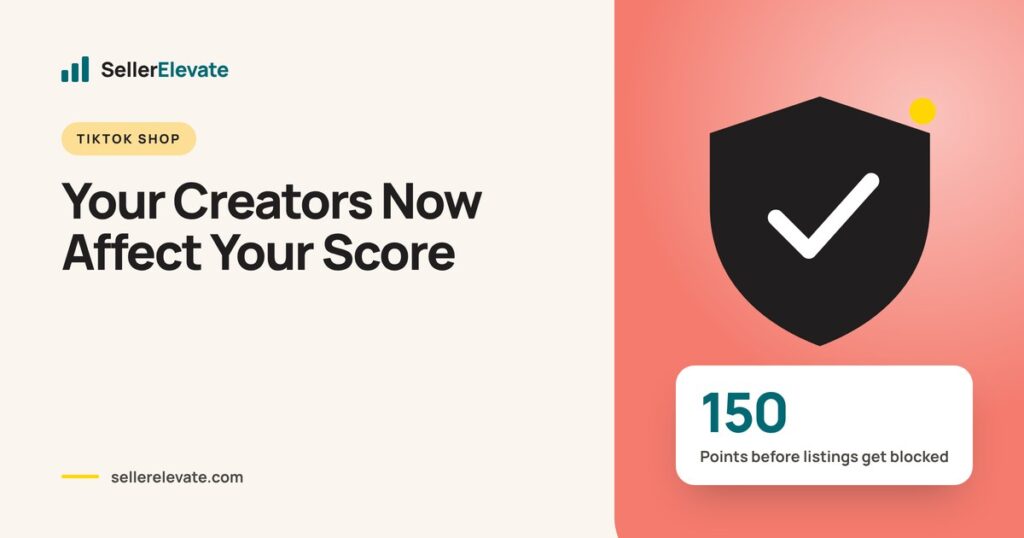
What is TikTok Shop Account Health Rating, and can a creator's video get my shop suspended?
Account Health Rating is TikTok Shop's points-based risk score that replaced Violation Points in July 2026. Every shop starts at 200 points on a 0 to 1,000 scale. Affiliate videos linked to your listings count toward it, and below 150 new listings and campaigns are blocked; at 0 the shop may be permanently deactivated.
Key takeaways
- TikTok Shop's Account Health Rating replaced Violation Points in July 2026 and runs on a 0 to 1,000 point scale over a 180-day rolling window.
- Every shop starts at 200 points, and falling below 150 triggers a 7-day block on new mega campaigns and new listings.
- Any affiliate video linked to your product listing contributes to your score, and violations can hit it within hours.
- Points come back slowly: 4 points for every 200 finished orders, capped at 20 points per week.
- A written creator brief with banned claims and a de-linking right is the main control a brand has.
TikTok Shop’s Account Health Rating (AHR) is the score that replaced the old Violation Points system in July 2026, and yes, a creator’s video can lower it. Any affiliate video linked to your product listing counts toward your score, and enough deductions can block new listings and campaigns or, at zero, put the shop at risk of permanent deactivation.
That second part is the one most brands we talk to have not absorbed yet. Under the old system, an affiliate’s bad video was mostly the affiliate’s problem. Now it is yours too. Below is how the rating works as of October 2026, what actually triggers restrictions, and the monitoring routine and creator-brief rules we would put in place before Q4.
What is TikTok Shop Account Health Rating?
It is a points-based risk score for your shop. According to PPC Land’s summary of TikTok’s US requirements document, published June 29, 2026:
- The scale runs from 0 to 1,000 points.
- Every seller starts at 200 points.
- It runs on a 180-day rolling window. Points you lose, and points you earn, reset 180 days later.
- A score preview appeared in May 2026, the full requirements document was published June 25, 2026, and AHR was scheduled to fully replace Violation Points platform-wide in July 2026.
Violations are grouped into eight categories: product compliance, product safety, listing quality, intellectual property, fair trading, fulfillment and after-sale issues, account management, and customer review violations.
One inconsistency to be aware of. PPC Land describes the bands as Green (200 and above), Orange (51 to 199) and Red (50 or below). Common Thread Collective’s July 17 explainer describes them as Green, Yellow and Red, with Red meaning possible payout freezes or termination. The labels differ; the direction does not. Check the bands shown in your own Seller Center rather than relying on either article.
What happens at each score threshold?
This is the part that matters for Q4, because the first restriction arrives well before the shop is in serious trouble.
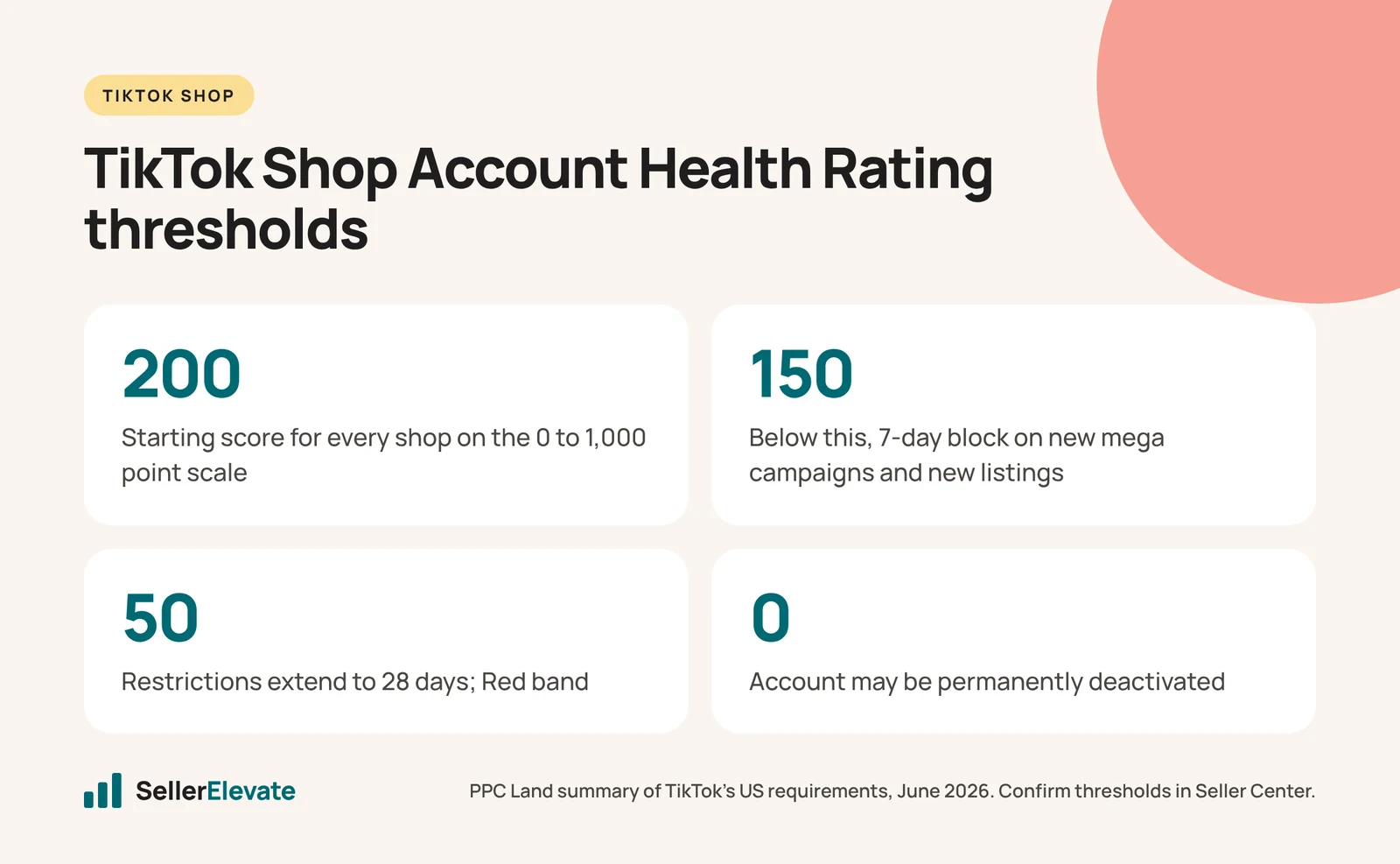
| Score | What PPC Land reports happens |
|---|---|
| 200 and above | Healthy. No restrictions. |
| Below 150 | 7-day block on new mega campaigns and new listings. Also gates Smart Promotion and Countdown Bidding. |
| 100 | Restrictions extend to 14 days. |
| 50 | Restrictions extend to 28 days. Red band. |
| 0 | Account “may be permanently deactivated.” |
Read that table with your campaign calendar next to it. A shop that starts at 200 only needs to lose a little over 50 points to fall below 150. If that happens in early November, a 7-day block on new campaigns and listings can cover the stretch when you most want to be adding Black Friday offers.
There is also a second score running in parallel. The Shop Performance Score (a 0 to 5 scale) governs affiliate marketing, campaign participation, CRM access and settlement speed. PPC Land reports Smart Promotion needs both an AHR above 150 and a Shop Performance Score of 3.5 or higher. So you can be fine on one and still locked out by the other.
Can a creator's video really get my shop suspended?
Directly and in one step, unlikely. Indirectly and over time, yes.
Common Thread’s reading is blunt: “any video linked to your product listing… contributes to your score,” and violations hit the rating “within hours of being posted,” not days. It lists six content categories that cause problems:
- Misleading claims (unverified benefits, exaggerated before-and-afters)
- Gambling references (spin-to-win, mystery boxes)
- Shocking imagery
- Spam tactics (repetitive promotions, mass messaging)
- Fraud patterns (fake reviews, manufactured proof)
- Manipulative promotions (artificial urgency, fake timers)
Most of those come from affiliates, not brands. A supplement creator who says “this cured my bloating” or a beauty creator who shows a filtered before-and-after is doing exactly what the algorithm used to reward. Under AHR, that video can now cost you points.
Neither source we reviewed publishes a fixed point value per violation. PPC Land says severity and frequency decide how many points you lose. So we cannot tell you “one bad video costs X.” What we can say is that a brand with dozens of affiliates posting unreviewed content is carrying risk it cannot see. We found in our own TikTok Shop affiliate work that across 2,449 affiliates, the top four videos drove about 57% of video revenue. The flip side is that the long tail of hundreds of small creators produces little revenue and most of the compliance exposure.
How do you earn points back?
Slowly, and in a capped way. PPC Land reports two routes:
- Order completion: 4 points for every 200 finished orders within the 180-day window, capped at 20 points per week.
- Policy quizzes: points for passing quizzes linked to violations, with amounts varying by quiz. Sellers who hit a milestone can also take a milestone quiz to shorten the restriction.
A worked example, with hypothetical numbers. A shop completing 300 orders a week earns 6 points a week from orders. If a run of creator violations knocks it from 200 to 140, it needs 10 points to get back above 150. That is roughly two weeks of normal order volume, assuming nothing else goes wrong. To hit the 20-point weekly cap, you would need 1,000 completed orders that week. Most brands are not earning their way out quickly. Prevention is cheaper than recovery.
Fulfillment metrics also changed. Canopy Management reports that negative review rate and seller-fault return and refund rate are now benchmarked against sellers in your own category rather than fixed thresholds, and that After-Sales Handling Time, a 60-day rolling average of how fast you resolve issues, replaced Customer Complaint Rate. Separately, StackInfluence’s August round-up reports TikTok asking sellers to keep Late Dispatch Rate at or below 4%, with enforcement possible above 10%, and On-Time Delivery Rate at or above 80%.
If you are on Fulfilled by TikTok, some of that is out of your hands, which is one reason we cover the trade-offs in our FBT vs 3PL comparison.
What should go in a creator brief now?
The brief is your main control. Creators rarely read policy pages; they read what you send them. We would put these rules in writing, at the top of every brief, before any talking points:
- Claims you can say, word for word. Give approved benefit statements. Anything outside the list needs your sign-off.
- Claims you must never say. Cures, treats, guarantees, “results in X days,” medical comparisons.
- No before-and-after unless you supply the footage and can document it.
- No fake urgency. No countdown timers you did not set, no “last day” if it is not.
- No giveaways, spin-to-win or mystery-box framing.
- No scripted fake reviews or “my friend tried it” stories that did not happen.
- Real voice, real footage. TikTok’s June policy bans AI-generated voices and limits static frames in shoppable videos and lives. We cover that separately in AI avatars vs real creators.
- Packing and product claims match the label. If a creator says “fresh batch,” your shelf-life dates need to back it. See our packaging and shelf-life rules post.
Then tell creators what happens if they break the rules: you will de-link the video. Common Thread notes sellers can de-link flagged content or appeal with documentation. Having the right to de-link written into the agreement makes it a routine action, not a fight.
What we'd do this week
A routine we would run on any shop going into Q4. It takes about 30 minutes a day once set up.
Daily
1. Check AHR and Shop Performance Score in Seller Center. Note any change, however small.
2. Review new violation notices and identify which video or listing caused each one.
3. De-link any affiliate video flagged for content, then message the creator with the specific rule they broke.
Weekly
4. Pull new affiliate videos for your top SKUs and spot-check the ten with the most views for claims and urgency language.
5. Check Late Dispatch Rate, On-Time Delivery Rate and After-Sales Handling Time against the thresholds above.
6. Review open collaborations. Pause open collaboration on any SKU where an unvetted creator has already caused a violation, and move that SKU to targeted collaborations with creators you have briefed.
Before November
7. Work out how many points of headroom you have above 150 and plan your Black Friday listing and campaign submissions so a 7-day block would not wipe them out.
8. Take any policy quizzes available. They are the one fast way to add points.
If you want a second pair of eyes on this before Black Friday, our TikTok Shop management team runs this check as part of onboarding. Thresholds and scoring are as of October 2026; confirm the current numbers in Seller Center before acting, because the system is only a few months old and the details are still moving.
Frequently asked questions
What score does a new TikTok Shop start with?
Every seller starts at 200 points on a 0 to 1,000 scale, according to PPC Land's summary of TikTok's US requirements document. The score runs on a 180-day rolling window, so both deductions and earned points reset 180 days later. Check your current score in Seller Center, since the system is new and details may change.
Which affiliate videos can lower my Account Health Rating?
Any video linked to your product listing can count. Common Thread lists six problem categories: misleading claims, gambling references, shocking imagery, spam tactics, fraud patterns such as fake reviews, and manipulative promotions such as fake countdown timers. Brief creators on all six and de-link flagged videos quickly.
Is Account Health Rating the same as Shop Performance Score?
No. Shop Performance Score is a separate 0 to 5 scale that governs affiliate marketing, campaign participation, CRM access and settlement speed. PPC Land reports Smart Promotion needs both an Account Health Rating above 150 and a Shop Performance Score of 3.5 or higher, so you need to watch both.
What fulfillment metrics does TikTok Shop watch in 2026?
StackInfluence reports TikTok asks sellers to keep Late Dispatch Rate at or below 4%, with enforcement possible above 10%, and On-Time Delivery Rate at or above 80%. Canopy reports negative review and seller-fault return rates are now benchmarked against your category, and After-Sales Handling Time replaced Customer Complaint Rate.
Sources
- PPC Land: TikTok Shop blocks new listings and campaigns when seller AHR hits 150 (Jun 29, 2026)
- Common Thread Collective: TikTok Shop Account Health Rating (Jul 17, 2026)
- Canopy Management: TikTok Shop Account Health Rating changes (Jul 6, 2026)
- StackInfluence: August 2026 ecommerce news and updates (Aug 12, 2026)
Get the honest version of your numbers
A free account audit from the person who would actually run your account.