How many creatives should I run per ad set after Meta Andromeda?
There is no official number. Guides range from 8 to 12 distinct concepts per campaign to 20 to 30 distinct ads per ad set, and Jon Loomer warns more isn't necessarily better. What matters is real difference: new people, hooks, stories and formats, not headline swaps. Match volume to how many conversions your budget produces.
Key takeaways
- Andromeda is Meta's retrieval stage, narrowing tens of millions of ad candidates to a few thousand before ranking.
- Sources disagree on volume, from 8 to 12 concepts per campaign to 20 to 30 distinct ads per ad set.
- Near-copies of one ad behave like one ad, so variety in the first three seconds matters more than headline swaps.
- Meta added a creative diversity metric on August 26, 2026 that rates ad sets Low, Medium or High and is still labeled in development.
- Rule out attribution, seasonality and landing page problems before blaming creative for a rising CPA.
There is no official magic number, but the 2026 consensus is that one ad set needs many genuinely different creatives, not five versions of the same ad. Practitioner guides range from 8 to 12 distinct concepts per campaign up to 20 to 30 distinct ads per ad set, and if your CPA is rising, a shortage of real creative variety is one of the first things we check.
The reason is Andromeda, Meta’s ad retrieval system. It changed what “targeting” means on Facebook and Instagram. Your audience settings matter less than they did, and your creative now does most of the work of finding the buyer. Below is what changed, what the sources actually say about volume, and a creative system a small brand can produce every month without a studio.
What is Meta Andromeda, and why does it change targeting?
Andromeda is the retrieval stage of Meta’s ad system. In Meta’s own engineering post from December 2, 2024, Meta describes it as selecting ads “from tens of millions of ad candidates into a few thousand relevant ad candidates” before the ranking models decide what actually shows. Meta reported a 6% recall improvement and an 8% ads quality improvement on selected segments, and said the system was built to handle the growth in creative volume coming from its generative AI tools.
According to a May 2026 analysis on Medium, the global rollout completed in October 2025, followed by GEM, Meta’s large ranking model, which Meta reported lifted conversions 5% on Instagram and 3% on Facebook Feed.
The practical shift: the system reads your creative (format, opening seconds, tone, theme) and uses it to decide who is likely to convert. Audience inputs act more like suggestions than walls. That means two things for advertisers:
- Your creative is your targeting. An ad aimed at new parents and an ad aimed at gym-goers will find different people even inside the same broad ad set.
- Similar ads compete with each other. The Medium analysis reports that Meta groups visually and narratively similar ads together. Ten near-copies of one ad behave more like one ad than ten.
How many creatives should you run per ad set?
Here the sources disagree, and we would rather tell you that than pick the number that sounds best.
| Source | What they recommend |
|---|---|
| Medium, May 2026 | 20 to 30 structurally distinct ads per ad set |
| Segwise, updated Sep 3, 2026 | 8 to 12 distinct concepts per campaign, 2 to 3 variations each |
| Jon Loomer, Oct 2025 | “More isn’t necessarily better.” Start with a few meaningful variations and expand |
Loomer’s point is the one we would underline. Meta’s own guidance, as he quotes it, is that creatives should be “distinctly different.” Thirty ads that are the same image with new headlines are not thirty creatives in Andromeda’s eyes. Eight ads built on eight different ideas probably beat them.
What counts as different? Across the sources, the changes that register are the ones a viewer would notice in the first seconds: a different person on camera, a different setting, a different story structure, a different hook, a different format. The Medium piece calls out the first three seconds of any video specifically. Swapping a headline or a button color does not.
Budget matters too. Segwise cites roughly 50 conversion events per week as a threshold for useful learning. If your ad set produces 15 purchases a week, 30 creatives will spread that signal thin. In that case fewer, more different ads is the sensible starting point.
What changed in Ads Manager in August 2026?
Two updates make creative even more central.
A creative diversity metric (August 26, 2026). Meta added a column that rates each ad set’s creative as Low, Medium or High diversity. Search Engine Land reports it is found under Columns, Customize columns, Creative diversity, and that Meta labels it “in development.” It estimates how visually diverse your images and videos are. Early testers, including AdMake, saw accounts with statics, video, UGC and carousels still rated Low, which suggests it compares visual similarity rather than format. Treat it as a hint, not a score to chase.
Placement exclusions removed at ad-set level (announced August 20, 2026). AdMake reports Meta announced that excluding placements, platforms, devices and operating systems will no longer be available on ad sets. The replacement is a placement value rule that adjusts bids from -90% to +1000%. As AdMake puts it, “a 90 percent cut is still a bid.” Account-level placement controls remain the only hard switch. With fewer manual levers, the creative you feed the system carries more of the outcome.
Why is your Meta CPA rising?
Not every CPA rise is a creative problem. Before rebuilding your ads, rule out the others:
- Attribution changed. Meta redefined click-through attribution in March 2026, which lowered reported ROAS for many accounts without changing real sales. Our post on the 2026 Meta attribution changes explains how to compare fairly.
- Seasonality. CPMs climb into Q4. A higher CPA in October is not automatically a broken account.
- The offer or landing page. If conversion rate on site dropped, no ad fixes that.
- Creative fatigue. Segwise lists the signs: frequency above 3.0 on prospecting, CTR falling 10% or more week over week, CPA rising 15% or more week over week. It also reports fatigue windows shrinking from 6+ weeks to 2 to 3 weeks.
If the first three check out and the fourth is true, you have a creative supply problem.
We see the same pattern on TikTok Shop. Across 2,449 affiliates on one client account, the top four videos drove about 57% of video revenue (details here). Winners are rare and concentrated. The only reliable way to find more of them is to put more genuinely different ideas into market.
A creative system a small brand can actually produce
You do not need a 20-person content team. You need a repeatable monthly structure that forces variety. Here is the one we use as a starting point for small brands; adjust the numbers to your budget.
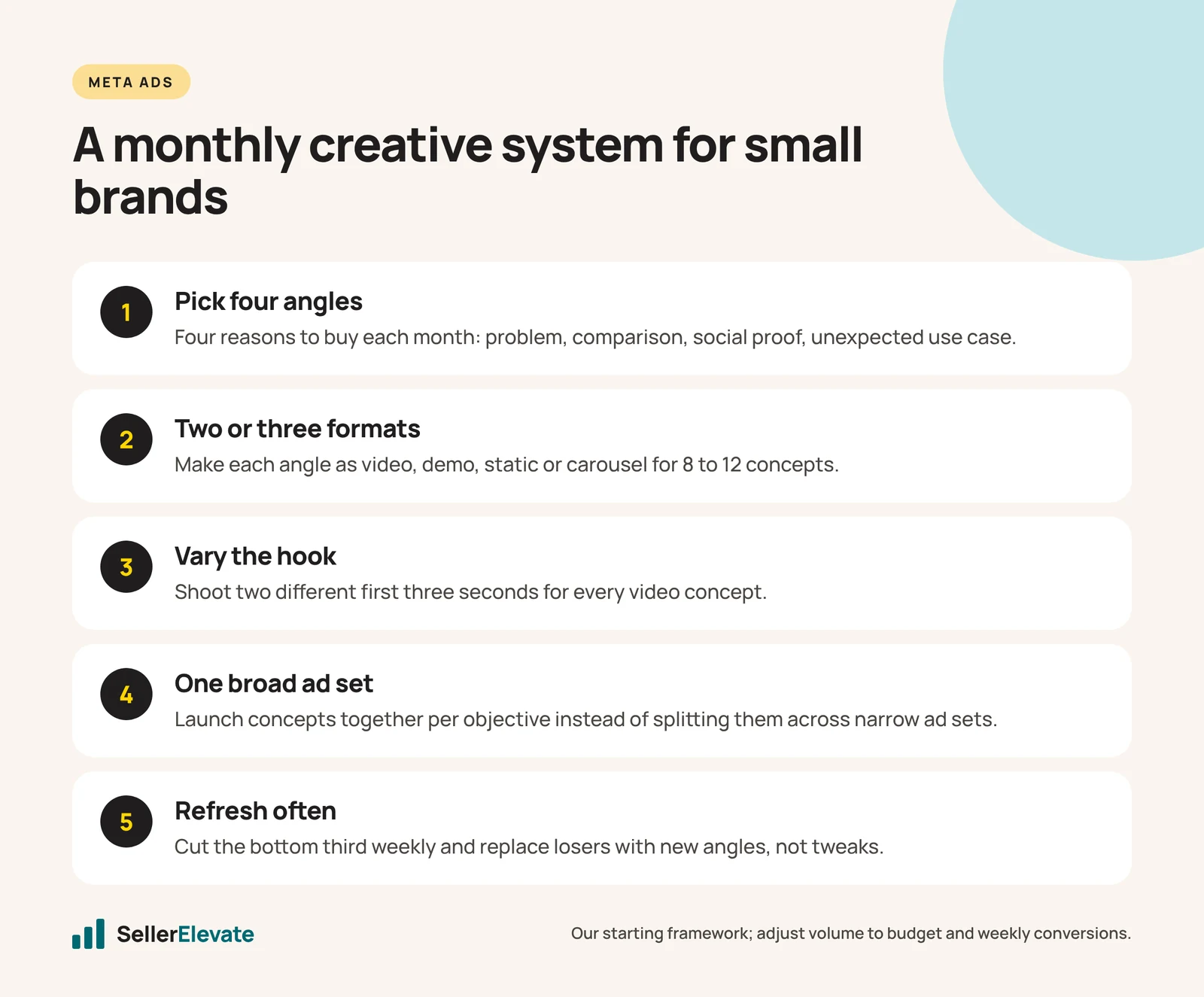
Step 1: Pick four angles a month. An angle is a reason to buy, not a format. For example: the problem it solves, a comparison with the usual alternative, social proof, and a use case people do not expect.
Step 2: Make each angle in two or three formats. A talking-head video, a product demo, a static with a strong claim, a carousel. That gives 8 to 12 concepts, which lines up with the lower end of the guidance above.
Step 3: Vary the first three seconds. For each video concept, shoot two different openings. This is the cheapest way to create real distinctness.
Step 4: Launch into one broad ad set per objective, rather than splitting the same creatives across many narrow ad sets. Segwise reports a test where one ad set with 25 diverse creatives beat five ad sets with five each by 17% on conversions. That is one vendor’s test, not a law, but it matches the logic of how retrieval works.
Step 5: Review weekly, refresh every two to three weeks. Kill the bottom third by spend-weighted CPA, keep winners running, and replace the losers with new angles, not tweaks of losers.
A hypothetical month for a brand spending $5,000 on Meta: four angles, ten concepts, three of them shot by a creator, three edited from existing footage, four statics made in-house. That is achievable for a two-person team with one freelance editor.
What we'd do this week
- Add the Creative diversity column to your main campaigns and note where you sit. Do not panic about Low; use it as a prompt.
- Count your truly distinct concepts per ad set. Group ads that share the same opening shot and person. Most accounts we audit have fewer real concepts than they think.
- Check fatigue signals: frequency, week-over-week CTR and CPA.
- Brief four new angles for the next two weeks, with two hooks per video.
- If you were relying on ad-set placement exclusions, review account-level placement controls before the change reaches your account.
If you want help building the testing calendar, our social media marketing team runs Meta for ecommerce brands, including Amazon brands driving external traffic.
Frequently asked questions
Does Andromeda mean audience targeting no longer matters?
It matters less. According to a May 2026 analysis, Andromeda reads the creative itself, including format, opening seconds and tone, and uses it to decide who is likely to convert, so audience inputs act more like suggestions. Exclusions and broad settings still shape delivery, but your creative now does much of the work audience targeting used to do.
Where do I find Meta's creative diversity metric?
Search Engine Land reports it sits under Columns, Customize columns, Creative diversity in Ads Manager reporting. It rates each ad set as Low, Medium or High and Meta labels it in development. Early testers saw accounts with statics, video, UGC and carousels still rated Low, so use it as a hint rather than a target.
What are the signs of creative fatigue on Meta?
Segwise lists frequency above 3.0 on prospecting, CTR falling 10% or more week over week and CPA rising 15% or more week over week. It also reports fatigue windows shrinking from 6+ weeks to 2 to 3 weeks. Check these before rebuilding campaigns, and rule out attribution and seasonal changes first.
Can I still exclude placements like Audience Network?
Not at ad-set level once the change reaches your account. Meta announced on August 20, 2026 that excluding placements, platforms, devices and operating systems will no longer be available on ad sets. A placement value rule adjusting bids from -90% to +1000% replaces it. Account-level placement controls remain the only hard exclusion.
Sources
- Meta Engineering: Meta Andromeda, next-gen personalized ads retrieval engine (December 2, 2024)
- Medium (tentenco): Why Andromeda, GEM and iOS 26 broke the old playbook (May 14, 2026)
- Segwise: Meta Andromeda update, the 2026 creative strategy playbook (updated September 3, 2026)
- Jon Loomer: Meta Andromeda creative diversification (October 20, 2025)
- Search Engine Land: Meta’s creative diversity metric (August 2026)
- AdMake: Meta ads updates, September 2026 (August 31, 2026)
Get the honest version of your numbers
A free account audit from the person who would actually run your account.