Which Klaviyo flows should I set up first?
Build a welcome series, abandoned checkout, browse abandonment and post-purchase flow, in that order, before adding more campaigns. Klaviyo's 2026 data shows flows produce nearly 41% of email revenue from just 5.3% of sends, because they reach people at the moment they show intent.
Key takeaways
- Flows produce nearly 41% of email revenue from just 5.3% of sends, per Klaviyo's 2026 benchmarks.
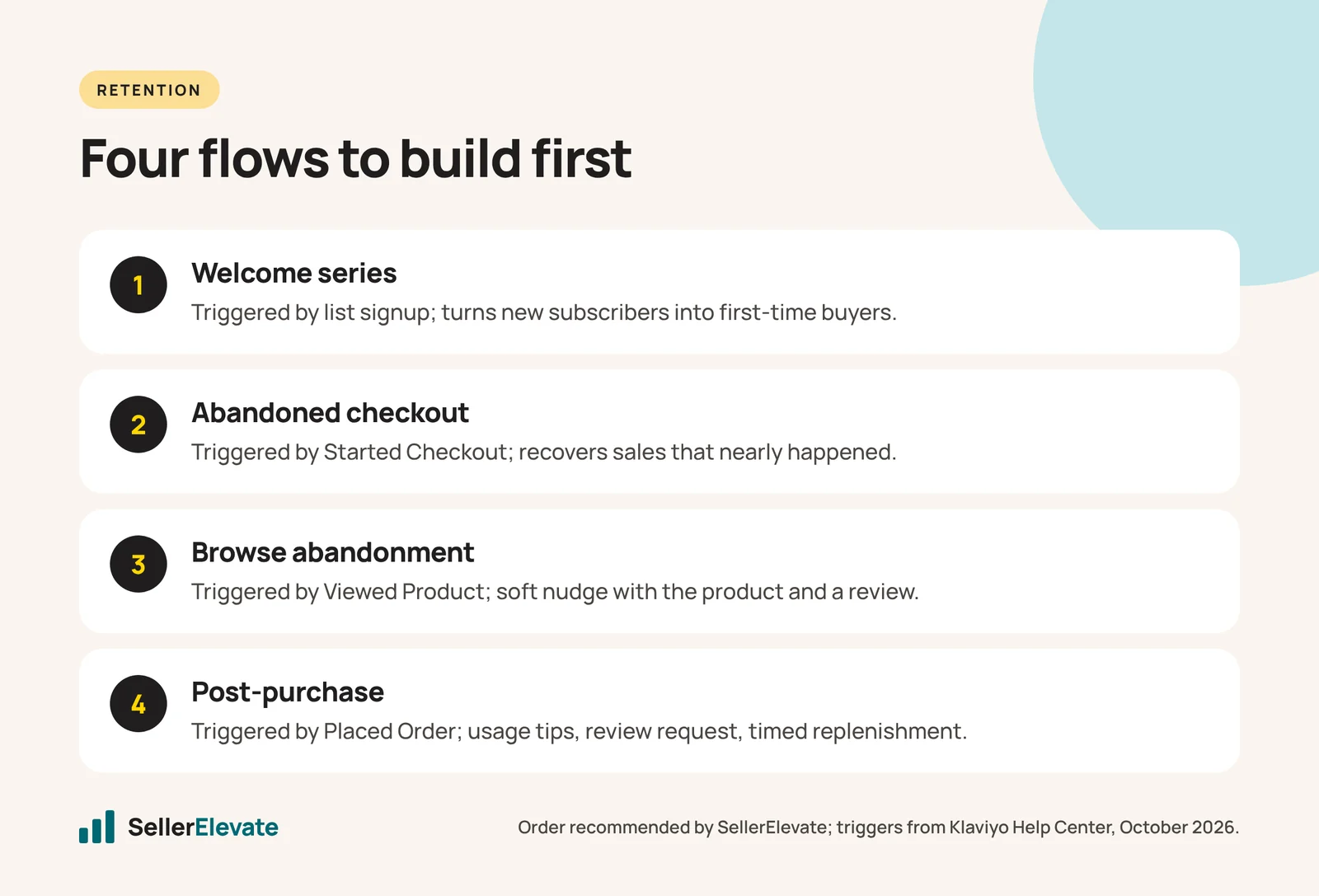
- Build welcome, abandoned checkout, browse abandonment and post-purchase first; add winback and sunset after.
- Klaviyo advises separate welcome flows for email and SMS because each can only be entered once.
- Hold discounts back in the first abandoned checkout email so customers are not trained to abandon.
- Judge flows against flow benchmarks, such as a 5.58% average click rate, not campaign numbers.
Build four flows before you add another campaign to the calendar: a welcome series, abandoned checkout, browse abandonment and post-purchase, in that order. Flows are where most email profit comes from on a per-send basis; Klaviyo’s 2026 data shows they produce nearly 41% of email revenue from just 5.3% of sends.
Campaigns still matter. But a Shopify brand sending three campaigns a week with no working abandoned checkout flow is spending effort in the wrong place. Here is why, what each flow should do, and how to build them without overthinking it.
Flows vs campaigns: what's the difference, and why does it matter so much?
A campaign is a message you send to a list or segment at a time you choose: a launch, a sale, a newsletter. A flow is an automated sequence triggered by something a person does: signing up, starting checkout, viewing a product, placing an order.
The difference in results is large. From Klaviyo’s email benchmarks, based on over 183,000 customers:
| Metric | Campaigns | Flows |
|---|---|---|
| Average click rate | 1.69% | 5.58% |
| Share of sends | 94.7% | 5.3% |
| Share of email revenue | Remainder | Nearly 41% |
| Revenue per recipient | Baseline | Nearly 18x campaigns |
| Revenue from new buyers | 16% | Nearly 48% |
SMS shows the same pattern. Klaviyo’s SMS benchmarks report flows producing 45.2% of SMS revenue from 7.6% of sends, with an average click rate of 9.65% against 5.6% for campaigns and conversion of 1.9% against 0.27%.
The reason is timing. A flow reaches someone at the moment they showed intent. A campaign reaches them whenever your calendar says so. That last row in the table matters too: flows win a lot of first purchases, which makes them part of acquisition, not just retention. If your CAC is rising, flows are one of the cheapest places to claw some back.
Which Klaviyo flows should I set up first?
Klaviyo’s own getting started guide recommends welcome series, abandoned cart, post-purchase and winback, in that order. We agree with the first two and swap in browse abandonment ahead of winback for most Shopify brands under a few years old, because a young brand has few lapsed customers to win back but plenty of visitors who looked and left.
Here is the order we use and what each one needs.
1. Welcome series
Trigger: someone joins your list (usually through a signup form or popup).
Job: turn a subscriber into a first-time buyer. Klaviyo describes it as introducing subscribers to your brand and converting them into first-time customers.
Build: three to four emails over about a week. Email 1 delivers whatever you promised at signup, immediately. Email 2 tells the brand story and why the product exists. Email 3 shows proof: reviews, before and after, press. Email 4 is a reminder of the offer before it expires.
Watch for: Klaviyo notes you should create separate welcome flows for email and SMS, because subscribers can opt in to each separately and each welcome flow can only be entered once.
2. Abandoned checkout
Trigger: Klaviyo’s help docs list the Started Checkout or Added to Cart metric. Start with Started Checkout; those are the people closest to buying.
Job: recover a sale that nearly happened.
Build: two to three emails. The first within about an hour, showing the exact items left behind, with no discount. The second the next day, answering objections (shipping, returns, sizing). Only the third, if any, should carry an incentive, and only if your margins support it.
Watch for: sending discounts in the first message trains customers to abandon checkout on purpose.
3. Browse abandonment
Trigger: the Viewed Product metric.
Job: nudge someone who looked at a product but didn’t add it to cart.
Build: one or two emails, softer in tone. Show the product they viewed, two or three related products, and a review. No hard sell.
Watch for: this flow only reaches people your store can identify (subscribers or past customers), so it grows with your list. Exclude anyone who already started checkout so they don’t get two flows at once.
4. Post-purchase
Trigger: the Placed Order metric.
Job: make the first order go well and set up the second one.
Build: an order thank-you with what to expect, a how-to-use email timed to delivery, a review request once they’ve had time to use it, and a replenishment or cross-sell email timed to when the product typically runs out.
Watch for: the replenishment timing. A 30-day supply should prompt around day 25, not day 7.
After these four, add winback (lapsed customers, also triggered from Placed Order) and a sunset flow that cleans out long-inactive subscribers.
What does a good first version look like?
Don’t wait for perfect. A plain, accurate flow that’s live beats a beautiful one in draft. Klaviyo does recommend reviewing and customizing its default templates before you turn them on, so they match your brand; that’s the minimum.
A checklist before you switch each flow live:
- Trigger is correct and tested with a real test profile.
- Filters exclude people who already bought (for welcome, checkout and browse flows).
- Dynamic product blocks show the right product image and price.
- Every link goes to the exact product, not the home page.
- Discount codes, if used, are unique or expire.
- Smart sending or frequency rules stop a person getting three emails in one day from overlapping flows.
- Mobile preview checked.
- SMS steps only go to people with SMS consent.
How do I know if my flows are working?
Judge flows against flow benchmarks, not campaign ones. The useful numbers:
- Click rate: Klaviyo’s flow average is 5.58%, and top 10% flows reach 10.48%.
- Flow order rate: 1.62% to 2.17% depending on industry.
- Revenue per recipient: top 10% flows reach $7.79 per recipient.
- Share of total email revenue: if flows sit far below about 41%, either a core flow is missing, or not enough people are entering them.
Open rates are a poor guide because of Apple Mail Privacy Protection. We explain why in what a good email open and click rate is in 2026.
A hypothetical example: a Shopify brand with 2,000 started checkouts a month and no abandoned checkout flow. If a three-email flow converts even a small slice of those people, it brings in orders that otherwise needed paid traffic to win. Run the numbers on your own checkout volume and average order before you plan another sale.
What we'd do this week
- Audit what’s live. In Klaviyo, list every flow with status, trigger and last 30 days’ revenue. Brands are often surprised to find the welcome flow turned off after a theme change.
- Check your flow share of revenue. Compare it to the roughly 41% benchmark.
- Build or fix welcome and abandoned checkout first. These two usually carry the most revenue.
- Add browse abandonment once your signup form is capturing enough emails.
- Build post-purchase with replenishment timing based on real reorder data.
- Only then look at campaign frequency.
Mistakes we see: launching ten flows at once and never checking any of them, discounting in every flow, and leaving default template copy that mentions a product you don’t sell.
If you sell on Amazon and Shopify, your email list is the one customer channel you fully own, which is part of why we cover it in our account management work. Our free audit includes a look at your flows. If you’re adding text messages, read our post on SMS quiet hours and lawsuit risk first.
Frequently asked questions
Should I start abandoned cart flows on Added to Cart or Started Checkout?
Start with Started Checkout. Klaviyo's help docs list both metrics as triggers, but people who reached checkout are closest to buying and the flow converts better. Once that flow is working, consider a separate, lighter Added to Cart flow, with filters so nobody receives both.
How many emails should a welcome series have?
Three to four emails over about a week works for most Shopify brands: deliver the signup offer immediately, tell the brand story, show proof such as reviews, then remind them before the offer expires. Exclude anyone who buys so they move into your post-purchase flow instead.
Do SMS flows outperform SMS campaigns too?
Yes. Klaviyo's 2026 SMS benchmarks show flows producing 45.2% of SMS revenue from 7.6% of sends, with a 9.65% average click rate against 5.6% for campaigns. Only send SMS flow steps to people who gave SMS consent, and check quiet-hours rules before launching.
When should I build a winback flow?
After the four core flows are live and you have enough past customers who have lapsed. Klaviyo lists winback fourth in its getting started order. For a young brand with few repeat-purchase cycles behind it, browse abandonment usually brings in more revenue sooner.
Sources
- Klaviyo: Email marketing benchmarks (2026)
- Klaviyo: SMS marketing benchmarks (2026)
- Klaviyo Help Center: Getting started with flows (accessed October 2026)
- Klaviyo Help Center: Event variables in flows (accessed October 2026)
Get the honest version of your numbers
A free account audit from the person who would actually run your account.