What should I do when my Amazon PPC campaign runs out of budget early in the day?
Raise the budget only if the campaign is at or below your target ACoS. If it's around target, trim the most expensive bids so the budget lasts all day. If it's above target or has no sales, don't add money: add negatives, tighten targeting and review placement adjustments first.
Key takeaways
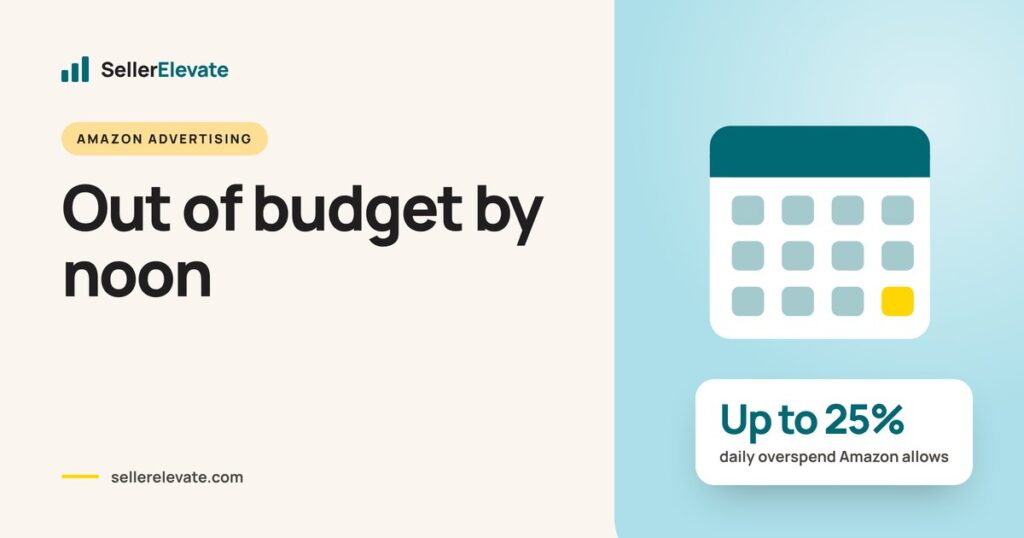
- Amazon averages daily budgets over a calendar month and lets a campaign spend up to 25% more on a given day.
- A $10 daily budget can spend $12.50 on a busy day and averages $300 a month.
- Raise budget only on campaigns at or below target ACoS; fix bids and targeting on the rest.
- Dynamic bids can add up to 100% for top of search on top of placement adjustments, which drains budgets quickly.
- Separate branded traffic so cheap, high-converting clicks never compete for the same budget.
If a campaign runs out of budget by noon, raise the budget only if that campaign is profitable at your target ACoS; if it isn’t, lower bids and cut waste first, because a bigger budget will just lose money faster. Either way, the cost of running out early is real: you miss every afternoon and evening shopper, and for many products that is when a large share of orders happen.
So the question isn’t “should I add budget.” It’s “is this campaign worth more money, and if not, why is it spending so fast?”
Why does my Amazon PPC campaign run out of budget so early?
There are four usual causes, and they need different fixes:
- The campaign is genuinely good and underfunded. It converts at or below your target ACoS and simply has more demand than budget.
- Bids are too high for the traffic. You’re winning expensive clicks, often top of search, and burning the day’s budget in a few hours.
- Targeting is too loose. Broad terms, auto campaigns with no negatives, or short one-word keywords are buying irrelevant clicks.
- Placement and dynamic bidding are stacking. A placement adjustment plus “dynamic bids, up and down” can multiply your base bid well beyond what you set.
The Seller Forums thread that sums up this problem is a UK seller whose £80 daily budget was gone by 3pm, then a raised budget of £250 went in about an hour. Seller Support suggested competitor click fraud. The replies were blunter: the seller had spent £80 in six hours with presumably no sales and responded by adding more money twice. Suggested fixes were longer, more specific keywords (“wooden shoe rack” rather than single words), auto campaigns to find converting search terms, and keeping ACoS under control. Click fraud exists, but rapid spend with no orders is almost always a targeting problem first.
How does Amazon's daily budget actually work?
According to Amazon Ads’ budget best practices guide, daily budgets are averaged over a calendar month. On any given day you can spend up to 25% more than your average daily budget, but the monthly total stays consistent. Amazon’s example: a $10 daily budget can spend $12.50 on a busy day and averages $300 over the month.
Two practical points follow:
- A campaign that spends slightly over budget isn’t broken. That is the averaging at work.
- Unspent budget doesn’t roll forward to save a busy day later. The averaging smooths day-to-day, but a campaign that is capped by noon every day is still capped.
The same guide lists tools worth using: out-of-budget alerts in the campaign manager, budget rules (schedule-based rules that raise the budget by a percentage for a date range, and performance-based rules that raise it when a campaign hits a threshold such as click-through rate), and a Budgets page (beta) showing estimated missed sales, estimated missed impressions and a recommended budget, based on machine learning models of similar campaigns that stayed in budget. Amazon also recommends a minimum of $10 per campaign. Rules and tools change, so confirm what your ad console shows as of October 2026.
How do I calculate the sales I'm losing when ads run out of budget?
Amazon’s estimated missed sales is a good start, but it is a model, so check it against your own numbers. Here is the method, with hypothetical figures:
A campaign has a $50 daily budget and runs out at 1pm every day. Over the last 30 days it averaged $50 spend and $200 sales a day, so ACoS is 25% against a 30% target.
Pull the hourly or daypart pattern from a period when the campaign ran all day (or from a similar uncapped campaign). Suppose 45% of that product’s ad sales usually come after 1pm.
If $200 is the 55% that happened before 1pm, the full-day potential is about $364. Missed sales are roughly $164 a day.
To capture it at the same efficiency, you’d need about $41 more budget a day (25% of $164). In practice, afternoon clicks may convert a little differently, so treat this as an upper estimate and test.
If the campaign is under target ACoS, that missed $164 a day is profit you are choosing not to make. If it is over target, the missed sales would come at a loss, and capping early is quietly protecting you.
Should I raise the budget or lower bids?
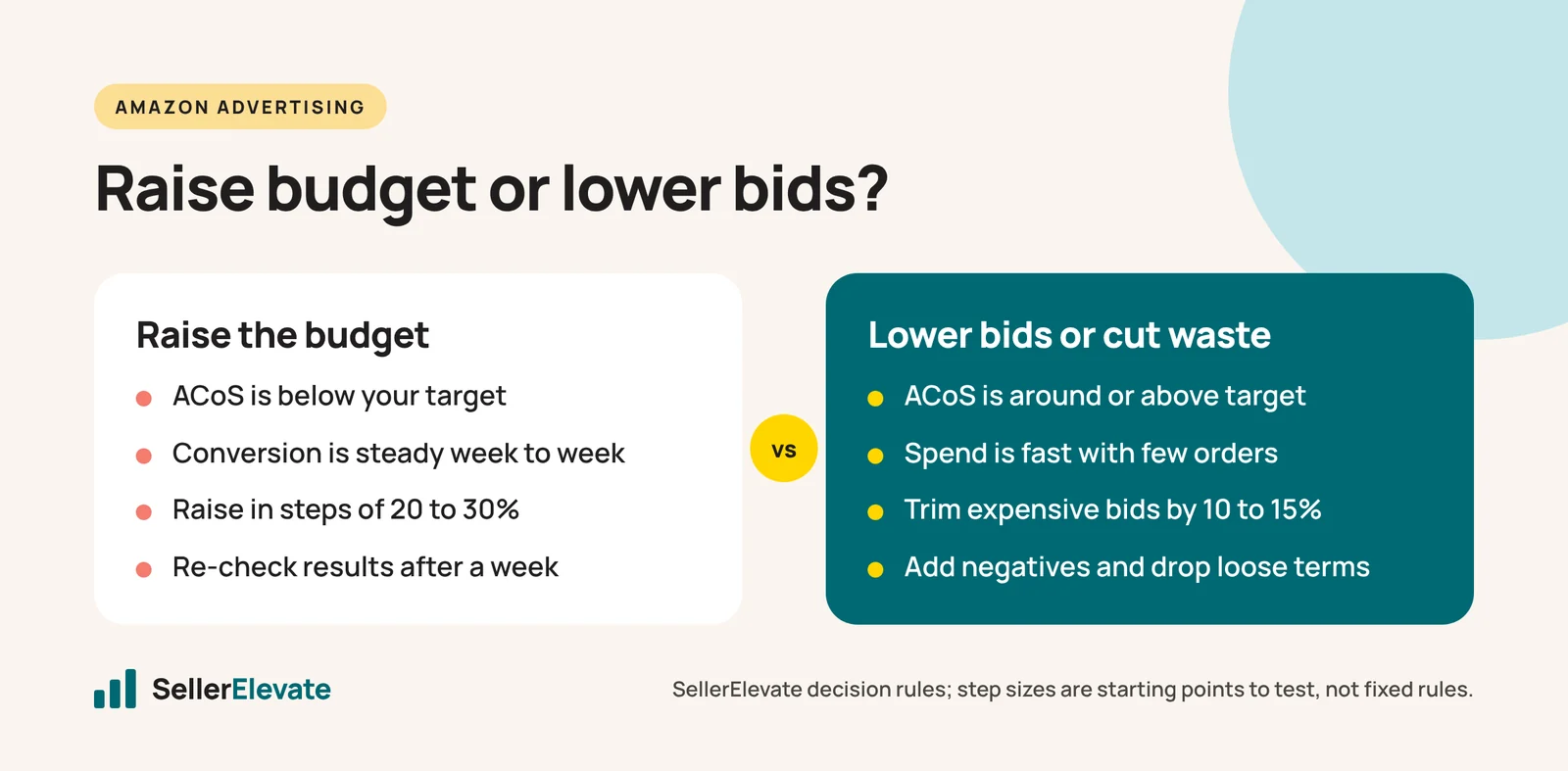
Use the campaign’s efficiency to decide. Here’s the table we work from:
| Campaign status | Out of budget early? | What to do |
|---|---|---|
| ACoS below target, steady conversion | Yes | Raise budget in steps of 20 to 30%, re-check after a week |
| ACoS around target | Yes | Lower bids on the most expensive placements or terms by 10 to 15%, so the budget lasts longer at similar volume |
| ACoS above target | Yes | Don’t raise budget. Add negatives, cut weak terms, review placement adjustments |
| No sales and fast spend | Yes | Pause and rebuild targeting. This is the forum thread problem |
| ACoS below target | No, but spends fully every day | Test a 20% raise; you may be close to the cap |
Lowering bids is often the better first move, even on good campaigns. Expensive top-of-search clicks frequently convert better, but not always enough to justify their cost. If your search term report shows the same terms converting at a lower bid in rest-of-search or product pages, you can stretch the day without losing much.
Check your bidding strategy too. With dynamic bids up and down, Amazon can raise bids by up to 100% for top of search and 50% for other placements, and that stacks on top of any placement adjustment, per JumpFly’s placement guide. A $1.50 bid with a 100% top-of-search adjustment and dynamic up-and-down can end up far higher than you think you’re paying. Our post on dynamic vs. fixed bids goes into when to switch.
Should I split the campaign or use dayparting?
Splitting helps when one campaign mixes strong and weak traffic. If branded and generic terms share a budget, generic terms can eat it before your cheap, high-converting branded traffic gets a chance. Move branded into its own campaign so it never runs out; see how we structure Amazon PPC campaigns for the full layout.
Dayparting, using schedule rules or third-party tools to cut bids in weak hours, can help a campaign that spends its budget on poor morning traffic. But it’s often used to hide a targeting problem. Fix the targeting first, then look at timing. We cover when it actually saves money in does dayparting Amazon PPC save money.
What we'd do this week
- List every campaign that hit its budget in the last 14 days, with ACoS, conversion rate and the time it typically ran out.
- Sort them into the table above: under target, around target, over target, no sales.
- Under target: raise budget 20 to 30%, or set a schedule-based budget rule for peak days.
- Around target: trim bids on the most expensive terms and placements by 10 to 15%.
- Over target or no sales: don’t add money. Pull the search term report, add negatives, and remove one-word and loose broad terms.
- Separate branded traffic so it never competes for the same budget.
- Check the Budgets page estimates against your own missed-sales calculation, and adjust after a week.
The aim is a set of campaigns that run all day at an ACoS you can live with. When that holds, extra budget becomes a straightforward decision. Our Amazon PPC management team runs this triage every week, and an account audit will show which of your campaigns are capped and which are simply wasting money.
Frequently asked questions
Does unspent Amazon ad budget roll over to the next day?
Not in a way that helps a capped campaign. Amazon averages daily budgets over the calendar month and can spend up to 25% more than the daily amount on a busy day, but a campaign that runs out by noon every day is still capped every day.
Is click fraud draining my Amazon PPC budget?
Rarely the main cause. When budget disappears fast with few or no orders, the usual culprits are loose targeting, one-word keywords, high bids or stacked placement and dynamic bidding. Check the search term report before assuming fraud, and report suspicious patterns to Amazon Ads with evidence.
What are Amazon budget rules?
Budget rules automatically raise a campaign's budget. Schedule-based rules increase it by a set percentage over a date range, such as a sale event. Performance-based rules increase it when the campaign meets a threshold, such as a click-through rate. Confirm available options in your ad console.
How accurate is Amazon's estimated missed sales figure?
It is a machine learning estimate based on similar campaigns that stayed in budget, so treat it as a guide. Check it against your own calculation using the share of sales that usually happens after your campaign runs out, and treat both as upper estimates.
Sources
Get the honest version of your numbers
A free account audit from the person who would actually run your account.