What is the best Amazon PPC campaign structure?
The best structure separates branded, generic and competitor traffic, pairs an auto and broad research layer with an exact-match performance layer, and groups products that share keywords and margin. Use single keyword campaigns only for top terms where placement control pays, because every extra split leaves each campaign with less data.
Key takeaways
- Separate branded, generic and competitor targeting so you can see which one is losing money.
- Placement adjustments of 0 to 900% are set at campaign level, which is the main reason to split campaigns.
- Amazon recommends a minimum of $10 per campaign per day, so many tiny campaigns quickly add up.
- If most campaigns have fewer than about 10 orders in 30 days, you have probably over-segmented.
- Start new launches with auto and broad research campaigns, then promote converting terms to exact.
The best Amazon PPC structure is the simplest one that still lets you control budget and bids where it matters: separate campaigns for branded, generic and competitor traffic, a research layer (auto and broad) feeding a performance layer (exact), and product groups kept together only when they share margins and keywords. How finely you split beyond that depends on your catalogue size and budget, because every extra campaign divides the same clicks into smaller piles.
Most structure arguments online are really about one question: how much control is worth how much lost data?
What are the main ways to structure Amazon PPC campaigns?
There are three common approaches, and they aren’t mutually exclusive.
By product. One campaign or ad group per product. Seller Metrics recommends this mainly for sellers with few SKUs, because it gives clean visibility per product but makes budget control harder and can put your own products in competition with each other as the catalogue grows.
By keyword theme and match type. Ad groups built around similar keywords, split by intent (branded vs. non-branded) and match type. Seller Metrics calls this “the approach that generally makes the most sense” for most accounts. A common version is the alpha/beta setup: an exact-match campaign with your proven keywords and stronger bids, and a phrase or broad campaign at lower bids for discovery, with the exact terms added as negatives so the two don’t overlap.
Single keyword campaigns. One keyword per campaign. JumpFly makes the case that the main payoff is placement control: because placement bid adjustments are set at campaign level, one keyword per campaign lets you push top of search for that keyword alone. It also helps defend brand terms. JumpFly is open about the costs: optimization takes much longer, and low volume per campaign makes decisions hard with so few clicks and orders.
That trade-off is the whole game. Placement adjustments can raise bids by 0 to 900% on top of search and product pages, per JumpFly’s placement guide, and dynamic bidding can raise a bid by up to a further 100% for top of search and 50% for other placements. Those levers only exist at campaign level, which is why people split. But each split thins the data each campaign learns from.
Which structure should I use for my catalogue size?
Here’s how we’d decide. Budgets are rough guides, not rules.
| Account situation | Structure we’d use | Avoid |
|---|---|---|
| 1 to 5 SKUs, under about $1,500/month in ads | One auto campaign, one broad/phrase research campaign, one exact performance campaign, one branded campaign. Products grouped where keywords overlap. | Single keyword campaigns for anything except your brand and one or two hero terms |
| 5 to 50 SKUs, moderate budget | Campaigns by product group (shared keywords and similar margin), each with research and exact layers. Separate branded, generic and competitor campaigns. Portfolios per product line. | One campaign per SKU; mixing high- and low-margin products in one campaign |
| 50+ SKUs or large budget | Product-group structure as above, plus single keyword campaigns for the top 10 to 20 terms by spend, where placement control pays for the extra work. Bulk files for management. | Hand-building hundreds of campaigns nobody will review |
| New launch | Auto plus broad research at modest budgets, then promote converting search terms to exact after a week or two of data | Building the “final” structure before you know which terms convert |
Seller Metrics suggests starting auto campaigns at $10 to $25 a day and waiting one to two weeks before judging them. Amazon’s own guidance recommends a minimum of $10 per campaign per day. That minimum is the quiet reason over-segmentation fails: 40 campaigns at $10 a day is $400 a day of commitments, and most of them will never collect enough data to optimize.
How do I know if I've over-segmented my campaigns?
Do the sums before you split. Here’s a hypothetical example:
A campaign has a $1.00 cost per click and a 10% conversion rate. At $15 a day it buys about 15 clicks and 1.5 orders a day, around 45 orders a month. That’s enough to make bid decisions within a couple of weeks.
Split that same $15 across five single keyword campaigns at $3 each and each buys three clicks a day. At a 10% conversion rate, that’s one order every three or so days per campaign. You’d need a month or more before any single campaign told you anything reliable.
Signs you’ve split too far:
- Most campaigns have fewer than about 10 orders in the last 30 days.
- You are changing bids on keywords with two or three clicks.
- Campaigns run out of budget at random times because each one is tiny.
- The same search term shows up in several campaigns and they bid against each other.
- Nobody on the team can say what each campaign is for.
If three or more of these are true, consolidate. Merge campaigns that share products, intent and margin, keep the exact performance campaigns that genuinely need their own placement settings, and move the rest into themed ad groups.
Should branded, competitor and generic keywords be in separate campaigns?
Yes, nearly always. They behave too differently to share a budget.
- Branded terms convert well and cheaply. Mixed into a generic campaign, they make that campaign look far more efficient than it is, which hides waste.
- Generic terms are where most new customers come from, and where most spend is lost.
- Competitor terms (keywords and product targets) usually have lower conversion and need their own bids and targets.
When we audit an account with high ACoS, mixed intent is one of the first things we check, because until the three are separated nobody can see which one is losing money. We wrote about that pattern in PPC is an amplifier, not a fix, where cutting loose broad and auto spend and tightening targeting came before any scaling.
What we'd do this week
If you’re rebuilding from scratch or cleaning up an account:
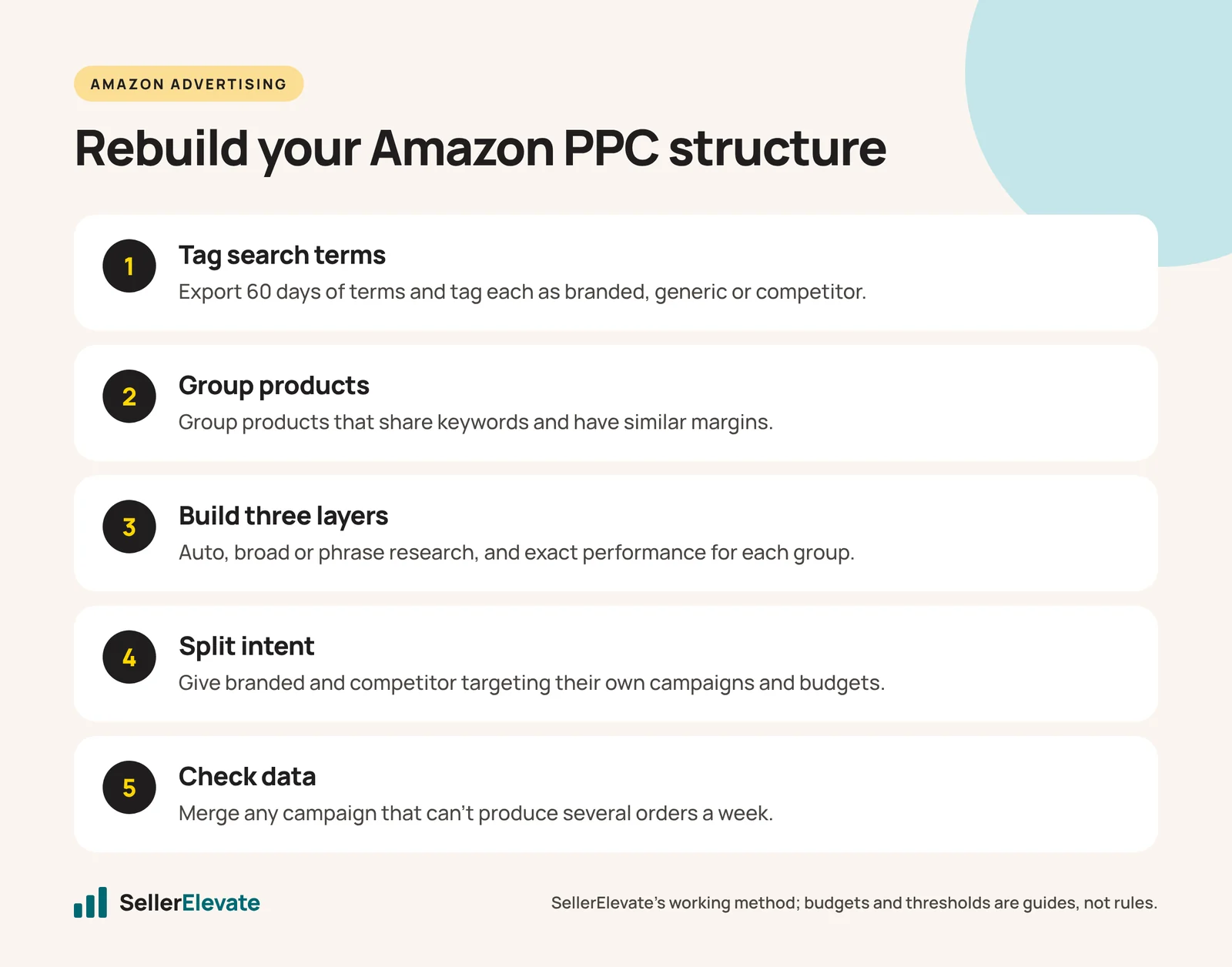
- Export 60 days of search term data and tag each converting term as branded, generic or competitor.
- Group products by shared keywords and similar margin. These are your campaign groups.
- Build three layers per group: auto, broad/phrase research, and exact performance. Add exact terms as negatives in the research layer.
- Pull branded and competitor targeting into their own campaigns.
- Give single keyword campaigns only to the terms that earn them: your top spenders, where placement control is worth the work.
- Check the data per campaign. If a campaign can’t get enough clicks to produce several orders a week at its budget, merge it.
- Set a review rhythm: search term harvesting weekly, bids weekly, structure monthly.
Two cautions. Automation and rules work much better on a clean structure, but they don’t replace judgment; our account of a $358K single-SKU campaign at 4.00 ROAS shows both what automation does well and where it nearly went wrong. And structure is only one part; if the listing doesn’t convert, the best-built account in the world will still lose money.
If you’d like us to rebuild or audit your structure, that’s the core of our Amazon PPC management work. For the next decisions after structure, see dynamic vs. fixed bids and what to do when ads run out of budget by noon.
Frequently asked questions
Are single keyword campaigns still worth it on Amazon?
For a small number of high-spend keywords and brand terms, yes, because they give you placement control for that one term. For most of the account, no. They take much longer to manage and each one collects little data, which makes reliable bid decisions slow.
How many keywords should be in one Amazon ad group?
There is no fixed number. Group keywords that share intent, match type and product, and keep the group small enough that one bid makes sense for every keyword in it. If you find yourself wanting very different bids within a group, split it.
Should auto campaigns stay on once I have manual campaigns?
Usually yes, at a modest budget, as a research layer. Auto campaigns keep surfacing new converting search terms. Harvest those terms into exact-match campaigns weekly and add them as negatives in the auto campaign so the two do not compete.
How often should I change my campaign structure?
Review structure monthly, not weekly. Bids and search term harvesting need weekly attention, but restructuring resets the data campaigns learn from. Change structure when a campaign is consistently starved of data, mixes intents, or no longer matches your product groups.
Sources
Get the honest version of your numbers
A free account audit from the person who would actually run your account.