Why does Amazon keep rejecting my children's product certificate?
Amazon usually rejects a CPC because the certificate, the test report and the listing do not match: a different model name, a missing safety rule, a lab that is not CPSC-accepted, or a report issued for another product. Fix the mismatch, then resubmit one clean package with a cover note rather than resending the same files.
Key takeaways
- Amazon checks whether your listing, certificate and test report describe the same product, not whether the product is safe.
- The CPSC lists seven required elements on a CPC, and the certificate and test reports must be in English.
- Put one identifier, ideally the model number, on the listing, the CPC and the lab report.
- There is no formal escalation path; one case with case IDs, a forum post and Brand Registry support are the realistic routes.
- From July 8, 2026, importers must electronically file certificates with US Customs and Border Protection, according to the CPSC.
Amazon usually rejects a Children’s Product Certificate because something on the certificate does not match the listing or the test report: a different model name, a missing safety rule, a lab that is not CPSC-accepted, or a test report that belongs to another product. Fix the mismatch, resubmit one clean package through Manage Your Compliance, and stop sending the same documents into the same queue.
That is the short version. The longer version matters, because the forum threads on this topic show sellers losing listings for a month while their submission sits “Under Review,” and others getting the same form letter five times in a row. Below is how the review actually works from the outside, what to check before you upload, and what to do when the queue stalls.
Why does Amazon keep rejecting my CPC?
Amazon is not grading whether your product is safe. It is checking whether your paperwork proves it, and whether that proof matches the ASIN it is attached to. A reviewer (or a model, then a reviewer) compares three things: the listing, the certificate and the test report. Any disagreement between them reads as “not compliant.”
ComplianceGate’s guide to Amazon compliance document requests lists the questions a reviewer is effectively asking about a test report: is it valid for the same product model or SKU, is it up to date, does it cover all applicable standards and regulations, and is it held by the correct company. The same guide names the most common failure we also see: a supplier hands over an outdated test report that was issued for a different product.
In practice the rejections we see fall into five buckets:
- Identity mismatch. The certificate says “Wooden Stacking Toy Model WT-12” and the listing says “Rainbow Stacker.” Nothing ties the two together, so the reviewer cannot confirm they are the same item.
- Missing rules. The CPC cites the general toy standard but leaves out a rule that clearly applies, such as lead in paint or phthalates for a product with plastic parts.
- Wrong company. The certificate is issued by the factory, while you are the importer of record. The certifying firm should be the one legally responsible for the product in the US.
- Lab problems. The lab named on the certificate is not on the CPSC-accepted list for the tests cited, or the lab details are incomplete.
- Stale or partial testing. The test dates predate a material or design change, or the report covers one color and you listed six.
There is a sixth bucket that is not your fault: products that should not be classed as children’s products at all. One seller in an Amazon forum thread on CPC escalation had a product labeled for ages 15 and up, sent package photos and a manufacturer letter, and still received identical CPC requests. An Amazon moderator’s question in that thread is the useful part: is there anything on the listing that could make it look like a toy? If your title, images or keywords suggest children, Amazon’s classifier will treat it as a children’s product no matter what the box says.
What has to be on the certificate?
The CPSC publishes the required elements. According to the CPSC’s Children’s Product Certificate page, a CPC must include seven things:
| # | Element | What Amazon’s reviewer compares it to |
|---|---|---|
| 1 | Product identification, detailed enough to match the certificate to each product | Your listing title, model number, images, variations |
| 2 | Each applicable children’s product safety rule (cite exemptions too) | The product type and materials shown on the listing |
| 3 | Name, full mailing address and phone of the importer or domestic manufacturer certifying | Your seller or brand details |
| 4 | Name, address, email and phone of the person keeping test records | Reachable contact, not a placeholder |
| 5 | Month and year of manufacture, and city, state or country of manufacture | Test dates and batch information |
| 6 | Date(s) and place(s) of testing | The dates on the lab report |
| 7 | Name, address and phone of the CPSC-accepted third-party lab | The lab name and address on the test report |
The CPSC also states that the CPC and supporting test reports must be in English. If your factory sends a bilingual report, make sure every field Amazon needs is readable in English.
One date to have on your radar: the same CPSC page says that beginning July 8, 2026, importers must electronically file certificates with US Customs and Border Protection. That is a customs requirement, not an Amazon one, but it means a sloppy certificate now creates problems at the border as well as on the listing. Confirm the current eFiling scope with your customs broker.
How do I match the listing to the certificate?
This is where most fixes happen, and it is usually faster to edit the listing than to reissue the certificate.
Step by step:
- Pull the three documents side by side. Listing (title, bullets, model number, variation names, images), CPC, lab report.
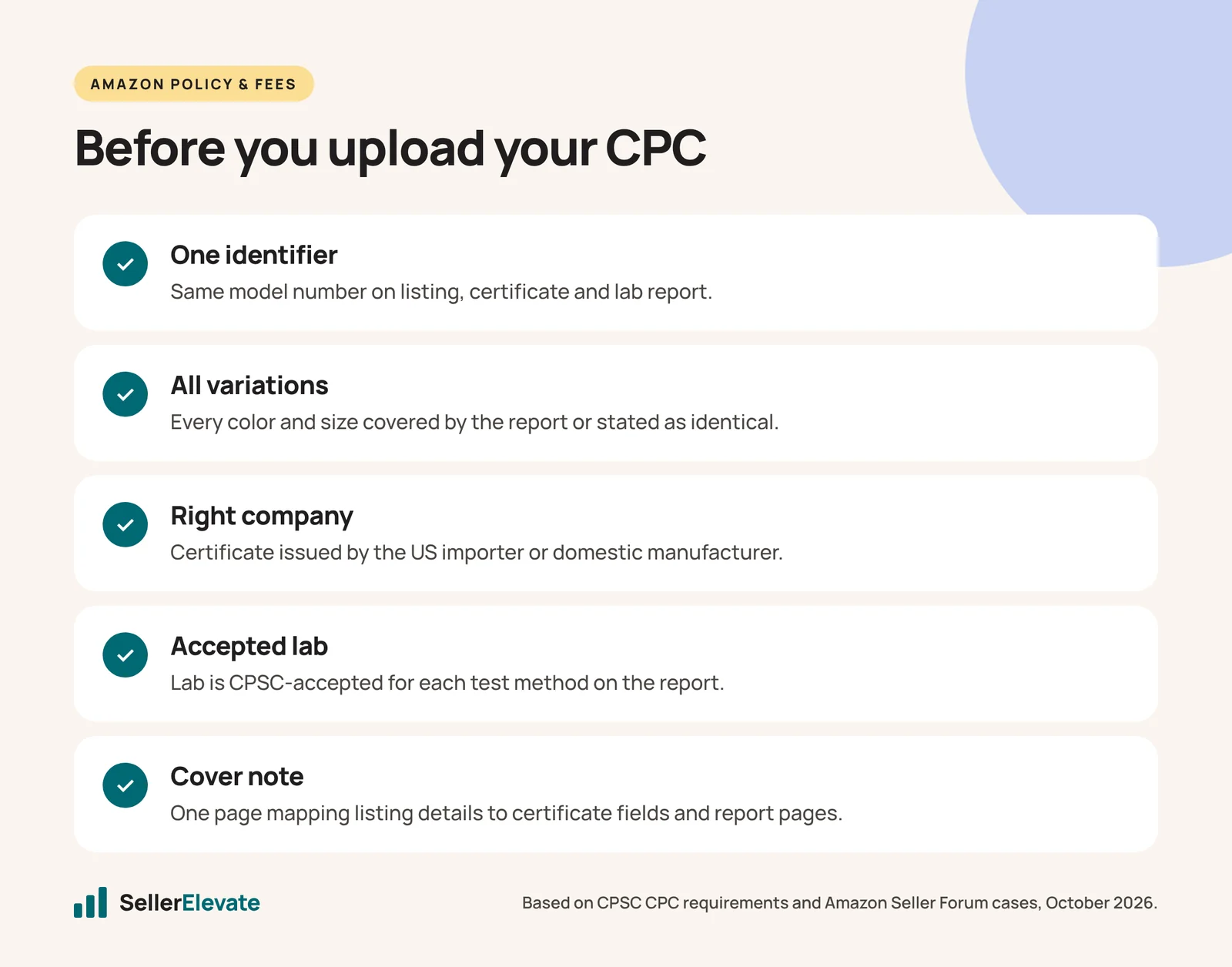
- Make one identifier appear in all three. Model number is best. Put it in the listing’s model number field, in the CPC product description and confirm it is on the lab report. If the lab report uses a factory code, list both on the CPC (“Model WT-12, factory code HX-4471”).
- Cover every variation. If you sell five colors, the CPC and report must cover all five, either explicitly or by stating that the colors are identical except for the colorant and the colorant was tested.
- Check the rules list against the materials. Painted or coated surfaces, plastic parts, small parts, cords and magnets each pull in rules. If a rule applies and you claim an exemption, cite the exemption rather than leaving it out.
- Check the certifying company. It should be the US importer or domestic manufacturer. If your company imports the goods, the CPC should carry your company name and address.
- Check the lab. Confirm the lab is CPSC-accepted for the specific test methods listed on the report.
- Check the dates. Testing should cover the production you are actually selling. If you changed paint supplier or material, retest.
- Upload one combined, labeled PDF (CPC first, then the test report, then a one-page cover note mapping listing details to certificate fields).
A cover note sounds unnecessary. It is not. Reviewers spend seconds per file. A note that says “ASIN B0XXXX, model WT-12 (listing model field), all 5 colors covered on report page 3, lab: [name], CPSC-accepted for the tests on page 2” removes the guesswork.
Cover note template:
ASIN(s): [list]
Product: [listing title] / Model: [model] (matches CPC line 1 and report page [x])
Certifying importer: [company, address]
Safety rules cited: [list]; exemptions cited: [list or none]
Variations covered: [list], see report page [x]
Lab: [name], CPSC-accepted; tested [dates] at [location]
Records contact: [name, email, phone]
What do I do when it's stuck under review?
A seller in a forum thread about a CPC under review for a month submitted the CPC, lab reports, instructions and images for four variations on August 18, 2024. Nearly 30 days later the listings had been removed and the status still read “Under Review.” The only movement came when a forum moderator escalated the case to a partner team.
So the honest answer: there is no formal escalation button. In the escalation thread, a seller put it bluntly when asked whether there is an appeal path beyond the standard queue: “There is not.” What you can do:
- Do not resubmit while a review is open unless Amazon asks. Fresh submissions can restart the clock.
- Do not recreate the listing to force a new review. Sellers mention this as a trick; it risks duplicate ASIN problems and a second compliance request on top of the first.
- Open one case with the ASINs, the submission date, and your cover note attached. Reference the case ID in any follow-up.
- Post in the Seller Forums with your case IDs. The thread above shows moderators do sometimes route cases internally.
- If you have Brand Registry, use Brand Registry support as a second contact route.
- Hold inbound inventory for affected ASINs. Shipping more units to FBA while compliance is unresolved adds storage cost and removal risk.
What we'd do this week
If you have a CPC rejection or a review that has stalled:
- Day 1: Line up the listing, CPC and report. Mark every mismatch.
- Day 1: Decide whether the product is truly a children’s product. If it is for ages 13 and up, remove child-oriented images, keywords and phrasing before you argue the point. Then request a review with a General Certificate of Conformity where your product needs one, which another seller suggested in the escalation thread.
- Day 2: Fix what you can on the listing (model number, variation names). Ask your lab or supplier for a corrected CPC only if the certificate itself is wrong.
- Day 3: Upload one combined PDF with the cover note. Open one case.
- Day 10: If nothing has moved, post in the forums with case IDs and contact Brand Registry support.
If your account has several children’s ASINs flagged at once, treat it as a catalog problem rather than a document problem. An account audit that maps every flagged ASIN to its documents is faster than fighting them one by one. Related compliance issues tend to arrive together, so it is worth reading our notes on GPSR rules for Amazon EU and on products flagged as pesticides.
A CPC is the importer’s legal responsibility, not Amazon’s. If you are unsure which rules apply to your product, pay a CPSC-accepted lab for a consultation before you pay for another round of rejected uploads. We are not a testing lab, and this post is not legal advice.
Frequently asked questions
Does a product for ages 15 and up need a CPC?
A CPC applies to children's products, meaning products designed primarily for children 12 and under. If your product is for older users but Amazon still asks for a CPC, remove child-oriented images, keywords and phrasing from the listing first, then explain the classification with supporting packaging images. A General Certificate of Conformity may still be needed.
Can my factory issue the CPC?
The CPC should be issued by the US importer or domestic manufacturer, because that firm is legally responsible for the product. A factory-issued certificate is a common reason for rejection when your company is the importer of record. Ask the factory for the test report and issue the CPC in your own company name.
Should I recreate the listing to restart a stuck compliance review?
No. Recreating a listing can create duplicate ASIN problems and trigger a second compliance request on top of the first. Keep the existing ASIN, open one case referencing your submission date and case ID, and use the Seller Forums or Brand Registry support if nothing moves.
Does one test report cover all my color variations?
Only if the report says so. Either each color must be listed and tested, or the report and certificate should state that the variations are identical except for colorant and that the colorants were tested. Amazon's reviewer compares variations on the listing with what the report covers.
Sources
Get the honest version of your numbers
A free account audit from the person who would actually run your account.