What are successful DTC brands doing differently in 2026?
They run their site as one channel among several, add Amazon and retail deliberately, and keep claims defensible. Rothy's took a strategic investor and launched on Amazon Fashion in May 2024, Caraway expanded categories off a clear position, and Hanna Andersson is joining Amazon with a 90% unique assortment.
Key takeaways
- Allbirds went from a valuation above $4 billion at its 2021 IPO to selling its footwear assets for $39 million in 2026.
- Rothy's took a 49.9% strategic investment from Alpargatas at a $1 billion valuation rather than going public.
- Caraway expanded from cookware into food storage, bakeware and a coffee maker under one positioning.
- Hanna Andersson is joining Amazon with a 90% unique assortment, limiting overlap with its own site.
- Comparative safety claims you cannot substantiate can turn into lawsuits, as Caraway's 2026 cases show.
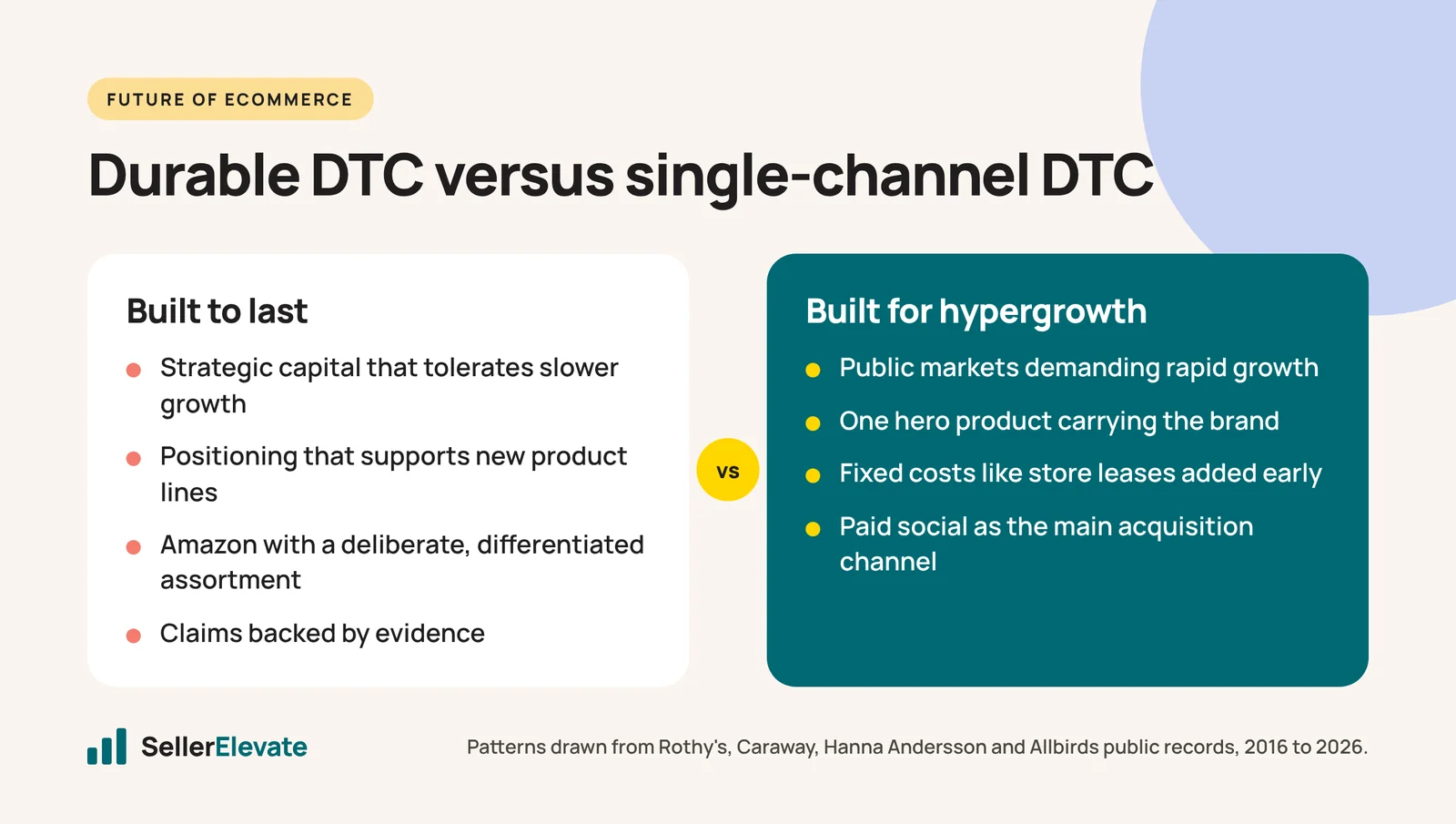
The DTC brands still growing in 2026 are not the ones that raised the most or spent the most on paid social. They are the ones that treated their own site as one channel among several, added Amazon and retail on their own terms, and kept product and claims tight enough to survive scrutiny.
Rothy’s, Caraway and Hanna Andersson are useful examples because they took different paths to the same place. Allbirds, which went the other way, is the useful contrast. Below are the patterns we think other brands can actually copy, with the limits of what the public record shows.
What happened to the DTC class of the 2010s?
The short version: the brands that assumed cheap social traffic would last forever had to rebuild their model, and some did not make it.
Allbirds is the clearest case. It went public on November 3, 2021 at a valuation above $4 billion, according to Wikipedia’s company history. Revenue went from $219 million in 2021 to $189.8 million in 2024. In January 2026 it announced it would close all full-price US stores, and on March 30, 2026 it sold its footwear assets to American Exchange Group for $39 million. The footwear brand survives under new ownership; the public company that built it does not exist in its original form.
The lesson is not “DTC is dead.” It is that a single-channel brand funded for hypergrowth has very little room when acquisition costs rise and growth slows. The brands below made different choices.
How did Rothy's build staying power?
Rothy’s launched its washable shoes made from recycled plastic bottles in 2016 and reported $140 million in revenue in 2018, per Wikipedia. Three decisions stand out from the public record:
- A strategic owner instead of the public markets. In December 2021, Brazilian footwear group Alpargatas (owner of Havaianas) bought a 49.9% stake at a valuation of $1 billion. That gave Rothy’s capital and manufacturing know-how without quarterly pressure from public investors.
- Experienced retail leadership. Jenny Ming became CEO in January 2024.
- Amazon as a channel, not a threat. Rothy’s launched on Amazon Fashion in May 2024.
Modern Retail’s September 2026 podcast is titled “How Rothy’s built a DTC footwear brand with staying power,” which tells you how the trade press now sees the brand. We were not able to review the full episode for this post, so we are not attributing specific quotes or figures from it.
What can brands learn from Caraway?
Caraway, founded in 2019 by Jordan Nathan, started with a ceramic cookware set and has since expanded into food storage, bakeware and, in September 2026, a coffee maker that sold out its first batch and passed $1 million in sales, according to Modern Retail.
Two lessons, one positive and one cautionary.
Category expansion off a clear position. Nathan told Modern Retail, “we are really a non-toxic home brand.” Every new product line fits that frame, which means existing customers have a reason to buy the next thing. That is how a one-time purchase category like cookware turns into repeat revenue.
Claims discipline. In February 2026, Groupe SEB and Meyer Corporation sued Caraway over advertising claims about PFAS and “toxic cookware,” and a California consumer class action followed in summer 2026. Modern Retail also reports that the National Advertising Division recommended in 2025 that Caraway discontinue certain claims in competitive contexts. Caraway has used the dispute in its own marketing. That may work for them; for most brands, comparative health and safety claims you cannot fully substantiate are a legal cost waiting to happen, on your site and in Amazon listings alike.
Why is Hanna Andersson joining Amazon with a unique assortment?
Hanna Andersson has been selling children’s clothing since 1983, out of Portland, Oregon, and has been owned by L Catterton since 2016, per Wikipedia. In late September 2026, Modern Retail reported that the brand is joining Amazon with a 90% unique assortment.
We could not access the full article, so we will not speculate on the commercial terms. The headline alone describes a strategy we recommend often: if you go on Amazon, sell products that do not directly compete with your own site. A mostly unique assortment means Amazon can reach new customers without training your existing ones to buy there instead, and without price comparisons against your own store.
What patterns can other brands copy?
| Pattern | Who shows it | What it looks like for a smaller brand |
|---|---|---|
| Patient, strategic capital | Rothy’s (Alpargatas stake) | Grow from profit or partners who understand your category; avoid funding that demands growth at any cost |
| Clear positioning that supports new lines | Caraway | Define the brand by the customer problem, not the first product |
| Amazon as a controlled channel | Rothy’s, Hanna Andersson | Brand Registry, a deliberate assortment, consistent pricing, authorized sellers only |
| Claims you can defend | Caraway (as a caution) | Substantiate every comparative and safety claim before it goes live |
| Fewer fixed costs | Allbirds (as a caution) | Test stores and wholesale before committing to leases |
None of these brands relied on one channel. That is the common thread. We wrote about this from the manufacturer side in our post on controlling your CPG brand across marketplaces, and the same logic applies to Walmart; see why Amazon brands are adding Walmart.
How should you add Amazon without hurting your DTC site?
This is the question we get most from DTC founders. A step-by-step version:
- Enroll in Brand Registry first. It gives you control of your listings, A+ content and enforcement tools against unauthorized sellers.
- Choose the assortment deliberately. Options include bundles, sizes or colorways you do not sell on your site, or your best sellers only. Hanna Andersson’s 90% unique approach sits at one end of that range.
- Set one pricing policy across channels. If Amazon is cheaper, your site loses; if your site is cheaper, Amazon’s algorithms may suppress your offer. Decide and hold the line.
- Lock down distribution. Stop wholesale accounts from reselling on Amazon unless you authorize it.
- Build the listing for conversion before spending on ads. Advertising amplifies whatever the listing is. We saw this directly when a client spent 25% more on ads after a listing rebuild and net profit rose 81.5%.
- Measure the halo. Watch whether branded search and site traffic hold steady after launch.
What we'd do this week
If you run a DTC brand thinking about durability, not growth at any price:
- Calculate contribution margin by channel. Most brands know revenue by channel; fewer know profit after ads, shipping and returns.
- List every product claim on your site, packaging and ads, and mark which ones you could substantiate tomorrow if challenged.
- Check who sells your product on Amazon today. If it is not you, someone else controls how your brand appears there.
- Pick one new channel to test, not three, with a 90-day budget and a profit target.
If you want a second opinion on the Amazon side before committing, our account management team does this work daily.
Frequently asked questions
Is DTC dead in 2026?
No, but single-channel DTC funded for hypergrowth has struggled. Brands that kept their own site while adding Amazon, wholesale or stores on their own terms have held up better. The site still matters for margin, customer data and brand control; it just cannot be the only channel.
Will selling on Amazon cannibalize my DTC site?
It can if you list the same products at lower prices. A differentiated assortment, consistent pricing and control over who resells you reduce that risk. Hanna Andersson's 90% unique assortment is one way to reach new Amazon shoppers without training existing customers to switch.
Should a DTC brand raise venture capital in 2026?
Only if the business can use it without depending on growth at any cost. Rothy's took a strategic investor with category expertise instead of public markets, while Allbirds' public-market path ended with its footwear assets sold for $39 million. Profitable growth gives you more options.
How do I check whether my product claims are defensible?
List every claim on your site, packaging, ads and marketplace listings, then attach the test data or source that supports each. Comparative claims about competitors and health or safety claims carry the most risk. Anything you cannot support today should be rewritten or removed.
Sources
- Wikipedia: Allbirds (accessed October 2026)
- Wikipedia: Rothy’s (accessed October 2026)
- Wikipedia: Hanna Andersson (accessed October 2026)
- Modern Retail: Cookware startup Caraway got sued by its competitors. It then used the lawsuit for marketing (September 30, 2026)
- Modern Retail: How Rothy’s built a DTC footwear brand with staying power (September 19, 2026)
- Modern Retail: Hanna Andersson is joining Amazon with a 90% unique assortment (September 29, 2026)
Get the honest version of your numbers
A free account audit from the person who would actually run your account.