What is the legitimate way to get reviews on Amazon?
There are two sanctioned routes: the Request a Review button in Seller Central, which sends Amazon's own neutral message, and Amazon Vine, where brand-registered sellers get up to 30 badged reviews from vetted Vine Voices. Everything else, including paid services, review groups and friends and family, is prohibited or a bet against detection.
Key takeaways
- Request a Review sends Amazon's own pre-approved message and is the only fully compliant way to prompt a specific customer.
- Amazon Vine is the single exception to the incentivised review ban, with up to 30 reviews per enrolled parent ASIN.
- Review gating, friends and family reviews, review swaps and any third-party review service all break Amazon policy.
- Since 21 October 2024 the FTC's Consumer Reviews and Testimonials Rule has made review manipulation a legal question, not just a platform one.
- The highest-leverage review tactic is a product that matches its listing, because most one and two-star reviews come from that mismatch.
Reviews are the foundation everything else sits on. A listing at zero reviews converts at a fraction of one with fifteen, which means your conversion rate, your rank, your ad efficiency and your break-even CPC are all downstream of a number you cannot directly control.
Which is exactly why the review space is full of people selling shortcuts.
Here is the honest version of what is allowed in 2026, what isn’t, and what actually works — including the parts that make this slower than anyone wants it to be.
What are the allowed ways to get Amazon reviews?
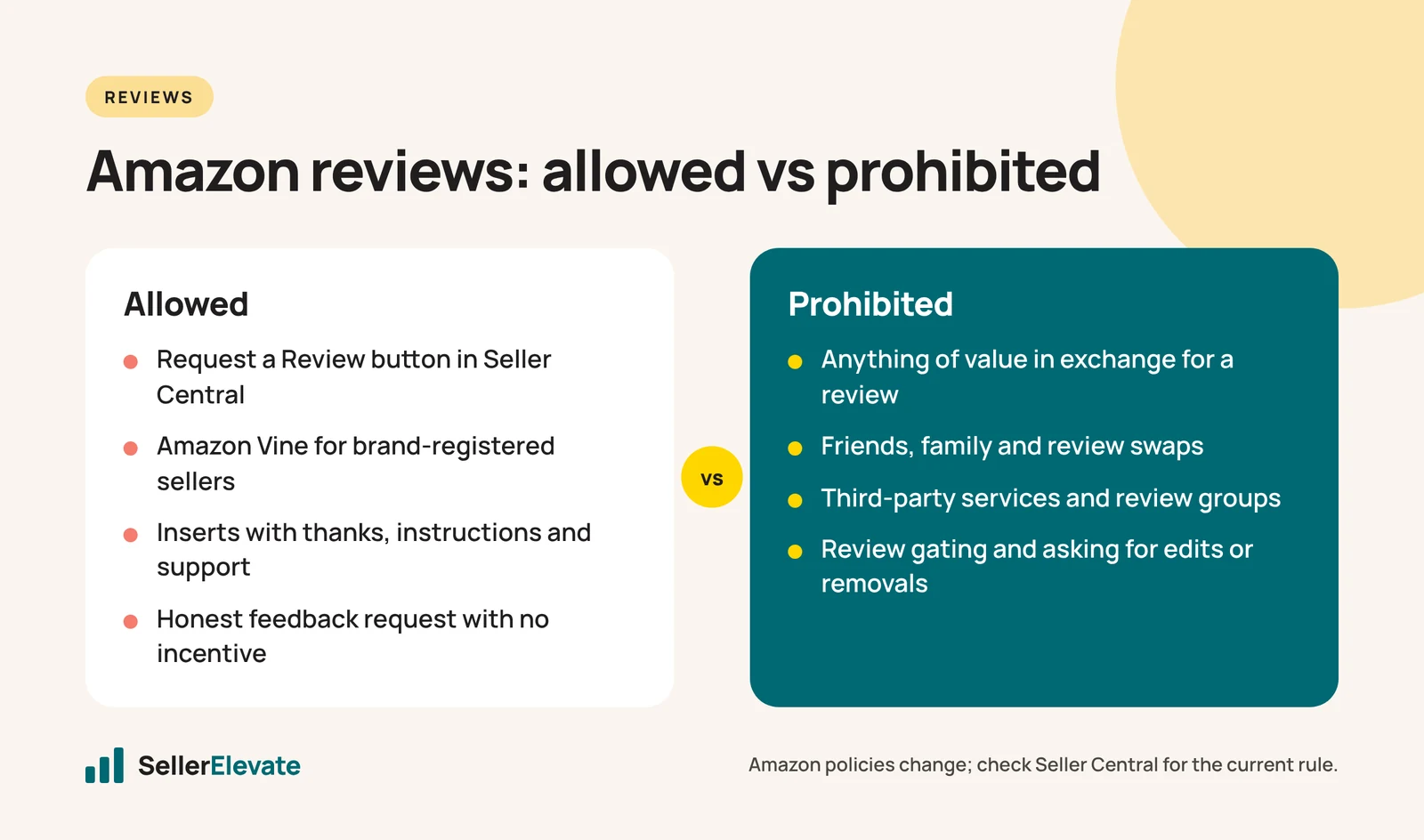
The Request a Review button. Found on individual orders in Seller Central. It sends Amazon’s own neutral, pre-approved message. You cannot edit it, you cannot add to it, and that is precisely why it carries no policy risk. It is the only fully compliant way to prompt a specific customer.
Amazon Vine. The single exception to Amazon’s ban on incentivised reviews, because Amazon controls the incentive rather than you. Brand-registered sellers enrol a parent ASIN for a flat $200 fee and receive up to 30 reviews from vetted Vine Voices, clearly badged as such. Amazon suggests allowing two to eight weeks from delivery; in practice most arrive within four if the product works and the reviewer engages with it.
That is the complete list. Everything else is either explicitly prohibited or a wager on Amazon’s detection systems not noticing.
Which Amazon review tactics are prohibited?
Amazon banned incentivised reviews in October 2016 and has not loosened it since. A review is incentivised if the reviewer received anything of value in exchange — a free product, a discount, a refund, a gift card, a payment, or a promise of future compensation.
Also prohibited:
- Friends and family reviews. Amazon cross-references shared addresses, payment methods and account connections. Even if they genuinely bought the product.
- Review swaps with other sellers.
- Third-party review services, including any that describe themselves as compliant or white hat. There is no compliant paid route outside Vine.
- Facebook, Telegram and WhatsApp review groups. Amazon cross-references IP, purchase behaviour and timing. These have a short half-life.
- Helpfulness vote manipulation, including coordinated voting on competitors’ reviews.
- Asking a customer to edit or remove a review, or offering a refund to have one taken down.
- Review gating — routing dissatisfied customers to private support while directing satisfied ones to Amazon. This one catches a lot of brands who think they are being helpful.
One eligibility detail worth knowing, because it explains a lot of frustration: a customer can only leave a review if they have spent at least $50 on Amazon in the previous twelve months on a valid card. A meaningful share of your buyers simply cannot review you, no matter how happy they are.
What happens if Amazon catches review manipulation?
Bulk review deletion is usually Amazon’s first move, not its last. Then ASIN removal. Then account suspension, which means losing access to your inventory and having funds withheld while it is investigated.
There is now a second layer. The FTC’s Consumer Reviews and Testimonials Rule took effect on 21 October 2024 and addresses fake reviews, incentives conditioned on positive sentiment, undisclosed insider reviews and review suppression. Amazon has referred egregious cases and has sued review manipulation services directly. This has moved from a platform-policy question to a legal one.
The asymmetry is what makes it a bad bet. The upside is a faster launch. The downside is the business.
What actually works, in order
Deliver a product that matches its listing. This is not a platitude, it is the highest-leverage review tactic available. Most one and two-star reviews are not about quality in the abstract — they are about a mismatch between what the page promised and what arrived. Overstate in the copy and you are buying bad reviews at the same time as you buy traffic.
Set expectations accurately, including the limitations. Saying what a product does not do filters out the buyers who would have been disappointed. Fewer sales, better reviews, and the maths usually favours the reviews.
Use Request a Review consistently. It is manual per order unless you use approved automation, which is tedious and genuinely works. Doing it for every eligible order compounds.
Use Vine on launches and on listings too thin to convert. It is most valuable in exactly the situation that is hardest to escape: you need conversion to rank, and you need reviews to convert. Thirty badged reviews breaks that loop legitimately.
One change to plan around: Amazon adjusted how reviews are shared across variations from 12 February 2026, with a further change on 31 May 2026. Sharing now depends on eligible variation themes, and variations with functional differences no longer aggregate to the parent automatically. If you launch a range, check which of your variations actually qualify before assuming the parent’s review count carries.
Use product inserts, correctly. Inserts are legal within specific boundaries. They can thank the buyer, explain how to use the product, offer support, and note that honest feedback helps other shoppers. They cannot offer any incentive, cannot ask for a positive review, and cannot route unhappy customers away from Amazon.
A compliant insert reads roughly like: “Thank you for choosing us. We hope these instructions help you get the most from your purchase. If anything is not right, contact us and we will put it right. Your honest feedback helps other Amazon customers decide.”
That is it. No discount codes, no “if you’re happy,” no QR code to a private feedback form.
Read the negative reviews as product research. The complaints cluster. When the same objection appears fifteen times, that is a design change, a packaging change, or a listing that promised something it shouldn’t have. Fixing the cause improves the rating far more reliably than chasing new reviews to dilute the old ones.
What should you do if Amazon removes your reviews?
Legitimate reviews do occasionally get caught in a sweep, usually after an unusual spike — a viral mention, a successful launch, a big promotion. If that happens you can appeal through Account Health with evidence that the spike was genuinely earned, which is a good reason to keep marketing and sales records for exactly those periods.
If the deletion follows detected manipulation, appeals rarely succeed and escalating can make things worse.
The uncomfortable summary
There is no fast, safe way to build reviews. The competitors who appear to have found one are either selling a product people genuinely like, or running a risk that has not caught up with them yet.
What compounds is unglamorous: a product that matches its description, accurate expectations, Vine at launch, Request a Review on every eligible order, inserts that stay inside the rules, and negative reviews treated as information rather than as an attack.
That is slower than the shortcuts. It is also the only version that still exists in three years.
If an agency offers to accelerate your review count and cannot explain exactly which Amazon policy permits the method, the answer is that none does. We would rather tell you that than take the retainer.
Frequently asked questions
How much does Amazon Vine cost and how many reviews do you get?
Per the post, brand-registered sellers enroll a parent ASIN for a flat $200 fee and receive up to 30 reviews from vetted Vine Voices, clearly badged as such. Amazon suggests allowing two to eight weeks from delivery, and most arrive within four if the product works. Fees change, so check Seller Central for the current rule.
Can friends and family leave Amazon reviews for my product?
No. Friends and family reviews are prohibited even if they genuinely bought the product. Amazon cross-references shared addresses, payment methods and account connections to find them. Review swaps with other sellers, Facebook, Telegram and WhatsApp review groups, and third-party review services are also prohibited, including services that call themselves compliant.
Are product inserts allowed on Amazon?
Yes, within limits. An insert can thank the buyer, explain how to use the product, offer support, and note that honest feedback helps other shoppers. It cannot offer any incentive, ask for a positive review, or route unhappy customers away from Amazon. That means no discount codes, no "if you're happy" wording and no QR code to a private feedback form.
Why can't some of my customers leave a review?
A customer can only leave a review if they have spent at least $50 on Amazon in the previous twelve months on a valid card. That means a meaningful share of your buyers simply cannot review you, however happy they are. It is one reason consistent use of Request a Review on every eligible order matters.
Get the honest version of your numbers
A free account audit from the person who would actually run your account.