How much are Amazon's holiday peak fees in 2026 and when do they start?
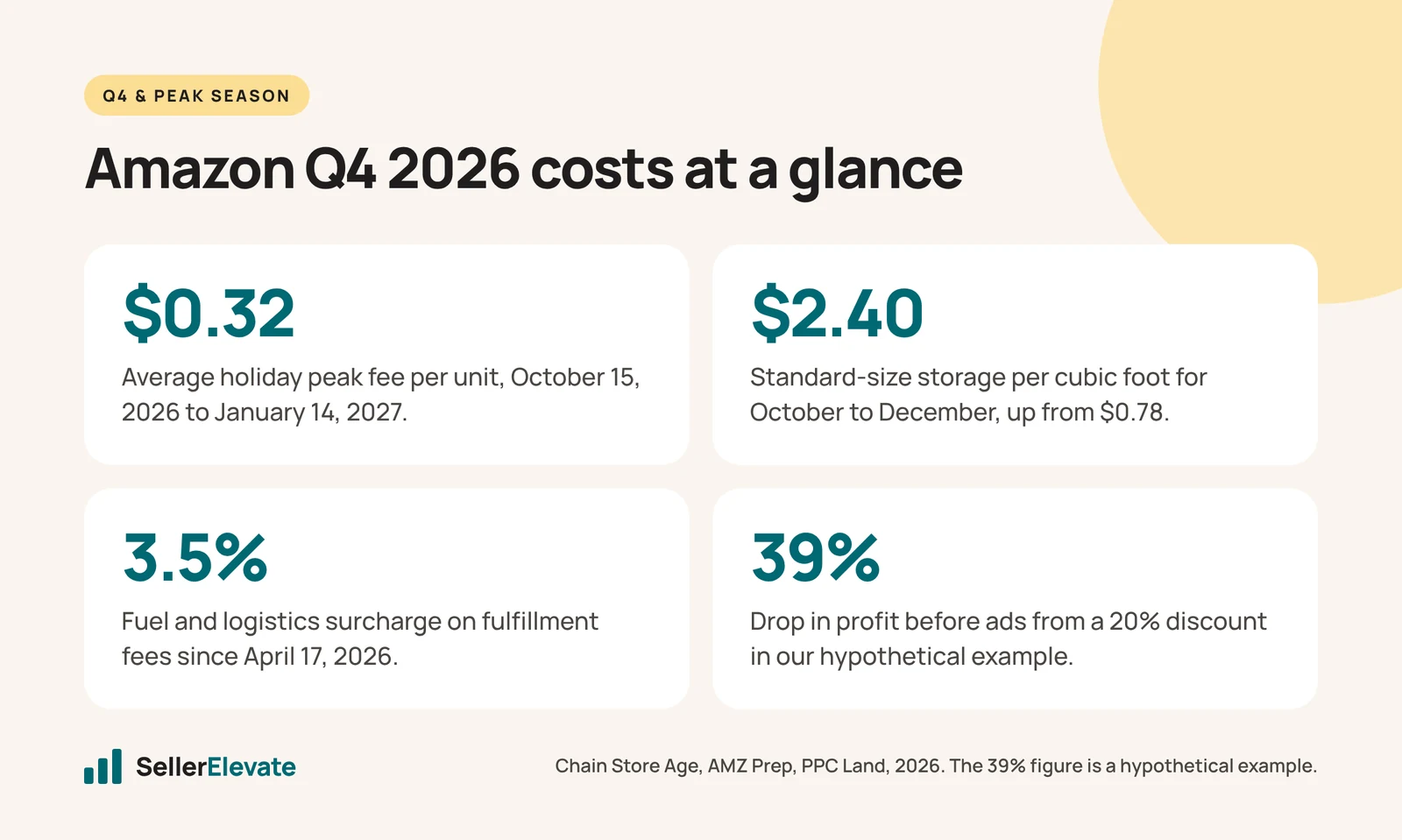
Amazon's holiday peak fulfillment fee runs from October 15, 2026 to January 14, 2027 and averages $0.32 per unit over non-peak rates. Standard-size storage also rises to $2.40 per cubic foot for October to December, and the 3.5% fuel and logistics surcharge still applies to fulfillment fees.
Key takeaways
- The 2026 holiday peak fulfillment fee averages $0.32 per unit from October 15, 2026 to January 14, 2027, the same increase as 2025.
- Standard-size storage rises from $0.78 to $2.40 per cubic foot for October to December, and oversize from $0.56 to $1.40.
- The 3.5% fuel and logistics surcharge applies to fulfillment fees, not sale prices, and stacks on top of the peak fee.
- In our hypothetical $29.99 example, Q4 fees add about $0.49 per unit, but a 20% discount cuts profit before ads by 39%.
- Low-price, bulky and overstocked products feel the Q4 increase most.
Amazon’s 2026 holiday peak fulfillment fee runs from October 15, 2026 to January 14, 2027 and adds an average of $0.32 per unit over non-peak rates. On top of that, standard-size storage rises to $2.40 per cubic foot for October to December, and the 3.5% fuel and logistics surcharge that started in April keeps applying to your fulfillment fees.
None of the three is new on its own. What is new for 2026 is that all three stack at once, during the same weeks most brands cut prices for Prime Big Deal Days and Black Friday. Here is what each fee is, a worked example of how they hit a $29.99 product, and what we would change before October 15. All figures are as of October 2026; confirm them in Seller Central and your fee preview before you reprice.
What are the three Q4 cost changes?
| Cost | Off-peak | Q4 2026 | When |
|---|---|---|---|
| Holiday peak fulfillment fee | Standard FBA fee | Average +$0.32 per unit | October 15, 2026 to January 14, 2027 |
| Monthly storage, standard-size | $0.78 per cubic foot | $2.40 per cubic foot | October to December |
| Monthly storage, oversize | $0.56 per cubic foot | $1.40 per cubic foot | October to December |
| Fuel and logistics surcharge | 3.5% of fulfillment fees | 3.5% of fulfillment fees | Since April 17, 2026 (FBA) |
The peak fee. Chain Store Age reports that Amazon kept the same per-unit increase as 2025, averaging $0.32 per unit, and that it applies to FBA, Remote Fulfillment with FBA, Multi-Channel Fulfillment and Buy with Prime. The $0.32 is an average. Your actual increase depends on size and weight tier, so check the fee table for your own tiers rather than multiplying units by $0.32.
Storage. Per AMZ Prep, standard-size storage goes from $0.78 to $2.40 per cubic foot, which is a little over three times the off-peak rate. Oversize goes from $0.56 to $1.40. Peak storage starts on October 1 for inventory already in the network, so it is already running as you read this.
The fuel surcharge. PPC Land covered Amazon’s April 4 announcement: a 3.5% charge on fulfillment fees (not on your sale price) for US and Canada FBA from April 17, and for Buy with Prime and MCF from May 2. PPC Land puts the average at about $0.17 per unit for US FBA orders. It said it “will continue to evaluate this surcharge as conditions evolve,” which is not the same as calling it temporary. We are planning as if it stays.
How much do the Q4 fees cost on a $29.99 product?
The example below is hypothetical. We have picked round numbers so the arithmetic is easy to follow; swap in your own figures from the Revenue Calculator.
Assume a $29.99 product, a 15% referral fee, a base FBA fee of $3.80, a landed product cost of $8.00, and 0.1 cubic feet per unit stored for one month before it sells. We apply the 3.5% surcharge to the whole fulfillment fee, including the peak increase.
| Per unit | Q3 (full price) | Q4 (full price) | Q4 (20% off, $23.99) |
|---|---|---|---|
| Referral fee (15%) | $4.50 | $4.50 | $3.60 |
| FBA fulfillment fee | $3.80 | $4.12 | $4.12 |
| Fuel surcharge (3.5%) | $0.13 | $0.14 | $0.14 |
| Storage (0.1 cu ft, one month) | $0.08 | $0.24 | $0.24 |
| Total Amazon fees | $8.51 | $9.00 | $8.10 |
| Product cost | $8.00 | $8.00 | $8.00 |
| Profit before ads | $13.48 | $12.99 | $7.89 |
At full price, Q4 fees take about $0.49 more per unit than Q3. That is real, but it is not what moves the result. The discount is.
Cutting the price 20% removes $6.00 of revenue and only $0.90 of referral fee, so profit before ads falls from $12.99 to $7.89, a 39% drop per unit. If you run that discount as a Lightning Deal or Best Deal, add the promotion fee too: $100 per promotion plus 1.5% of promotional sales, with the variable part capped at $5,000, per EcomCrew. At $23.99 that is about $0.36 per unit plus the $100.
Then add advertising. During deal events many brands raise budgets just as their per-unit profit falls. If your Q4 TACoS on this example product were 15% of $23.99, that is another $3.60, leaving roughly $3.93 per unit after the deal fee.
The point is not that you should never discount. It is that the stacked Q4 fees make the margin you are discounting from thinner than the one you are used to. Our BFCM 2026 discount strategy post shows how to work out how many extra units a deal needs to sell to pay for itself.
Which products get hit hardest?
Not every product feels Q4 the same way. Three groups take the biggest hit.
- Low-price items. The peak fee and the fuel surcharge are per unit, not a percentage of price. A $0.32 increase is about 1% of a $29.99 product but more than 3% of a $9.99 one. PPC Land reported that low-AOV sellers raised exactly this concern about the fuel surcharge.
- Bulky, slow-moving items. Storage is charged on volume. A product that takes 0.5 cubic feet and sits for two months in Q4 pays $2.40 in storage at the standard-size rate, compared with $0.78 for the same period off-peak.
- Overstocked ASINs. If you sent deep for Prime Big Deal Days and it underperformed, every unit left over pays peak storage until it sells.
Products that sell quickly and are small have the least to worry about. Most of their Q4 increase is the peak fee.
What about the low-inventory fee?
The obvious way to save on storage is to keep less stock in Amazon. That runs into the low-inventory-level fee. AMZ Prep describes it as triggering when both your trailing 30-day and 90-day days of supply fall below 28 days at the FNSKU level, at roughly $0.32 to $1.11 per unit for standard-size products. Another AMZ Prep guide lists lower tiers, from $0.24 to $0.97 per unit, so the published figures do not fully agree; check the current rate card in Seller Central.
Either way, cutting stock below four weeks of cover to save storage can cost you more than it saves, and it risks stockouts during Black Friday week. The balance most brands should aim for is enough stock to cover peak demand with a margin, without paying three times the storage rate on units that will still be there in January. Our FBA capacity limits post covers how AWD and 3PL storage fit into that.
What we'd do before October 15
- Re-run margins on your top 20 ASINs with the peak fee for each size tier, the 3.5% surcharge and October storage. Use your actual fee preview, not the averages above.
- Mark any ASIN whose profit before ads falls under your floor at the deal price you were planning. Either cut the discount, skip the deal, or fix the cost.
- Raise prices only where the market allows it. One option is to move price up a dollar or two for Q4 to absorb the fees. Check how that affects your Featured Offer and your reference price first; since April, Amazon only shows a strikethrough when your List Price is backed by real sales or another retailer’s price. See our strikethrough price explainer.
- Remove or liquidate slow movers that will not sell before January. Each month they sit in Q4 costs about three times what it did in September.
- Reset ad targets for Q4 margins. A break-even ACoS calculated in summer is too high for Q4, because there is less margin to spend. If your Amazon PPC rules are automated, update the targets before October 15, not after.
How does this fit the rest of Q4?
The fees are one of four pieces we are covering this month. The others are the Black Friday 2026 inventory deadlines (FBA arrival by October 21 or 28), the Prime Big Deal Days playbook for October 6 to 7, and the discount strategy above. Read them together: the inventory you send, the deals you run and the fees you pay are the same decision, made in three places.
If you want someone to run the margin check across your catalog, our account audit includes a Q4 fee and pricing review.
Frequently asked questions
Does the 3.5% fuel surcharge apply to my sale price?
No. The 3.5% fuel and logistics surcharge applies to fulfillment fees only, not to your sale price or other fee categories. PPC Land puts the average at about $0.17 per unit for US FBA orders. It applies to FBA in the US and Canada from April 17, 2026, and to Buy with Prime and MCF from May 2.
Is the Amazon fuel surcharge temporary?
Amazon has not called it temporary. It said it will continue to evaluate this surcharge as conditions evolve, and sellers in forums expect it to stay. We plan Q4 margins as if it is permanent. Check your fee preview in Seller Central, since your actual amount depends on your size tier.
Does the holiday peak fee apply to Multi-Channel Fulfillment?
Yes. Chain Store Age reports that the holiday peak fee applies to FBA, Remote Fulfillment with FBA, Multi-Channel Fulfillment and Buy with Prime from October 15, 2026 to January 14, 2027. The $0.32 is an average; your increase depends on size and weight tier.
Should I keep less stock in FBA to avoid Q4 storage fees?
Only on slow movers. Cutting fast sellers below 28 days of supply can trigger the low-inventory-level fee, which AMZ Prep reports at roughly $0.32 to $1.11 per unit for standard-size products, and it risks stockouts in Black Friday week. Trim products that will not sell before January instead.
Sources
- Chain Store Age: Amazon sets holiday peak fulfillment fees for sellers (Jul 17, 2026)
- PPC Land: Amazon’s 3.5% fuel surcharge is coming and sellers are furious (Apr 4, 2026)
- AMZ Prep: Amazon seller updates August 2026 (Sep 4, 2026)
- AMZ Prep: Amazon FBA capacity limits survival guide (updated Sep 25, 2026)
- EcomCrew: Amazon Publishes Q4 2026 Deadlines: Same Fees, Earlier Inventory Cutoffs (Jul 7, 2026)
Get the honest version of your numbers
A free account audit from the person who would actually run your account.