
Do I have to label AI-generated models in my Amazon product images?
Yes. Since July 22, 2026, Amazon requires a contains-synthetic-performer tag in the XMP metadata of any image, video or A+ content showing a photorealistic AI-generated person. Real people retouched with AI, illustrations and images without people are exempt. Add the tag before upload with an IPTC-compatible editor and confirm it survives export.
Key takeaways
- Amazon has required the contains-synthetic-performer tag on content showing photorealistic AI-generated people since July 22, 2026.
- The tag goes in the dc:subject XMP metadata field of the file itself, not in a Seller Central setting.
- Real people edited with AI, non-photorealistic characters and images with no people do not need the tag.
- The rule follows New York General Business Law Section 396-b, effective June 9, 2026, with penalties of $1,000 and then $5,000.
- Sources disagree on enforcement, so tag new uploads now and clear existing images on top ASINs before Q4.
Yes. Since July 22, 2026, Amazon requires sellers to embed a “contains-synthetic-performer” metadata tag in any product image, video or A+ content that shows a photorealistic person created by AI. Real people, including real people retouched with AI, do not need the tag, and neither do illustrations or images with no people in them.
The tag is not a checkbox in Seller Central. It lives inside the image file, which is why a lot of compliant-looking creative is not compliant at all.
Why did Amazon introduce the AI model label?
The trigger is a New York law. General Business Law Section 396-b took effect on June 9, 2026 and requires disclosure when an advertisement uses a “synthetic performer” instead of a human. eWeek reports penalties of $1,000 for a first violation and $5,000 for later ones.
Amazon’s answer was a single global mechanism rather than a New York-only one. beBOLD Digital describes the requirement as applying across Amazon’s worldwide stores, and when the tag is present, Amazon says it will add a customer-facing indicator to the listing.
So the label is two things at once: a legal disclosure for one US state, and a marketplace rule that applies everywhere you sell on Amazon.
Which images need the "contains-synthetic-performer" tag?
The definition hinges on whether the person is fully AI-generated and photorealistic. Here is how the sources describe it, as of October 2026:
| Content | Tag needed? |
|---|---|
| AI-generated model holding or wearing your product | Yes |
| AI-generated background people (shoppers, a family at a table) | Yes |
| AI-generated presenter in a product video | Yes |
| A+ modules with AI-generated people | Yes |
| A real model, photographed, then retouched or extended with AI | No |
| Illustrated, cartoon or clearly non-photorealistic characters | No |
| Characters from films, TV or video games | No |
| AI-generated room scene or background with no people | No |
| Product-only shots | No |
GeekSeller’s summary lists product images, lifestyle images, product videos and A+ Content as covered. eWeek adds “enhanced graphics” used on product pages.
The grey zone is a real photo with an AI-generated person composited in, or a real model whose face was swapped. If any person in the frame was created by AI and looks real, we would tag it. The cost of tagging is a small disclosure. The cost of not tagging could be the image.
What happens if I don't label AI-generated people?
Here the sources differ. eWeek reports that Amazon may remove non-compliant images or suppress listings that fail marketplace requirements. GeekSeller, writing on August 3, says Amazon’s notice did not specify enforcement actions and only describes the customer indicator. beBOLD says the tag is mandatory for new uploads and that updating existing listings is best practice, especially high-traffic ASINs.
Our reading: treat new uploads as strictly required now, and treat existing images as a liability you should clear before Q4 rather than wait to see how enforcement plays out. A suppressed main image on a hero ASIN during Black Friday week is a far bigger problem than a small disclosure badge.
Separately, the New York law sits with the advertiser, not just Amazon. If you run the same AI-model creative in your own ads or on your website, Amazon’s tag does nothing for those placements. Ask your own counsel about those.
How do I add the tag to an image?
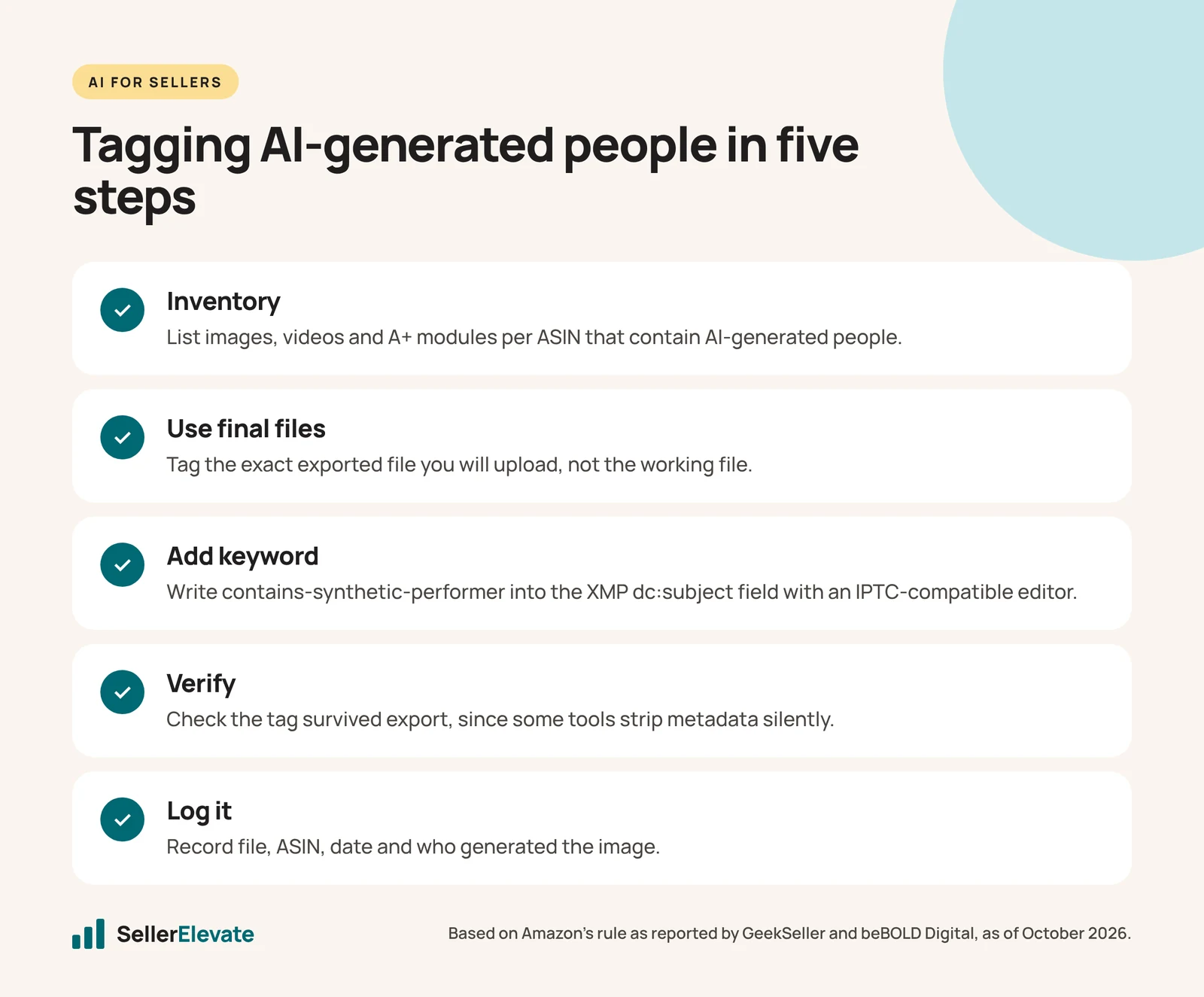
Amazon wants the keyword written into the file’s XMP metadata, in the dc:subject field, using an IPTC-compatible editor, before you upload. Step by step:
- Inventory your creative. List every main image, secondary image, video and A+ module per ASIN and mark which contain AI-generated people. Ask your designer or agency directly; you often cannot tell by looking.
- Open the final export, not the working file. The tag must survive into the exact file you upload.
- Add the keyword. In Adobe Bridge or Lightroom, add
contains-synthetic-performeras a keyword, which writes todc:subject. From the command line, ExifTool does the same:exiftool -XMP-dc:Subject+="contains-synthetic-performer" image.jpg. - Check it stuck. Run
exiftool -XMP-dc:Subject image.jpgon the final file. Compression tools, some export presets and some web optimizers strip metadata silently. - Upload and record it. Keep a simple log of which file, which ASIN, which date, and who generated the image. beBOLD recommends documenting creative provenance, and we agree: it is the record you will want if an image is ever questioned.
- Repeat for video and A+. Same keyword, same check, in the files you upload to those tools.
If your creative comes from an agency or freelancer, make the tag part of the delivery spec, in writing, so it is not your job to remember it on every file.
Should I still use AI models, or go back to real photography?
AI models are not banned. They now carry a visible disclosure, and that changes the trade-off rather than ending it.
| AI-generated models | Real photography | |
|---|---|---|
| Cost and speed | Low cost per image, fast to iterate | Model, studio and shoot day costs |
| Disclosure | Tag required; customer indicator shown | None |
| Variety | Easy to show many ages, settings and seasons | Limited to what you shot |
| Trust risk | Shoppers may discount staged “people” once labeled | Real people on real product |
| Accuracy risk | Hands, fit and scale can be subtly wrong | What the shopper sees is real |
Where we would still pay for a real shoot:
- The main image and first two secondary images on your top sellers. These carry most of the click and conversion weight, and a disclosure there is the most visible.
- Apparel, wearables and anything where fit is the purchase decision. An AI model that makes a product look better than it fits is a return waiting to happen.
- Products where trust is the sale, such as baby, personal care and health-adjacent categories.
A quick test we use before commissioning any AI person for a listing:
- Would a shopper make a different decision if they knew this person was not real?
- Does the image show fit, size or scale on a body?
- Is this image in the first three positions on a top-selling ASIN?
If the answer to any of these is yes, the case for a real shoot gets much stronger.
Where AI people are still fine with the tag: secondary lifestyle scenes, seasonal refreshes, A+ banners and testing new angles before you commit budget to a shoot. AI backgrounds with no people need no tag at all, which makes them the easiest win.
We have no published data on whether the label changes conversion, and we have not seen any trustworthy study on it yet. If you want to know for your own listing, Manage Your Experiments can test a main image when you have the traffic.
What we'd do this week
- Pull the image, video and A+ inventory for your top 20 ASINs and flag every AI-generated person.
- Tag and re-upload the flagged files, verifying the metadata survived.
- Add the tag to your creative brief and agency contracts.
- Decide, ASIN by ASIN, where a real shoot earns its cost before Q4 and where tagged AI is fine.
- Use the same pass to check the other 2026 listing changes: titles over the 75-character limit, strikethrough prices that disappeared and AI rewrites of your content.
Our listing images and A+ content work now includes the metadata check by default. If you are not sure what is in your current creative, our free audit will tell you.
Frequently asked questions
Do AI-generated backgrounds need the synthetic performer tag?
No, not if there are no people in them. The tag is only for photorealistic people created by AI. An AI-generated kitchen, garden or studio backdrop behind a product shot needs no label. If the scene includes AI-generated shoppers or family members, even in the background, the tag applies to that image.
Does the tag apply outside the US Amazon store?
beBOLD Digital describes the requirement as applying across Amazon's worldwide stores, even though the trigger was a New York law. If you use the same image files across marketplaces, tag them once at the file level so the metadata travels with every upload. Confirm current requirements in Seller Central for each store you sell in.
Will Amazon show shoppers that my image uses an AI model?
Yes. Amazon says that when the metadata is present, it adds an indicator to inform customers. That visible disclosure is the main reason to think about where AI people appear in your image stack, especially in the main image and the first secondary images on your best-selling products.
What tool do I use to add the contains-synthetic-performer tag?
Any IPTC-compatible metadata editor that writes the keyword into the XMP dc:subject field. Adobe Bridge and Lightroom keywords do this, and ExifTool can do it from the command line. After exporting, check the final file still contains the tag, because some compression and optimization tools strip metadata silently.
Sources
- eWeek: Amazon AI-generated product images labels and the New York law (July 24, 2026; updated September 12, 2026)
- GeekSeller: Amazon introduces new rules for AI-generated images (August 3, 2026)
- beBOLD Digital: Amazon AI-generated people label (August 8, 2026)
Get the honest version of your numbers
A free account audit from the person who would actually run your account.