Why did my Amazon FBA capacity limit drop and how do I get more?
Your limit is set from forecast sales, sell-through, IPI and network space, and Q4 leaves Amazon less room. Raise it by deleting unsent shipments and clearing aged stock, improving sell-through on key ASINs, or requesting space through Capacity Manager. If the squeeze is network-wide, AWD or a 3PL may be better.
Key takeaways
- FBA capacity limits are monthly, measured in cubic feet, and count on-hand stock, inventory in transit and created-but-unsent shipments.
- Limits respond to sales velocity, forecast demand, IPI, fulfillment center capacity and network speed.
- Deleting draft shipments and removing aged stock is the fastest way to free capacity.
- Capacity Manager performance credits were designed to offset up to 100% of the reservation fee if the extra stock sells.
- AWD inventory for Black Friday must arrive by October 14, a week before the earliest FBA cutoff.
If your FBA capacity limit dropped, it is most likely because Amazon now sets limits from several signals at once (forecast sales, sell-through, your Inventory Performance Index and how much space the network has), and in Q4 the network has less room to give. You can raise your effective limit by clearing space you are wasting, improving sell-through, or paying for more through Capacity Manager, and for some brands AWD or a 3PL is the better answer.
Amazon has been open about the squeeze. It says fulfillment center teams “concentrate on receiving holiday shipments during September and October, then shift to processing customer orders in November and December,” as quoted by PPC Land. Inbound gets harder from here, not easier. Here is how the limits work, the three levers that actually move them, and when to stop fighting for FBA space.
How are FBA capacity limits calculated in 2026?
Amazon does not publish the full formula, so be careful with anyone who claims to know it exactly. What we can say from the sources:
- Limits are monthly and measured in cubic feet, split by storage type (standard-size, oversize and so on). This replaced the old weekly restock and quarterly storage limits when the current system launched in 2023, according to Supply Chain Dive.
- They count more than what is on the shelf. Your limit covers inventory on hand, inventory in transit, and shipments you have created but not yet sent. A forgotten draft shipment uses capacity just as if it were in a warehouse.
- They are driven by performance signals. beBOLD lists historical sales velocity, forecast demand, IPI, available fulfillment center capacity and network movement speed, and describes the system as “rewarding inventory efficiency instead of inventory volume.”
- The forecast window got shorter. AMZ Prep reports that a May 2025 update cut the calculation from six months of projected sales to five, and reintroduced ASIN-level restock limits of around 90 days of supply.
AMZ Prep also publishes IPI bands (below 400 means restrictions, 500 and above is the safest position). Treat those as a vendor’s observation, not Amazon policy. Even AMZ Prep notes that a high IPI “does not guarantee protection from system-wide cuts.”
So when your limit drops, it is usually one of two things: your own signals got worse (slower sell-through, more aged stock, a lower forecast), or the network got tighter for everyone. The first you can fix. The second you can only work around.
Which three levers actually raise your limit?
1. Stop wasting the capacity you have
This is the fastest and cheapest lever, and most accounts we audit have something here.
- Delete created-but-unsent shipments. They count against your limit immediately.
- Remove or liquidate aged and slow inventory. Every cubic foot of a product that will not sell before January is a cubic foot your Black Friday heroes cannot use. It also costs $2.40 per cubic foot per month in Q4 storage for standard-size items, per AMZ Prep’s August update, versus $0.78 off-peak.
- Check stranded inventory. Units that are not attached to an active listing still use space and still pay storage.
2. Improve sell-through on the products that matter
Faster sell-through feeds both your IPI and your forecast, which are inputs to the next month’s limit. In practice that means pushing the ASINs that sell (advertising, price and Featured Offer health) rather than spreading attention evenly. It also means not sending deep on products that sell slowly just because you have them.
This lever works over weeks, not days. Use it to improve next month’s limit, not this week’s.
3. Pay for more through Capacity Manager
Capacity Manager lets you request extra space for a reservation fee per cubic foot. When the system launched, Amazon described it as an auction where the highest fee per cubic foot is granted first, with performance credits earned from sales on the extra capacity “designed to offset up to 100% of the fee,” per Supply Chain Dive. In plain terms: if the extra stock sells, the space can cost you little or nothing. If it does not, you pay the fee.
Amazon does not publish a fixed rate, and the vendor guides we checked do not give current 2026 figures. Check the suggested fee in Capacity Manager in Seller Central and only request space for ASINs you are confident will sell through.
When are AWD or a 3PL the better answer?
If your limit is tight because the network is tight, levers one to three only get you so far. That is when holding stock upstream makes sense.
| Option | Counts against FBA limit? | Q4 storage cost | Black Friday timing | Best for |
|---|---|---|---|---|
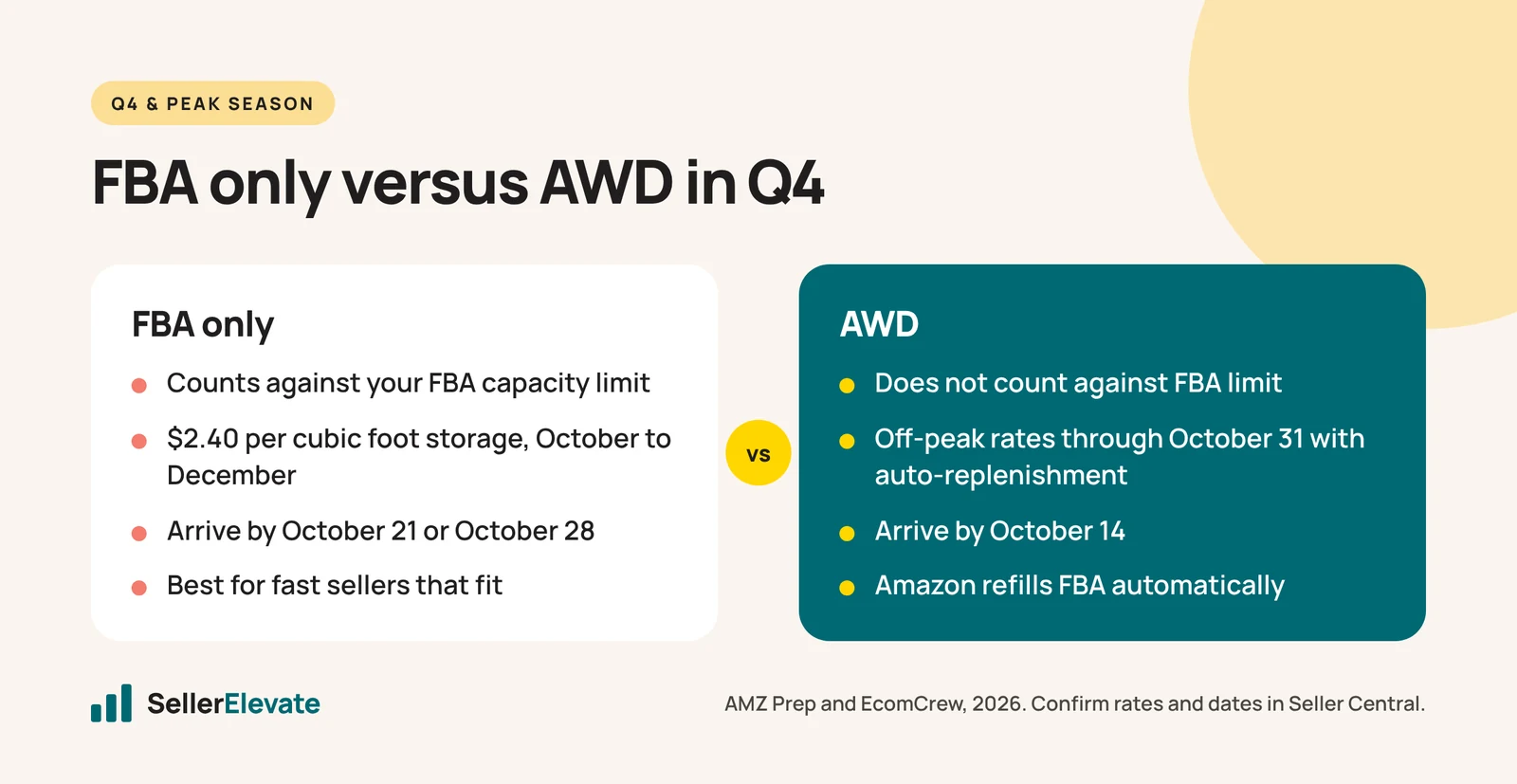
| FBA only | Yes | $2.40 per cu ft (standard-size, Oct to Dec) | Arrive by October 21 (minimal splits) or October 28 (optimized splits) | Fast sellers that fit your limit |
| Capacity Manager | Yes, but adds to your limit | Q4 storage plus a reservation fee, offset by credits if it sells | Same as FBA | Proven sellers with a short-term squeeze |
| AWD | No, per AMZ Prep | $2.40 per cu ft peak, per AMZ Prep; off-peak rates through October 31 with auto-replenishment, per EcomCrew | Arrive by October 14 | Brands that want Amazon to refill FBA automatically |
| 3PL | No | Set by your 3PL contract | Your own replenishment schedule, plus FBA receiving time | Bulky or seasonal stock, or multichannel brands |
AWD. EcomCrew reports that AWD sellers with auto-replenishment keep off-peak storage rates through October 31, even after FBA peak fees start on October 15. The catch is the deadline: AWD inventory for Black Friday and Cyber Monday is due October 14, which is a week earlier than the earliest FBA cutoff. AWD is also not free; our post on whether AWD is still worth it in 2026 covers the costs in more detail.
3PL. A 3PL gives you control and no cubic-foot cap, at the cost of running replenishment yourself and paying FBA receiving time on every transfer. In November, when Amazon says receiving slows down, that receiving time is the risk. Ship to FBA from a 3PL early and often, rather than in one big transfer the week before Black Friday.
What we'd do this week
Today is October 3. In order:
- Open Capacity Monitor and write down your current and next-month limits by storage type.
- Delete any draft shipments you are not going to send this month.
- List your top 10 ASINs for Black Friday with days of cover at expected peak velocity. These get first claim on capacity. SellerSprite suggests holding 8 to 10 weeks of supply for peak, with mid-November replenishment for high-velocity SKUs.
- Remove or liquidate anything with more than about six months of cover that will not sell through by January.
- Decide AWD by October 10 at the latest. If you are going to use it for Black Friday, the stock has to arrive by October 14.
- Request Capacity Manager space only for the top 10 list, and only for the amount you expect to sell.
- Ship FBA early. Aim to have Black Friday stock received well before the October 28 cutoff; see our Black Friday 2026 inventory deadlines for the full countdown.
One trap to avoid while you cut: the low-inventory-level fee. AMZ Prep describes it as triggering when both your 30-day and 90-day days of supply fall below 28 days, at roughly $0.32 to $1.11 per unit for standard-size products (another AMZ Prep guide lists $0.24 to $0.97, so check Seller Central). Trimming your heroes below four weeks of cover to free space can cost more than the space is worth.
How does capacity fit the rest of your Q4 plan?
Capacity decides how much you can sell, so it sits upstream of everything else. Your deals only work if the stock is there, and your margins depend on not paying peak storage on inventory that will not move. If you have not already, read our breakdown of Q4 2026 Amazon fees and our BFCM 2026 discount strategy before you commit space to deal ASINs. And use the Prime Big Deal Days sell-through data from October 6 to 7 to decide which products deserve the space.
If your limits have fallen and you cannot see why, an account audit is a good place to start; aged stock, stranded inventory and slow movers usually show up within the first hour.
Peak season is also when inventory goes missing most often. Check how FBA reimbursements work now so you can file claims before the window closes.
Frequently asked questions
Do created shipments count against my FBA capacity limit?
Yes. Your limit covers inventory on hand, inventory in transit and shipments you have created but not yet sent. A forgotten draft shipment uses capacity just as if it were already in a warehouse. Deleting drafts you will not send this month is the quickest way to free space.
What IPI score do I need to avoid capacity cuts?
Amazon does not publish a threshold. AMZ Prep reports that sellers below 400 face restrictions and 500 and above is the safest position, but it also notes a high IPI does not guarantee protection from system-wide cuts. Treat IPI as one input alongside sell-through and forecast demand.
Does AWD inventory count against my FBA capacity limit?
According to AMZ Prep, no. AWD stock sits upstream and is moved into FBA as needed. EcomCrew reports that AWD sellers with auto-replenishment keep off-peak storage rates through October 31. For Black Friday, AWD inventory must arrive by October 14, 2026.
Is Capacity Manager worth paying for in Q4?
Only for products you are confident will sell. You bid a reservation fee per cubic foot, and performance credits earned from sales on the extra capacity were designed to offset up to 100% of the fee. If the stock sells, the space can cost little or nothing; if it does not, you pay the fee.
Sources
- beBOLD: Amazon FBA restock limits 2026 (Jul 25, 2026)
- AMZ Prep: Amazon FBA capacity limits survival guide (updated Sep 25, 2026)
- AMZ Prep: Amazon seller updates August 2026 (Sep 4, 2026)
- SellerSprite: Amazon October and Q4 peak (Aug 5, 2026)
- PPC Land: Amazon freezes 2026 holiday seller fees, cuts inbound windows shorter (Jul 21, 2026)
- Supply Chain Dive: Amazon’s new FBA capacity management system (Jan 19, 2023)
- EcomCrew: Amazon Publishes Q4 2026 Deadlines: Same Fees, Earlier Inventory Cutoffs (Jul 7, 2026)
Get the honest version of your numbers
A free account audit from the person who would actually run your account.